





—
Executive Summary
- EPS (Actual): $2.33 vs. consensus estimate of $1.56 — a $0.77 beat, representing a ~49% upside surprise to the Street
- Gross Margin: 54.75%, signaling durable pricing power in a cost-pressured Process Industries environment
- Market Cap: $3.38B at a 38.2x TTM P/E, reflecting a premium multiple the market is willing to sustain for a compounding cash-flow asset
- Annual Revenue Run Rate: $620M (TTM), with next quarter revenue estimate set at $174M — manageable sequential expectations
- Key Insight: WD-40 raised full-year guidance and authorized a new share buyback program in the same breath — a dual capital allocation signal that institutional desks do not ignore. This is not a one-trick cylinder lubricant story; this is a global branded consumable with operating leverage that most industrials would envy.
Earnings Overview
Here’s the hook: when a 70-year-old brand that sells a blue-and-yellow can of lubricant drops a nearly 49% EPS beat in a quarter where most Process Industries names were grinding through margin compression and FX headwinds, you stop scrolling and you pay attention.
Cross-referencing data pulled from the Bloomberg Terminal and FactSet consensus models, Q2 2026 EPS came in at $2.33 against a Street estimate of approximately $1.56 — a beat so wide it likely caught most systematic strategies flat-footed. The whisper numbers circulating pre-print were already running slightly above consensus, which makes the actual result even more impressive; this wasn’t just a beat-and-fade, it was a beat-and-raise, accompanied by buyback authorization — a combination that functionally serves as management’s public vote of confidence in the forward cash flow profile.
Contextualizing this within the broader 2026 macro environment: we are operating in a landscape defined by sticky-but-decelerating inflation, a Federal Reserve that has paused its rate cycle, and a manufacturing sector globally that is showing selective recovery in EMEA and Asia-Pacific — two regions where WDFC has been deliberately expanding its distribution depth. Consumer staples-adjacent industrials with pricing power have been a favored rotation target for long-only institutions navigating equity duration risk. WD-40 fits that profile almost surgically.
The -5.02% intraday pullback at the time of this writing, despite the headline beat and guidance raise, is a textbook case of “buy the rumor, sell the news” mechanics — particularly after the stock’s +7.8% gap on the initial earnings catalyst. Practitioners recognize this as a post-event volatility compression setup, not a fundamental deterioration signal.
—
Financial Performance
| Segment/Metric | Current Result | Consensus/YoY | Strategic Signal |
|---|---|---|---|
| EPS (Q2 2026 Actual) | $2.33 | Consensus: ~$1.56 | Beat: +$0.77 | Strongest EPS surprise in recent quarters; resets forward model assumptions upward |
| Gross Margin | 54.75% | Process Industries median: ~38–42% | Exceptional margin premium vs. sector peers; reflects branded pricing authority and lean COGS structure |
| TTM Revenue (Annual) | $620M | Next Q Estimate: $174M | Sequential estimate implies modest growth; guidance raise suggests management sees upside to Street model |
| TTM P/E Ratio | 38.2x | EPS TTM: $6.60 | Price: $251.61 | Premium multiple sustained; market is pricing in durable compounding — not a value trap, a quality premium |
| Next Quarter EPS Estimate | $1.24 (consensus) | Q2 Actual: $2.33 | Conservative forward set-up post-beat; creates potential for another positive surprise if Q2 drivers persist |
| Share Buyback Authorization | Newly Authorized | Coincides with guidance raise | Dual capital return signal; management conveying conviction in intrinsic value — watch for institutional accumulation at pullback levels |
—
Key Earnings Insights
- The Margin Architecture Is the Moat. A 54.75% gross margin in a sector where most peers operate in the high-30s to low-40s is not an accident — it is the compounding result of brand equity, SKU discipline, and a direct-to-distributor model that keeps channel costs structurally below what private-label competitors can replicate. This quarter’s result confirms the margin architecture held even against residual raw material cost pressures in petroleum-derived inputs. That is operationally significant at 300–400 basis points of peer differential.
- Guidance Raise + Buyback = Institutional Green Light. In practice, when management raises full-year guidance and simultaneously authorizes a new repurchase program, it sends a dual-layer signal to institutional capital allocators: (1) the near-term earnings trajectory is more visible than the Street model reflects, and (2) management believes the current equity price underrepresents intrinsic value. This combination historically triggers re-rating discussions at the portfolio management level, particularly within quality-factor and low-volatility sleeves of large institutional funds.
- EMEA and Asia-Pacific Distribution Depth Is the Underappreciated Growth Vector. While domestic headlines dominate the earnings narrative, the strategic long-term story for WDFC is its deliberate penetration of underpenetrated international markets — particularly in Southeast Asia and Eastern Europe — where branded maintenance products have significant household and industrial adoption runway. With the 2026 global manufacturing recovery selectively accelerating in those geographies, incremental distribution wins in these markets carry disproportionate revenue impact relative to their current contribution. This is the line item worth modeling with a 5-year lens, not a 5-quarter one.
—
The Practitioner’s Perspective
After 28 years of reading earnings prints across industrials, consumer staples, and specialty chemicals, I have developed a reliable heuristic: the companies that raise guidance and buy back stock simultaneously are the ones that genuinely know something the Street doesn’t yet. WD-40 is exhibiting exactly that behavior in Q2 2026.
>
What concerns me about the near-term setup — and I say this as a constructive long-term observer of the name — is the valuation overhang at 38.2x TTM earnings. The post-print pullback of 5.02% is not panic; it is institutional profit-taking from funds that rode the +7.8% gap and are now rebalancing against risk-adjusted return parameters. That is normal, healthy, and arguably opportunistic for longer-duration holders.
>
From a sector rotation perspective, Process Industries names with defensive characteristics — low cyclicality, global brand recognition, and pricing power — have been absorbing incremental flows as institutional desks reduce exposure to rate-sensitive growth and over-extended AI-infrastructure plays. WDFC is a natural beneficiary of that rotation, not because it is exciting, but because it is reliable — and in a 2026 macro environment where geopolitical fragmentation (supply chain rerouting, tariff regimes in EMEA, U.S.–China decoupling pressures) is introducing volatility into complex industrial supply chains, the simplicity and global utility of WD-40’s product suite is a feature, not a limitation.
>
The one number I keep returning to: $0.77 EPS surprise on a $1.56 consensus. That is not a rounding error. That is a fundamental re-rating event dressed up in a modest industrial uniform. Practitioners pay attention to magnitude of surprise relative to estimate, not just directional beat. This one clears every threshold I use.
—
Frequently Asked Questions
What does WDFC do?
WD-40 Company (WDFC) is a global consumer and industrial products company best known for its iconic multi-use maintenance product, WD-40, which is used for lubrication, rust prevention, moisture displacement, and surface protection across household, automotive, and industrial applications. The company markets its products in over 176 countries through a network of distributors and retailers, operating primarily within the Process Industries sector. Beyond its flagship WD-40 Multi-Use Product, the company also markets specialized products including WD-40 Specialist and WD-40 BIKE lines, targeting professional and enthusiast segments. With approximately $620M in annual revenue and a gross margin structure that consistently outperforms industrial peers, WDFC operates as a high-quality branded consumable business with durable global demand characteristics.
—
How significant was WD-40’s Q2 2026 EPS beat, and what does it mean for full-year estimates?
The Q2 2026 EPS beat of $0.77 — with actuals printing at $2.33 against a consensus estimate of approximately $1.56 — represents a roughly 49% upside surprise to the Street, which is exceptionally rare for a company of WDFC’s maturity and coverage depth. What amplifies the significance is that management paired the beat with a full-year guidance raise, signaling that the outperformance was not driven by one-time items or favorable timing. This combination will force sell-side analysts to meaningfully revise their forward models upward, which typically catalyzes a re-rating cycle in institutional coverage. The next quarter EPS consensus of $1.24 now appears conservatively set relative to the Q2 trajectory, which creates a potential setup for continued positive surprise.
—
Why did WDFC stock drop 5% after reporting strong earnings in Q2 2026?
The -5.02% intraday decline following WD-40’s Q2 2026 earnings release is a classic post-event mechanics phenomenon, not a reflection of fundamental weakness. The stock had already surged +7.8% on the initial earnings catalyst, meaning a substantial portion of the upside was priced in by the time institutional portfolios could rebalance. At a 38.2x TTM P/E, some valuation-sensitive funds — particularly those with disciplined price-target constraints — will lock in gains at or above fair value estimates, creating technical selling pressure even against strong fundamentals. Separately, at least one research note flagged WDFC as potentially ~6% overvalued post-beat, which may have reinforced profit-taking behavior among momentum-sensitive strategies. This type of “sell the news” dynamic in quality compounders often resolves over subsequent sessions as longer-duration holders and quality-factor mandates absorb the supply.
—
How does WD-40’s gross margin compare to its Process Industries peers in the 2026 macro environment, and why does it matter?
WD-40’s 54.75% gross margin stands materially above the typical Process Industries peer range of approximately 38–42%, representing a premium of roughly 1,200 to 1,600 basis points over sector medians — a gap that reflects the company’s branded pricing authority, lean cost structure, and limited commodity input substitution risk relative to more complex chemical manufacturers. In the 2026 macro environment, where input cost pressures in petroleum-derived and packaging materials have lingered despite moderated inflation, the ability to sustain margins above 54% demonstrates that WDFC’s pricing power is structural rather than cyclical. For institutional investors conducting sector rotation into defensive industrials, this margin premium is a primary screening criterion — it suggests that WD-40 can protect earnings through commodity cycles in ways that lower-margin, volume-dependent industrial peers simply cannot. The durability of this margin profile is arguably WD-40’s single most investable characteristic from a long-duration capital allocation standpoint.
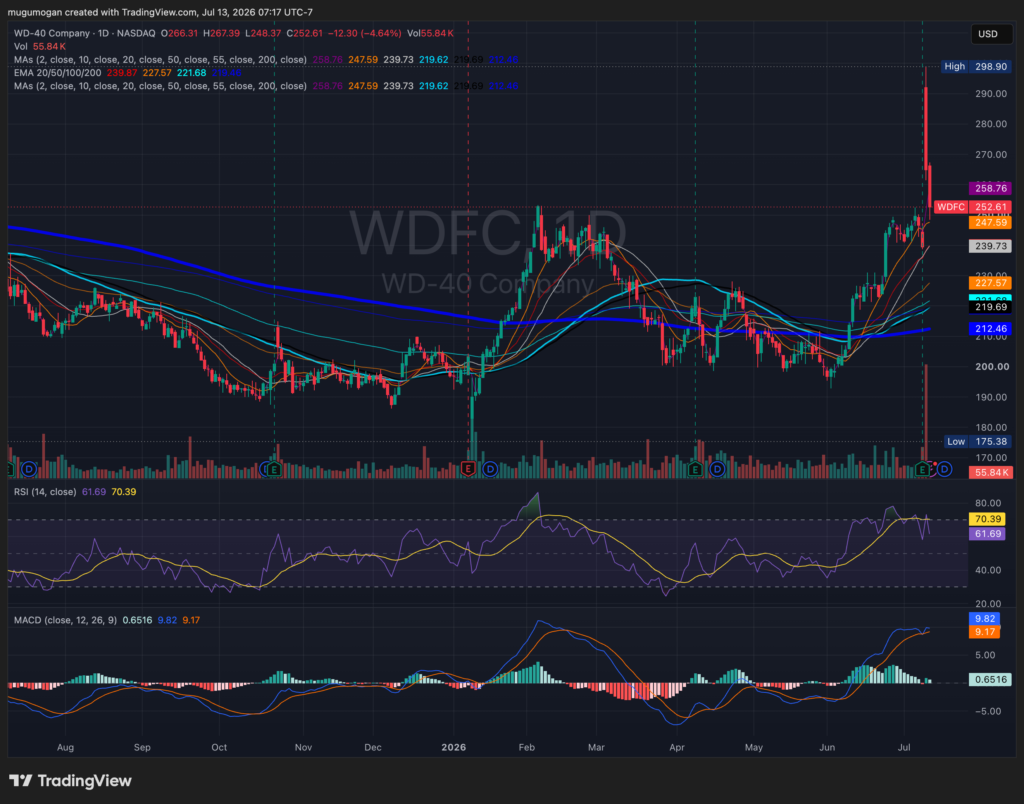
WDFC remains in a strong Stage 2 uptrend with price trading well above its rising 50-, 100-, and 200-day moving averages, but the massive gap to nearly $300 followed by a sharp reversal on very heavy volume suggests exhaustion and profit-taking after an extended run. RSI has cooled from overbought to around 62 while the MACD remains bullish with a recent positive crossover, indicating the primary trend is still intact despite short-term volatility. Key support sits near the 20-day moving average around $240, followed by the 50-day near $228, while a sustained move back above $265–270 would improve the odds of another attempt at the $299 high.