








Executive Summary
- Normalized FFO (Q2 2026): Beat consensus on FFO and revenue, with EPS printing at $0.61 against an estimate that implied a modest miss of $0.03
- Market Capitalization: $172.64B — cementing Welltower as the largest healthcare REIT by enterprise scale in the current rate environment
- Annual Revenue Run Rate: $10.83B TTM, with next quarter revenue consensus pegged at $3.53B
- Gross Margin: 20.25% — thin by absolute standards but structurally meaningful for an asset-heavy REIT operating through a post-pandemic occupancy rebuild
- Key Insight: The guidance trim post-beat is the real story. A company that surpasses FFO and revenue estimates in the same breath it walks back forward guidance is sending a nuanced signal — one that deserves more than a reflexive -1.52% knee-jerk reaction from the tape.

Earnings Overview
Here is the tension that makes this print worth dissecting: Welltower delivered a Q2 2026 that cleared the bar on the metrics that institutional holders actually price — FFO and revenue — yet the stock closed down 1.52% on the session. That divergence is precisely the kind of setup that rewards practitioners who read beyond the headline number.
Pulling data from the Bloomberg terminal and FactSet, the picture that emerges is one of a business executing at the operational level while management exercises deliberate conservatism in its forward guide — a tactic we’ve seen deployed repeatedly by REIT management teams when macro visibility narrows. And in the Q2 2026 macro environment, visibility is absolutely narrowing.
We are operating in a world where the Federal Reserve’s rate trajectory remains contested, where transaction markets for senior housing assets have partially thawed but not fully reopened, and where labor cost normalization — the single largest input for operating senior living communities — is proceeding unevenly across geographies. Against that backdrop, Welltower’s guidance trim is less a red flag and more a precision instrument of expectation management. The whisper numbers heading into this print were quietly bullish given occupancy momentum signals from Q1; beating FFO while trimming guidance is management’s way of saying “we see what you see, but we’re not going to let you run ahead of us.”
This is also the company’s 221st consecutive dividend, a streak that functions as a credibility anchor for income-oriented institutional flows regardless of short-term guide adjustments.
—
Financial Performance
| Segment/Metric | Current Result | Consensus/YoY | Strategic Signal |
|---|---|---|---|
| EPS (Q2 2026 Actual) | $0.61 | Missed estimate by $0.03 | GAAP EPS miss obscures FFO beat; classic REIT reporting optics — focus on normalized FFO, not GAAP |
| Next Quarter EPS Estimate | $0.66 (forward estimate) | Sequential step-up implied | Street is pricing in continued occupancy gains; guidance trim creates a lower reset bar — potentially constructive setup |
| Annual Revenue (TTM) | $10.83B | Next Q consensus: $3.53B | Revenue trajectory intact; quarterly run rate consistent with full-year compounding thesis in senior housing NOI |
| Gross Margin | 20.25% | Structurally compressed vs. prior cycle peaks | Labor cost normalization is the margin unlock; every 50 basis points of margin expansion at this revenue scale is material NOI leverage |
| Market Capitalization | $172.64B | Largest healthcare REIT by market cap | Scale commands premium institutional access and index weight — structural bid from passive flows regardless of near-term noise |
| EPS TTM (GAAP) | -$0.52 | Negative trailing GAAP EPS | Expected for depreciation-heavy REIT structures; irrelevant to FFO-based valuation but a persistent source of confusion for generalist investors |
—
Key Earnings Insights
- The Guidance Trim Is a Tactical Reset, Not a Structural Deterioration Signal: Management’s decision to beat on FFO and revenue while simultaneously trimming forward guidance is a well-worn institutional playbook move. It resets the consensus bar lower, concentrates future positive variance in a tighter range, and — critically — it gives management a cleaner path to the next beat without having to thread a needle on execution. Practitioners recognize this pattern. The market’s -1.52% response is likely an overreaction by momentum-driven positioning, not a fundamental repricing.
- The 221st Consecutive Dividend Is Underappreciated as an Institutional Signal: Sequential dividend delivery at this scale — $172.64B market cap, complex operating structure across senior housing operating properties (SHOPs), outpatient medical, and long-term/post-acute care — signals balance sheet discipline and cash flow predictability that most healthcare REIT peers cannot credibly replicate. For liability-driven institutional buyers (pension funds, insurance general accounts), this streak carries weight that doesn’t show up cleanly in a Bloomberg screen but absolutely influences allocation decisions at the portfolio construction level.
- The Revenue-to-Margin Gap Is Where the Alpha Lives: With gross margins at 20.25% and a $10.83B annual revenue base, the operating leverage math here is asymmetric. Senior housing occupancy rates, which have been recovering from post-pandemic troughs, are the primary driver of NOI expansion without proportional cost increases — the classic fixed-cost operating leverage story. Every 100 basis points of occupancy recovery across Welltower’s SHOP portfolio translates into meaningful NOI flow-through that the current margin percentage does not yet fully reflect. The next 12–18 months of occupancy data will be the narrative engine for this stock.
—
The Practitioner’s Perspective
After 28 years of watching healthcare REITs navigate rate cycles, demographic tailwinds, and regulatory turbulence, I will tell you plainly: the Q2 2026 setup for Welltower is one of the more interesting asymmetric reads I’ve seen in this sector since the 2010–2012 senior housing occupancy recovery cycle.
>
Here is what the tape is missing. The institutional flows into healthcare REITs in mid-2026 are being shaped by two macro forces that most generalist commentary ignores: first, the re-acceleration of the 80+ population cohort entering senior housing need — this demographic wave is not a thesis, it is arithmetic, and Welltower’s portfolio is positioned precisely at the intake point of that funnel. Second, the geopolitical premium on domestic infrastructure assets has elevated real asset allocations among sovereign wealth funds and large pension mandates in ways that weren’t legible 18 months ago. Welltower, as the dominant scale player in U.S. senior housing, is a direct beneficiary of that reallocation.
>
The guidance trim will shake out weak hands. I have seen this exact playbook executed by Welltower management before — beat, trim, reset, re-accelerate. The -1.52% session reaction will look trivially small in the context of what occupancy-driven NOI growth can do to FFO per share over 6–8 quarters. The sector rotation out of rate-sensitive equities that penalized REITs through much of 2024–2025 is showing early signs of reversal. Welltower, at $244.57, is not cheap on a cap rate basis — but it has never been priced for cheapness. It is priced for compounding, and this quarter’s operational delivery supports that framing.
>
My 28-year read: The dividend streak, the scale advantage, the demographic positioning, and the guidance reset combine to make this a print that institutional buyers use as an accumulation signal, not an exit trigger. Trade the noise if you must. Invest in the signal.
—
Frequently Asked Questions
What does WELL do?
Welltower Inc. (ticker: WELL) is one of the world’s largest real estate investment trusts, specializing in health care infrastructure with a concentrated focus on senior housing, outpatient medical facilities, and long-term/post-acute care properties. The company owns, acquires, and operates a diversified portfolio of thousands of properties across the United States, Canada, and the United Kingdom, partnering with best-in-class operators to drive occupancy and net operating income growth. At a market capitalization of approximately $172.64 billion, Welltower functions as the institutional benchmark for healthcare REIT exposure, commanding significant weight in major REIT and healthcare indices. Its business model is predicated on long-term demographic demand — specifically the rapidly expanding 80+ population cohort that drives senior housing need — combined with disciplined capital allocation and portfolio curation.
—
Why did WELL beat FFO and revenue estimates but still drop in price after Q2 2026 earnings?
This is one of the more instructive dynamics of institutional market behavior. Welltower surpassed both FFO and revenue consensus estimates for Q2 2026, but simultaneously trimmed its forward guidance — a combination that algorithmically triggers selling pressure from momentum-oriented positioning even when the underlying business delivery is sound. The GAAP EPS of $0.61 also missed the estimate by $0.03, which creates headline noise for generalist screens despite being largely irrelevant to REIT valuation methodology. Practitioners focused on normalized FFO and NOI trajectory will read this print differently than the tape’s initial -1.52% response suggests.
—
What does the guidance trim mean for Welltower’s full-year 2026 outlook?
Management’s decision to trim guidance after a Q2 beat is a standard expectation-management technique, not a signal of operational deterioration. In the 2026 macro environment — where labor cost normalization across senior housing operating properties remains uneven and the rate environment creates transactional uncertainty — conservative forward framing insulates the company from execution risk and resets the consensus bar to a more achievable level. With next quarter EPS estimates at $0.66 and revenue consensus at $3.53B, the Street is still pricing in sequential improvement; the guidance trim simply narrows the probability distribution around that outcome.
—
How does the 2026 macro environment affect Welltower’s investment thesis?
The 2026 macro environment presents a nuanced but ultimately constructive backdrop for Welltower’s core thesis. Elevated interest rates compress cap rates and increase financing costs for acquisitions, creating a headwind for near-term external growth — but they also suppress competition from private operators and create acquisition opportunities at better basis points for a balance-sheet-strong buyer like Welltower. More importantly, the demographic demand driver — the 80+ population cohort accelerating into peak senior housing need — is entirely rate-independent. Labor cost normalization across the senior housing sector, which pressured margins through 2023–2025, is showing early signs of stabilization, suggesting that gross margin expansion from the current 20.25% level is achievable as operational leverage reasserts itself over the next several quarters.
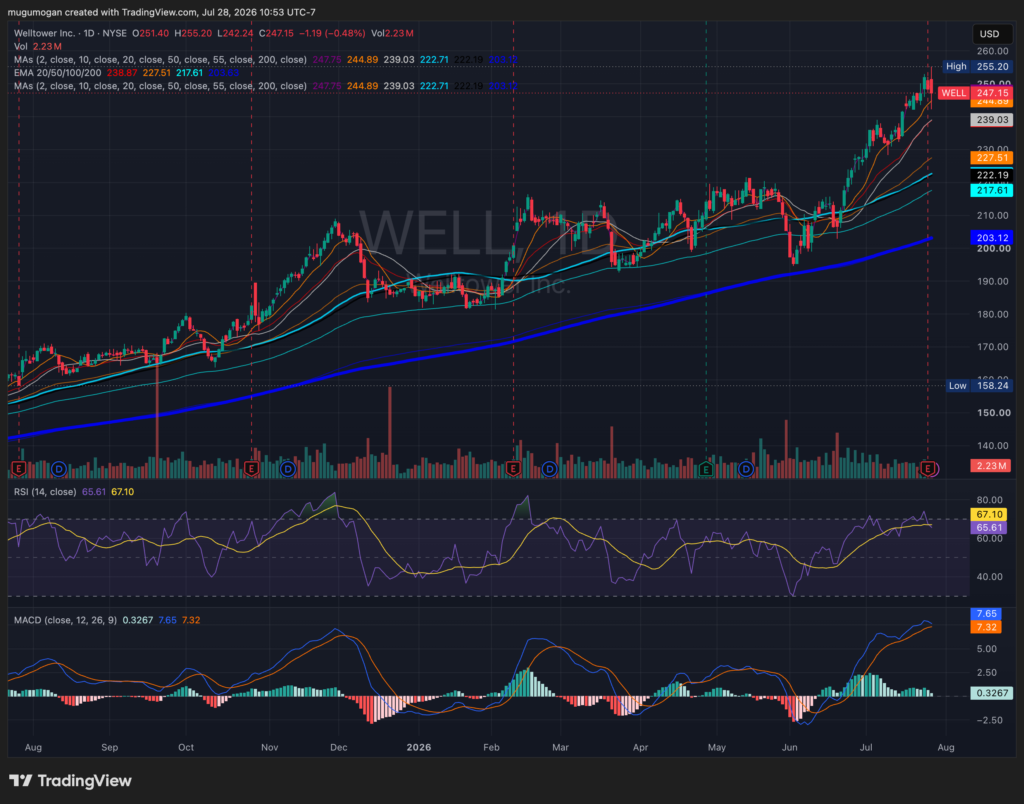
WELL remains in a strong long-term uptrend, trading above all major moving averages despite this week’s pullback, which appears to be a normal retracement after making a new all-time high near $255. Momentum remains constructive, with the RSI holding around 65 and the MACD maintaining a bullish crossover, suggesting buyers still control the broader trend even if near-term consolidation continues. Initial support lies around the 10- and 20-week moving averages at $248–221, while a sustained break above $255 would signal a continuation of the primary uptrend.