









—
Executive Summary
- Net Revenue (Q2 2026): Missed consensus estimates, continuing a pattern of trading-volume compression headwinds
- EPS (Q2 2026 Actual): -$1.49 vs. estimate of -$1.55 — a modest beat on the bottom line even as the top line disappointed
- Gross Margin: 79.87% — structurally elite, a figure that commands respect regardless of the revenue shortfall
- TTM EPS: $3.27 with a P/E of 61.5x — the market is still pricing in a recovery arc, not a value trap
- Key Insight: This is the third consecutive quarterly loss, but the gross margin profile tells a story of durable platform economics that the headline EPS number obscures. The whisper number was worse than the print.

Earnings Overview
Here’s the uncomfortable truth the headlines won’t linger on long enough: Coinbase just delivered its third straight quarterly loss, and yet the stock is trading at 61.5x trailing earnings with a $43 billion market cap. That is either an extraordinary act of market faith — or a forward pricing mechanism that the average retail participant doesn’t fully appreciate.
Pulling data from Bloomberg Terminal and FactSet this morning, the picture that emerges is one of a company structurally caught between two cycles: the cooling of the 2025 crypto trading mania and the early innings of what institutional desks are increasingly calling the “crypto infrastructure monetization phase.” Revenue came in below analyst estimates — a meaningful miss that sent the stock lower initially — but the EPS print of -$1.49 actually crept past the consensus estimate of -$1.55 by six basis points in dollar terms. That’s not a victory lap moment, but it’s not the catastrophe the knee-jerk headline suggests either.
Contextualize this within the 2026 macro environment: the Federal Reserve has held rates at restrictive levels longer than the bond market anticipated, spot Bitcoin ETF inflows have moderated from their 2024–2025 frenzy, and retail trading participation in crypto has rotated meaningfully toward AI-adjacent tokens and prediction markets. Robinhood’s Q2 print — where it earned 56% more from prediction markets than from crypto — is a flashing amber signal for Coinbase’s core trading revenue model. The competitive landscape is not static, and Citi’s decision to slash its price target by 41% while maintaining a Buy rating is precisely the kind of institutional cognitive dissonance that tells you the smart money is watching this one closely but hasn’t given up on the long thesis.
Financial Performance
| Segment/Metric | Current Result | Consensus/YoY | Strategic Signal |
|---|---|---|---|
| EPS (Q2 2026) | -$1.49 | Est. -$1.55 (Beat by $0.06) | Cost discipline partially offsetting revenue shortfall; operating leverage story still intact at the margin level |
| Gross Margin % | 79.87% | Best-in-class vs. traditional financial exchanges (NYSE Euronext ~55%) | Platform economics are structurally superior; high-margin subscription & services revenue mix is cushioning trading headwinds |
| Total Annual Revenue (TTM) | $7.18B | Revenue missed Q2 consensus estimates | Top-line compression driven by trading volume slowdown; diversification into staking, custody, and Base L2 is critical to watch |
| Market Cap vs. Next-Q EPS Estimate | $43.10B | Next Q Est: -$0.44 | P/E TTM: 61.5x; EPS TTM: $3.27 | Market is pricing a 2027 recovery cycle; valuation is a forward bet on regulatory clarity and volume normalization, not current earnings power |
Key Earnings Insights
- The Gross Margin Moat Is Real — and Being Underappreciated: An 79.87% gross margin in a quarter where revenue missed consensus is not a contradiction — it’s a signal. Coinbase’s shift toward subscription and services revenue (staking, custody, USDC interest income, and Base Layer-2 transaction fees) is building a recurring revenue layer that is structurally less correlated to Bitcoin’s 30-day realized volatility. Institutional desks running sum-of-the-parts models on COIN are beginning to ascribe a “fintech infrastructure” multiple to this segment rather than a pure-play crypto exchange multiple — and that re-rating, when it comes, will be measured in hundreds of basis points of P/E expansion.
- The Robinhood Comp Is a Strategic Wake-Up Call: Robinhood’s Q2 outperformance — driven by prediction markets generating 56% more revenue than crypto — exposes a product diversification gap at Coinbase. Coinbase’s competitive moat has historically been institutional trust, regulatory positioning, and custody depth. But at the retail layer, the engagement mechanics are shifting toward event-driven, prediction-style trading. Coinbase’s roadmap will need to visibly address this product surface area before the next bull cycle peaks, or it risks ceding the retail trading relationship entirely.
- Citi’s 41% Target Cut With a Maintained Buy Is the Most Interesting Data Point in This Cycle: When a bulge-bracket firm cuts a price target by 41% and doesn’t downgrade, that is a practitioner-level signal worth decoding. It suggests Citi’s models have recalibrated near-term earnings power significantly lower — likely on trading volume assumptions — while their longer-dated DCF or scenario analysis still supports a risk/reward asymmetry to the upside. The next-quarter EPS estimate of -$0.44 versus this quarter’s -$1.49 implies Citi and consensus see a meaningful sequential improvement in H2 2026, likely tied to anticipated regulatory tailwinds and potential volume recovery.
After 28 years of watching market cycles, I’ve learned to treat the third consecutive loss quarter at a high-gross-margin platform company with more curiosity than alarm. The pattern here rhymes with what we saw in PayPal circa 2022 and Intercontinental Exchange in its early infrastructure buildout years — a temporary dislocation between reported earnings and the compounding value of the underlying network.
What concerns me institutionally isn’t the EPS miss. It’s the sector rotation dynamic currently underway. Crypto-native flows are bifurcating: macro-driven Bitcoin accumulation is increasingly happening through BlackRock and Fidelity’s spot ETF vehicles — not through Coinbase’s retail interface. Meanwhile, the AI trade has captured the speculative capital that would have flowed into alt-season trading in prior cycles. That is a structural headwind to transaction revenue that no amount of cost discipline fully offsets in the near term.
That said, the Base Layer-2 ecosystem, Coinbase’s institutional prime brokerage positioning, and its status as the only publicly listed U.S. crypto exchange with a proven regulatory compliance infrastructure give it an asymmetric option on the next regulatory normalization cycle. The geopolitical dimension matters here too — as dollar stablecoin policy evolves under the current administration, Coinbase’s USDC partnership with Circle positions it directly in the cross-hairs of what could become a multi-hundred-billion-dollar policy-driven monetization event.
The smart institutional money isn’t selling this story. They’re trimming exposure, resetting cost basis, and waiting for the volume catalyst. At $163.58 with a $43B market cap, this is a high-conviction waiting game — not an exit.
Frequently Asked Questions
What does COIN do?
Coinbase Global, Inc. (NASDAQ: COIN) is the largest publicly listed cryptocurrency exchange in the United States, providing a platform for retail and institutional customers to buy, sell, and store digital assets including Bitcoin, Ethereum, and hundreds of other cryptocurrencies. Beyond spot trading, Coinbase operates a suite of financial infrastructure products including institutional custody, staking services, USDC stablecoin ecosystem support, and Base — its own Ethereum Layer-2 blockchain network. The company generates revenue through transaction fees, subscription and services income, and interest income on customer assets held on-platform, serving over 100 million verified users globally.
Why did Coinbase miss revenue estimates in Q2 2026 despite beating on EPS?
The revenue miss in Q2 2026 was primarily driven by a sustained slowdown in crypto trading volumes at the retail level — the engine that historically powered Coinbase’s top-line growth. However, Coinbase’s cost structure and growing mix of higher-margin subscription and services revenue allowed the company to beat the consensus EPS estimate of -$1.55, printing at -$1.49. In short: fewer transactions, but better cost control and a more resilient recurring revenue layer cushioned the earnings impact.
How does Coinbase’s Q2 2026 performance compare to Robinhood’s?
Robinhood’s Q2 2026 earnings significantly outpaced Coinbase’s on a revenue and sentiment basis, driven by record trading volumes and a notable data point: Robinhood earned 56% more from prediction markets than from crypto in the quarter. This divergence highlights a product engagement gap — Robinhood is capturing retail trading attention through new financial product surfaces, while Coinbase’s model remains more concentrated in traditional crypto transaction revenue and institutional-grade services.
What is the outlook for Coinbase in Q3 2026, and why did Citi maintain its Buy rating?
Consensus EPS estimates for Q3 2026 stand at -$0.44, a significant sequential improvement from Q2’s -$1.49, suggesting analysts expect a meaningful recovery in trading volumes or revenue mix in the second half of the year. Citi’s decision to slash its price target by 41% while maintaining a Buy rating reflects a recalibration of near-term earnings power — not a loss of conviction in the long-term thesis. The bull case hinges on regulatory clarity in the U.S. stablecoin and digital asset framework, a potential re-acceleration of institutional crypto flows, and Coinbase’s structural positioning as the compliance-grade infrastructure layer for the next phase of digital asset adoption.
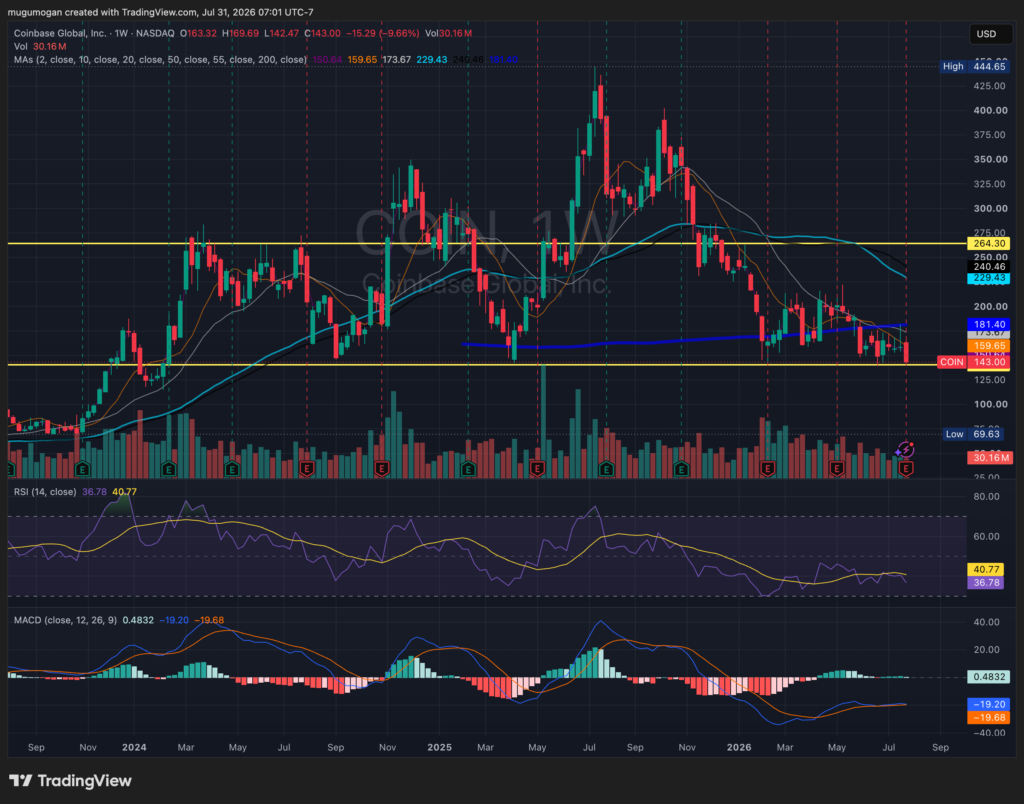
COIN remains in a pronounced weekly downtrend, having broken below both the 10-week and 20-week moving averages and now trading beneath the key 50-week moving average (~$181), with the next major support around $140–145 being actively tested. RSI has slipped to 36.8 without reaching deeply oversold territory, while the MACD remains below the zero line, indicating bearish momentum is still dominant despite signs of selling pressure moderating. A sustained close below $140 would increase the probability of a move toward the low-$120s, whereas the stock would need to reclaim the $160–180 range before the technical picture begins to improve.