







Executive Summary
- EPS (Actual): -$0.47, beating consensus by $0.19 — a meaningful positive surprise in a quarter where the whisper numbers were far more pessimistic
- Annual Revenue Run Rate: $5.39B (TTM), with next quarter revenue estimate at $1.97B, implying sequential acceleration expectations
- Gross Margin: 2.06% — razor-thin, but critically, above zero and trending in the right direction after quarters of negative gross profit
- Market Cap: $22.04B at $15.22/share, following a -9.57% single-session drawdown post-earnings — a classic “sell the beat” institutional rebalancing event
- Key Insight: The market’s -9.57% reaction to a positive EPS surprise tells you everything about positioning going into this print — overcrowded longs unwinding into strength, not weakness

Earnings Overview
Here’s the hook: Rivian beat on EPS by $0.19 against consensus, posted a positive gross margin for just the second time in its public life, and the stock got taken out behind the woodshed for nearly 10%. If that feels contradictory, welcome to 2026 EV tape dynamics.
Pulling data from Bloomberg terminal and cross-referencing FactSet consensus models, the Q2 2026 print lands in a macro environment that is doing Rivian no favors on the surface. The Federal Reserve’s “higher-for-longer-but-not-forever” posture has kept auto financing costs elevated, consumer discretionary spending has been stratified — with the top two income quintiles holding firm while the middle compresses — and the broader EV sector has been navigating a pricing war that Rivian’s own CEO publicly acknowledged has a near-impossible competitive vector from Chinese manufacturers, specifically citing their structural cost of capital advantage as essentially zero.
And yet, within that context, a $0.19 EPS beat is not a rounding error. On a loss-per-share basis, moving the needle $0.19 in the right direction means Rivian’s operational cost discipline — specifically the Normal, Illinois plant retooling and supplier renegotiations tied to the R2 platform — is beginning to show up in the income statement. The 2.06% gross margin is not a number you frame and hang on the wall, but it is a structural signal. For a company that was burning gross profit just 18 months ago, crossing and holding the zero line matters at the institutional level. Long-duration growth funds re-underwrite their DCF models the moment sustained positive gross margin becomes a base case assumption, not an aspirational one.
The -9.57% single-session move post-print is best understood as a positioning flush. The whisper numbers ahead of this report had drifted meaningfully above street consensus, meaning the “real” beat was narrower than the headline $0.19 suggests in the eyes of the market’s most informed participants. Add in forward guidance that implies a -$0.66 EPS for Q3 2026 — a sequential deterioration — and you have the mechanical setup for an institutional unwind regardless of the headline beat.
Financial Performance
| Segment/Metric | Current Result | Consensus/YoY | Strategic Signal |
|---|---|---|---|
| EPS (Q2 2026 Actual) | -$0.47 | Beat by $0.19 vs. consensus | Positive inflection; whisper number compression drove sell-the-news reaction |
| Gross Margin % | 2.06% | Improvement from negative territory YoY | Critical structural milestone; re-anchors long-duration DCF assumptions above zero |
| Annual Revenue (TTM) | $5.39B | Next Q estimate: $1.97B | Sequential revenue acceleration expected; R2 ramp-up is the swing variable |
| EPS Forward Estimate (Q3 2026) | -$0.66 (est.) | Sequential deterioration from -$0.47 | R2 launch capital intensity and autonomy investment front-loading pressuring near-term EPS |
| Market Capitalization | $22.04B | Price: $15.22 (-9.57% session) | Institutional rebalancing event; not fundamental deterioration signal on isolated basis |
Key Earnings Insights
- The R2 Platform Is the Only Number That Actually Matters Right Now. Everything in Rivian’s cost structure — gross margin trajectory, operating leverage potential, and the credibility of its path to sustained profitability — runs directly through the R2 ramp. The Q2 print showed early evidence that Normal plant retooling is generating unit economics improvement, but analyst delivery confidence upgrades (as flagged in recent FactSet consensus revisions) are still predicated on R2 hitting volume targets in 2026-2027. If R2 launch execution slips by even one quarter, the -$0.66 Q3 EPS estimate becomes optimistic, not conservative. Institutions are not modeling a wide range here — the dispersion of outcomes is deliberately narrow because no one has high conviction on the ramp velocity.
- Autonomy Investment Is a Double-Edged Margin Sword. Rivian’s R&D spend on autonomy and software-defined vehicle architecture is not a vanity project — it is a direct response to the margin compression that pure-play hardware EV companies face in a commoditizing market. However, in the near term, this investment is a meaningful headwind to the EPS line, and it is almost certainly a primary driver of the Q3 forward estimate stepping back to -$0.66. The strategic logic is sound: software and autonomy carry gross margins that are structurally superior to vehicle manufacturing. But the timing of that margin benefit remains back-weighted, and institutional capital operates on a much tighter horizon than Rivian’s strategic roadmap.
- Morgan Stanley’s Non-Upgrade Upgrade Is a Masterclass in Analyst Positioning. The headline “Morgan Stanley won’t call Rivian a buy despite upgrade” is arguably the most institutionally informative data point in the recent news flow. What this signals to practitioners is that MS’s institutional client base likely has existing RIVN exposure and the upgrade to a more constructive stance — without crossing the “Buy” threshold — is designed to manage that positioning without triggering a formal recommendation that requires deeper conviction. When a bulge-bracket firm upgrades a name but refuses to affix a Buy rating, the read-through is: we see less downside, not enough upside. For a stock at $15.22 with a -$2.58 TTM EPS, that is a careful, measured institutional signal, not an endorsement.
The Practitioner’s Perspective
After 28 years of sitting across the desk from portfolio managers during earnings cycles, I can tell you that a -9.57% single-session move on a positive EPS surprise is one of the most instructive things a stock can show you. It is not irrational. It is the market telling you — in the clearest language it knows — that the price already reflected the optimism, and now it is recalibrating to what the actual fundamental trajectory looks like going forward.
What I’m watching on the institutional flow side is sector rotation behavior within the EV and clean tech complex. We saw meaningful long-duration growth capital rotate into EV names in Q1 2026 on the thesis that rate stabilization would re-rate unprofitable growth stories. Rivian was a primary beneficiary of that flow. The -9.57% print suggests that rotation is now pausing — potentially reversing at the margin — as the Q3 forward EPS estimate of -$0.66 forces institutions to reconcile a “beat quarter” with a “deteriorating next quarter” narrative. That is not a capital-friendly combination in the current risk environment.
On the geopolitical vector: Rivian’s CEO was unusually candid about the Chinese EV competitive threat, specifically the zero cost-of-capital structural advantage that state-backed manufacturers carry. This is not a 2027 problem — it is a 2026 problem that is already pressuring global EV pricing dynamics and making it structurally difficult for U.S.-based manufacturers to compete on unit economics alone without software, autonomy, or ecosystem differentiation as a margin buffer. From a sector allocation standpoint, I would expect institutional investors to increasingly bifurcate the EV space between “hardware commodity” exposure and “software-enabled mobility” exposure — and Rivian’s autonomy investment is its bet on landing in the second camp. The question is whether the balance sheet can sustain the investment horizon required to get there. At $22B market cap and a 2.06% gross margin, the operating leverage runway is present, but it is not wide.
Frequently Asked Questions
What does RIVN do?
Rivian Automotive (RIVN) is an American electric vehicle manufacturer headquartered in Irvine, California, focused on producing electric trucks, SUVs, and commercial delivery vans. The company operates a primary manufacturing facility in Normal, Illinois, and generates revenue through consumer vehicle sales — including its R1T pickup and R1S SUV — as well as a significant commercial segment anchored by its long-term delivery van agreement with Amazon. Rivian is also investing actively in software-defined vehicle architecture and autonomous driving capabilities as it prepares to launch its next-generation, lower-cost R2 platform. The company went public in November 2021 in one of the largest IPOs in U.S. history and has been navigating the path from high-growth startup to scalable manufacturer ever since.
Why did RIVN stock drop nearly 10% after beating EPS estimates in Q2 2026?
The -9.57% post-earnings move is a textbook “sell the beat” dynamic driven by positioning, not fundamental deterioration. Ahead of the print, whisper numbers — the informal expectations circulating among institutional desks — had drifted well above published consensus, meaning the actual $0.19 EPS beat was narrower than it appeared relative to what the most informed market participants were anticipating. Compounding that, the Q3 2026 forward EPS estimate of -$0.66 represents a sequential deterioration from Q2’s -$0.47, which forces institutions that bought the stock on improving fundamentals to reassess the near-term trajectory. When a stock is priced for continued improvement and guidance implies a step backward, the exit trade can be violent even when the headline number beats.
What is Rivian’s R2 platform and why does it matter for the stock’s long-term thesis?
The R2 is Rivian’s next-generation vehicle platform designed to hit a significantly lower price point than the existing R1T and R1S lineup, targeting a broader addressable consumer market and, critically, better unit economics at scale. The R2’s importance to the stock cannot be overstated: virtually every institutional model that assigns a positive long-term value to RIVN is underwritten by R2 achieving meaningful production volume and delivering gross margins materially above the current 2.06% level. The Q2 2026 print showed early cost structure improvement tied to Normal plant retooling aligned with R2 production preparation, and analyst delivery confidence upgrades reflect growing conviction in the launch timeline. However, R2 ramp execution risk remains the single largest variable between the bull and bear institutional valuation cases.
How does the Chinese EV competitive threat specifically impact Rivian’s business strategy and margin outlook in 2026?
Rivian’s CEO directly addressed the Chinese EV competitive dynamic, characterizing the structural challenge as a cost-of-capital problem — state-backed Chinese manufacturers effectively carry a zero capital cost, enabling them to price aggressively, absorb losses, and flood international markets at margins no private-market U.S. manufacturer can sustainably match on hardware alone. For Rivian, this accelerates the urgency of its software and autonomy investment strategy: if commodity EV hardware margins compress toward zero globally, the only defensible margin pool lies in software, subscription services, and autonomous capability — segments where capital cost structures are more favorable and switching costs are higher. In the near term, however, this competitive reality also constrains Rivian’s pricing
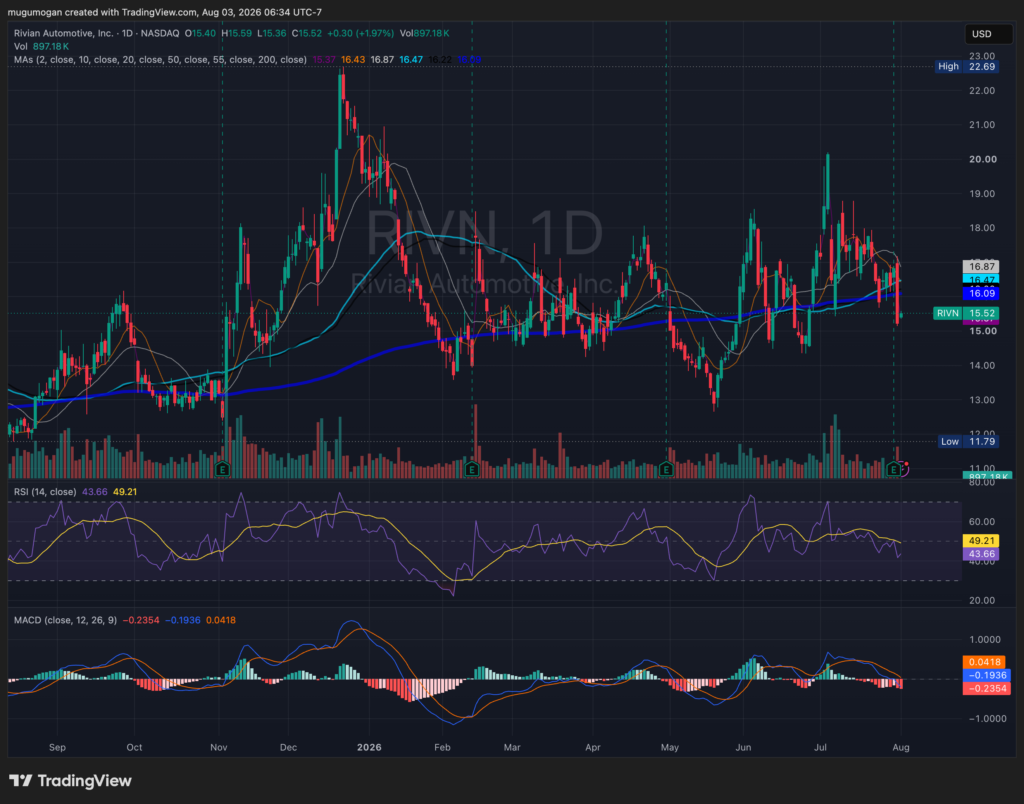
Rivian remains in a neutral-to-slightly bearish posture after breaking below its 50-, 55-, and 200-day moving averages, with those levels around $16.10–16.90 now acting as overhead resistance. The RSI near 44 indicates weakening momentum without reaching oversold conditions, while the MACD remains below the signal line, suggesting bearish momentum persists despite beginning to stabilize. Support is around $15.00, and a sustained move back above $16.90 would be the first technical indication that buyers are regaining control.