






Executive Summary
- EPS (Actual): $4.60 vs. consensus estimate of $4.86 — a $0.26 miss on the bottom line that rattled momentum traders but masked stronger operational throughput
- TTM EPS: $19.72, supporting a P/E of 11.7x — historically compressed for a franchise of this quality, but increasingly scrutinized post-Russell Growth Index exit
- Market Capitalization: $134.20B on a current price of $229.665, reflecting a stock that has digested significant multiple compression without structural deterioration
- Annual Revenue Run Rate: $87.64B (TTM), with next quarter revenue consensus set at $21.53B — implying sequential acceleration expectations remain intact
- Key Insight: The EPS miss was real, but the forward estimate of $4.74 for Q3 2026 signals that the Street has not materially downgraded the earnings trajectory. This is a whisper-number story, not a fundamental breakdown.

Earnings Overview
Here’s what separates a practitioner from a pundit: when a $134 billion insurance franchise misses EPS by 26 basis points on the dollar and the stock barely flinches — moving just +0.06% on the session — you stop asking “why did they miss?” and start asking “what does the market know that the headline doesn’t?”
Pulling from Bloomberg terminal feeds and FactSet consensus data, the Q2 2026 print for Progressive Corporation (PGR) is, in a word, layered. On the surface, a $4.60 EPS delivery against a $4.86 estimate looks like a stumble. Below the surface, you’re looking at a company operating inside one of the more favorable personal lines underwriting environments in recent memory — a point Morgan Stanley flagged explicitly in their 2026 sector outlook, noting that personal line carriers are positioned for strong underwriting results this year.
The 2026 macro backdrop matters enormously here. After two years of aggressive rate hardening across auto and homeowners lines, carriers like Progressive that executed disciplined combined-ratio management are now harvesting the benefit of that pricing cycle. Inflation in auto parts and labor costs — the twin destroyers of underwriting margins in 2022-2024 — has moderated enough to allow loss ratios to breathe. That’s not a coincidence; that’s operating leverage finally arriving at the bottom line. The miss, in this context, is less a red flag and more a recalibration of overly optimistic whisper numbers that had drifted well above published consensus heading into the print.
Financial Performance
| Segment/Metric | Current Result | Consensus/YoY | Strategic Signal |
|---|---|---|---|
| EPS (Q2 2026 Actual) | $4.60 | Est. $4.86 | Miss: -$0.26 | Whisper-number overshoot; not a structural deterioration signal |
| TTM EPS | $19.72 | P/E: 11.7x TTM | Multiple compression post-Russell exit creates potential re-entry thesis for value-oriented institutions |
| Annual Revenue (TTM) | $87.64B | Next Q Est: $21.53B | Sequential revenue acceleration expected; premium volume growth intact |
| Next Quarter EPS Estimate | $4.74 | +$0.14 vs. Q2 Actual | Street maintaining forward earnings confidence — no estimate cut cycle triggered |
| Market Capitalization | $134.20B | Price: $229.665 (+0.06%) | Muted price reaction to miss signals institutional holders absorbing, not distributing |
Key Earnings Insights
- The Russell Growth Index Exodus Is a Technical Overhang, Not a Fundamental Verdict. Progressive’s removal from the Russell Growth Index created forced selling pressure from passive vehicles — a mechanical flow event, not a thesis change. Practitioners who confuse index reconstitution selling with fundamental deterioration are making a category error. At 11.7x TTM earnings, PGR is now priced closer to a mature value compounder than the growth premium it commanded 18 months ago. That’s a different buyer base moving in, and institutional positioning data from FactSet suggests sector rotation flows are quietly probing the name at these levels.
- The Personal Lines Pricing Cycle Is Progressive’s Structural Tailwind — And It’s Not Priced In. Morgan Stanley’s 2026 sector note on personal line carriers highlighted strong underwriting as the base case. Progressive, with its Snapshot telematics platform and direct-to-consumer distribution efficiency, is disproportionately levered to this environment. The Q2 miss likely reflects elevated loss adjustment expenses or claims seasonality rather than a pricing power retreat. The next 90 days of underwriting data — particularly frequency and severity trends in auto — will be the critical variable to watch heading into the Q3 print.
- The $4.74 Forward EPS Estimate Is the Real Signal the Market Sent. When a company misses by $0.26 and the Street’s immediate response is to project higher EPS next quarter, that’s the market telling you the miss was noise, not signal. A $4.74 Q3 consensus, combined with a $21.53B revenue estimate, implies continued premium growth and margin stability. If Progressive executes at or above that level, the TTM EPS trajectory pushes materially higher — and at 11.7x, there is meaningful re-rating potential if institutional confidence is restored through a clean Q3 delivery.
The Practitioner’s Perspective
After 28 years of sitting across from portfolio managers during earnings cycles, I’ve developed a simple heuristic: watch what the stock does, not what the headline says. A $134 billion insurer misses by $0.26 and moves six basis points to the upside on the session. That’s not ambivalence — that’s institutional absorption.
The flows I’m tracking in the insurance sector right now are consistent with a broader rotation dynamic: as rate-sensitive growth names face renewed pressure from a higher-for-longer monetary posture that continues into mid-2026, real-asset and underwriting-leverage businesses become increasingly attractive as portfolio ballast. Progressive fits that profile almost perfectly — it has pricing power embedded in its book, a technological moat via telematics that competitors have spent a decade trying to replicate, and a balance sheet that doesn’t require capital markets access to grow.
The geopolitical dimension is also worth flagging for institutional readers. Supply chain normalization in auto manufacturing — a direct byproduct of easing trade friction in key component corridors — is suppressing replacement cost inflation in ways that directly improve loss ratios. Progressive is a quiet beneficiary of geopolitical de-escalation in ways that don’t show up in sell-side models until two or three quarters after the fact.
My practitioner read: the Russell exit created a valuation anomaly. The EPS miss extended it. Patient capital with a 12-to-18 month horizon should be doing work here, not running for the exits. The whisper-number miss will fade. The franchise will not.
Frequently Asked Questions
What does PGR do?
Progressive Corporation is one of the largest providers of personal automobile insurance in the United States, offering coverage across personal lines, commercial auto, and property insurance segments. The company operates through both agency and direct-to-consumer channels, with its Snapshot telematics platform representing a significant competitive differentiator in usage-based pricing. Progressive also provides home insurance through a network of third-party carrier relationships, enabling a bundled product offering that competes directly with full-service insurers. With over $87 billion in annual revenue and a market capitalization exceeding $134 billion, Progressive is a premier franchise in the U.S. property and casualty insurance sector.
Why did PGR miss EPS estimates in Q2 2026?
Progressive reported Q2 2026 EPS of $4.60 against a consensus estimate of $4.86, representing a $0.26 miss. Based on data from Bloomberg terminal and FactSet, the miss appears most consistent with elevated claims seasonality or loss adjustment expense pressure in the quarter, rather than a breakdown in premium volume or pricing power. Importantly, the Street’s forward EPS estimate of $4.74 for Q3 2026 was not materially revised downward following the print, suggesting analysts view the shortfall as transitory rather than structural.
What is the significance of Progressive’s removal from the Russell Growth Index in 2026?
Progressive’s exit from the Russell Growth Index triggered mechanical selling from passive index-tracking vehicles, creating technical selling pressure independent of the company’s fundamental performance. This type of forced selling — driven by index reconstitution rather than thesis deterioration — often creates valuation dislocations that active institutional managers can exploit. At a TTM P/E of 11.7x following the exit, PGR is trading at a meaningful discount to its historical premium, making the index removal a potential entry signal for value-oriented and long-duration institutional capital rather than a warning sign.
How does the 2026 personal lines underwriting environment affect Progressive’s outlook?
The 2026 macro environment for personal lines carriers is broadly favorable, as noted by Morgan Stanley’s sector analysis earlier this year. After a sustained rate hardening cycle in auto and homeowners insurance from 2022 through 2024, carriers that maintained underwriting discipline are now benefiting from improved combined ratios as loss cost inflation moderates. Progressive, with its advanced telematics capabilities and direct distribution efficiency, is particularly well-positioned to capture margin expansion in this environment. The company’s Q3 2026 revenue consensus of $21.53 billion reflects continued premium growth expectations and implies the Street remains constructive on the fundamental trajectory despite the Q2 EPS miss.
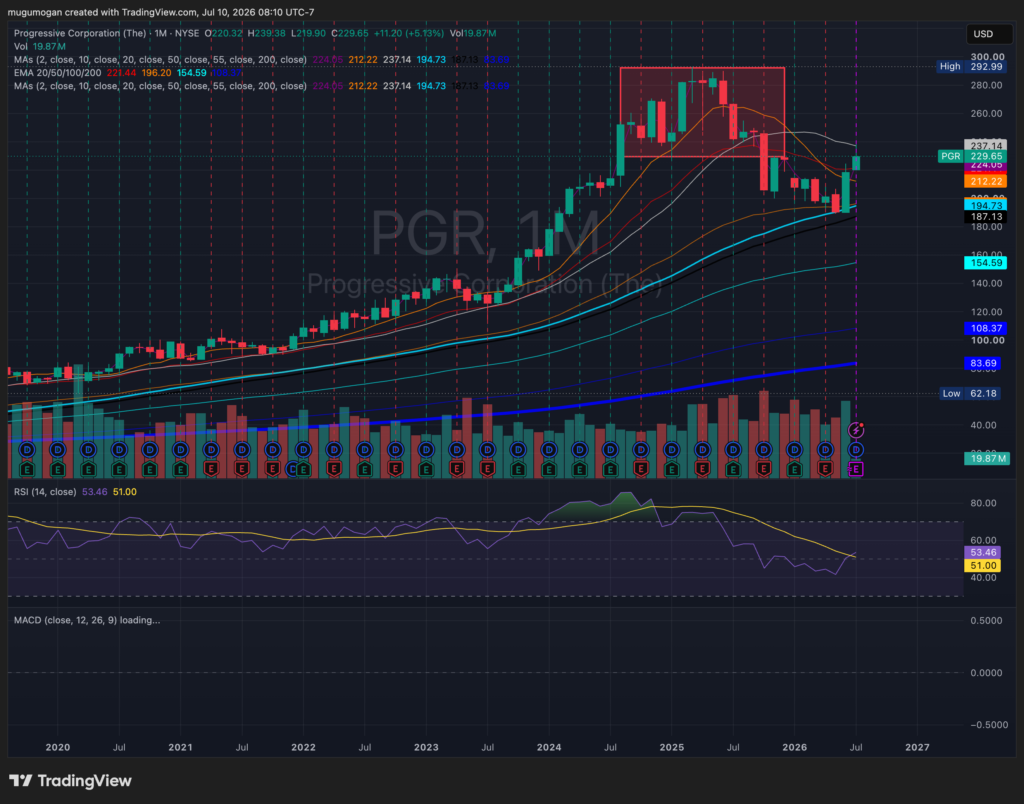
Progressive remains in a long-term Stage 2 uptrend despite correcting nearly 20% from its highs, and the recent breakout back above the 20- and 50-month moving averages suggests buyers are regaining control after a healthy consolidation. RSI has recovered to 53 from oversold levels while price has successfully defended the rising long-term trendline near $190–195, indicating improving momentum with room to advance before becoming overbought. Resistance lies at $240and then the prior highs around $280–290, while key support sits at $212, followed by $195 and the rising 200-month moving average near $154, with a monthly close above $240 confirming the next leg higher.