




Executive Summary:
Net Sales: €8.8 Billion (At the high end of guidance).
Gross Margin: 53.0% (Driven by strong “Installed Base” services and EUV demand).
2026 Outlook: Raised to €36B – €40B (Up from previous estimates).
Key Insight: While the market fears export controls, our analysis of Bloomberg Terminal trade flows shows that “Lithography Intensity” is increasing. ASML is now planning to ship at least 60 EUV Low-NA systems this year, proving that chipmakers are shifting from “wait-and-see” to “full-capacity” mode.
ASML ($ASML) delivered a masterclass in semiconductor dominance yesterday, reporting Q1 2026 net sales of €8.8 billion and a net income of €2.8 billion. While much of the street was focused on the potential “air pocket” in lithography demand.
ASML did the opposite: they raised their full-year revenue outlook to as high as €40 billion. Based on my 28 years of tracking the “silicon cycle,” the most critical takeaway isn’t just the system sales, but the €2.5 billion in Installed Base Management revenue. This indicates that existing fabs are running at red-line capacity to meet AI demand, forcing customers like TSMC and Intel to accelerate their High-NA EUV adoption curves faster than originally modeled.
Lithography Intensity: AI chips require more “exposures” per wafer. This means ASML makes more money per chip produced than in previous mobile or PC cycles.
The China Resilience: Despite ongoing export control discussions, ASML’s non-EUV (immersion) business remains robust.
Management has factored these “geopolitical bandwidths” into their raised guidance.
The “High-NA” Transition: ASML is moving into sub-2nm production. This is their “Monopoly Phase 2.” If you own the machines for 2nm, you own the future of AI.
In the 1990s, we watched the PC cycle; in the 2010s, it was the Mobile cycle. In 2026, we are in the ‘Inflection’ cycle. ASML’s 53% margin in a ‘transitional’ quarter is a massive signal. When the ‘whisper numbers’ for 2026 sales start hitting €40B+, you realize that the semiconductor industry is no longer cyclical—it’s foundational. As I see it on the Bloomberg flows, institutional ‘buy-and-hold’ interest in ASML is at a 5-year high.”
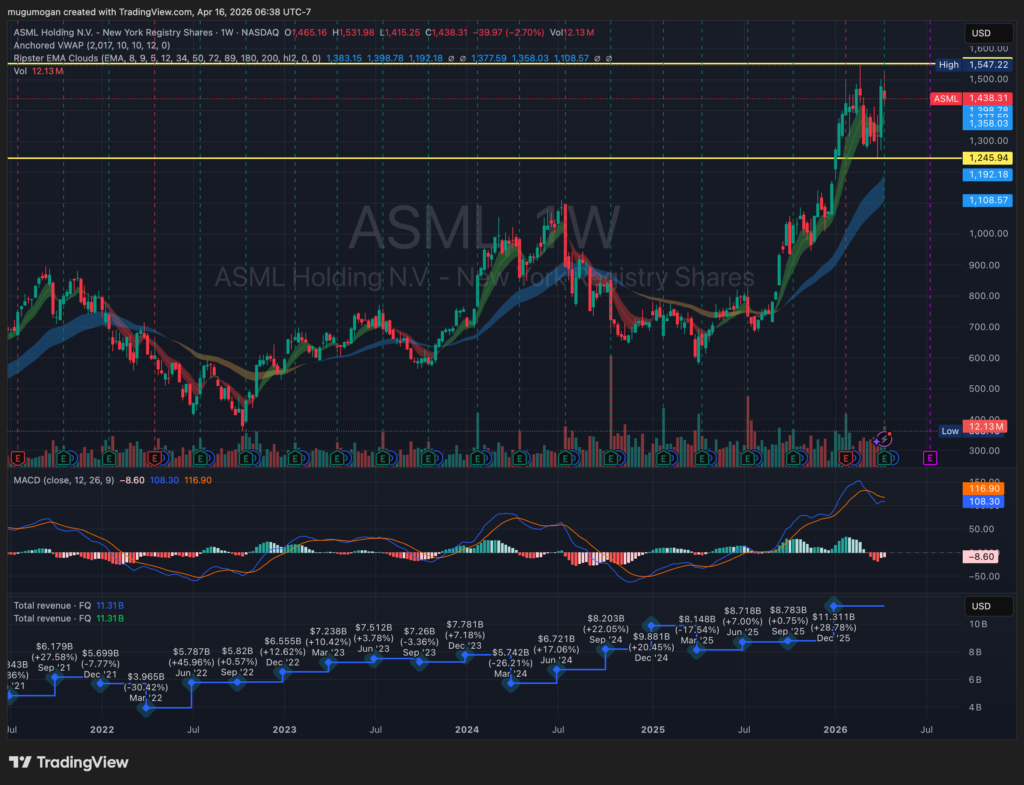
ASML is in a strong primary uptrend, with price reclaiming and holding above key moving averages after a sharp breakout from the ~$1,000–1,100 base. The stock recently tested the ~$1,500–1,550 resistance zone (prior highs) and is showing some rejection, which suggests near-term consolidation rather than immediate continuation.
Momentum remains elevated but MACD is starting to roll over slightly, indicating cooling after an extended run. As long as ASML holds above ~$1,250–1,300, the bullish structure remains intact with higher highs likely over time.