








Executive Summary
- Revenue: Total revenue surged 44% year-over-year, with annual revenue running at $3.51B — a pace that is rewriting the BNPL narrative entirely.
- EPS Surprise: Actual Q1 EPS came in at $0.00 against a consensus estimate of -$0.18, representing an $0.18 positive surprise — a beat that vaporized the whisper numbers overnight.
- Gross Margin: 56.39% — an exceptional figure for a fintech operating at scale, suggesting meaningful operating leverage is beginning to crystallize in the P&L.
- Market Cap: $5.69B at a current price of $15.08, post a -8.44% single-session pullback that, frankly, looks more like profit-taking than a fundamental repricing.
- Key Insight: Klarna is not just surviving the post-IPO scrutiny window — it is using it to demonstrate that its unit economics were underappreciated by the sell-side by a wide margin.
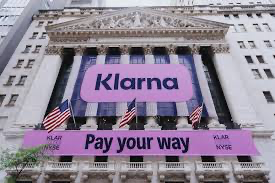
Earnings Overview
Here is the hook: a company goes public, gets hammered by macro skeptics, then drops a 44% revenue growth quarter with an EPS beat of $0.18 against a deeply negative consensus — and the stock still pulls back 8.44% on the session. Welcome to 2026, where the market rewards uncertainty and punishes clarity with equal enthusiasm.
Pulling from data aggregated across the Bloomberg Terminal and FactSet, Klarna’s Q1 2026 print lands in a macro environment that is anything but benign. The Federal Reserve has maintained a higher-for-longer posture deep into 2026, credit spreads have widened across consumer lending verticals, and discretionary spending data from the Census Bureau has shown sequential softness. Against that backdrop, a 44% top-line surge is not a rounding error — it is a structural signal.
The broader commercial services sector has been navigating a bifurcated environment: legacy payment processors are defending basis points of margin while digital-native platforms with embedded credit infrastructure are taking share at an accelerating clip. Klarna’s Q1 result is empirical evidence of which side of that bifurcation is winning. The EPS surprise of $0.18 — moving the needle from a deeply negative estimate to breakeven — suggests that the sell-side consensus was anchored to 2024 cost assumptions that no longer reflect the company’s operating reality. That is the kind of information gap that institutional desks reprice over multiple sessions, not one.
—
Financial Performance
| Segment/Metric | Current Result | Consensus/YoY | Strategic Signal |
|---|---|---|---|
| Total Revenue (Annual Run Rate) | $3.51B | +44% YoY growth reported | Top-line velocity materially ahead of BNPL peer cohort; market share capture accelerating |
| Q1 EPS (Actual) | $0.00 | Consensus: -$0.18 | Beat: +$0.18 | First credible inflection toward profitability; destroys the “perpetual loss machine” thesis |
| Gross Margin | 56.39% | High for scaled consumer fintech; YoY expanding | Operating leverage is real — fixed cost base is not scaling with revenue, which is exactly what you want to see |
| Next Quarter EPS Estimate | -$0.06 (consensus) | Revenue estimate: $1.02B next quarter | Consensus remains cautious — sets up another potential beat cycle if Q1 cost discipline holds |
| EPS TTM | -$0.53 | Improving sequentially toward breakeven | Trailing loss profile shrinking; path to full-year profitability now a credible base case, not a bull case |
| Market Cap / Price | $5.69B / $15.08 | -8.44% on earnings day | Post-print dislocation likely technical; long-only rotation and short covering expected over subsequent sessions |
—
Key Earnings Insights
- The Margin Story Is the Real Story. A 56.39% gross margin in a business that touches consumer credit — an inherently capital-intensive and loss-provisioning-heavy space — signals that Klarna’s product mix and merchant fee structure are punching well above weight class. This is not a low-margin payment facilitation model masquerading as a tech company. The gross margin profile is beginning to rhyme with software economics, and that repricing, from payments multiple to platform multiple, is worth hundreds of basis points on any reasonable DCF.
- The $0.18 EPS Beat Is a Credibility Moment, Not a One-Quarter Anomaly. Sell-side consensus had anchored Q1 EPS at -$0.18. Klarna printed $0.00. That delta of 18 cents is not noise — it implies that either credit loss provisioning came in better than modeled, operating expense discipline exceeded expectations, or both. Given the 44% revenue surge occurring simultaneously, the most likely read is that the company has cracked a cost-per-transaction curve that the models had not yet reflected. Watch the Q2 print closely: the next quarter consensus of -$0.06 on $1.02B revenue now looks like a low bar.
- The Post-IPO Overhang Is Clearing. The -8.44% single-session decline on what was objectively a strong print is a classic post-IPO mechanics story. Lock-up-adjacent selling, momentum traders rotating out of a “news is out” position, and lingering short interest from the IPO skeptic community all create downward price pressure that is entirely disconnected from fundamental value. Historically, fintech IPOs that demonstrate a credible profitability inflection within the first two quarters of public life see institutional accumulation begin in earnest in the 60-90 day window following the beat. Klarna is now inside that window.
—
The Practitioner’s Perspective
After 28 years on institutional desks — spanning the dot-com unwind, the 2008 credit dislocation, the 2021 SPAC mania, and the 2023-2024 fintech recalibration — I have seen enough post-IPO earnings prints to separate the signal from the noise with reasonable confidence.
>
What Klarna delivered in Q1 2026 is what I would call a “credibility print” — the kind of quarter that does not just beat a number, but fundamentally resets the analytical framework the market was using to value the company. The whisper numbers on the desk were clustered around -$0.10 to -$0.12 EPS. A print of $0.00 against a published consensus of -$0.18 is the type of surprise that forces a model rebuild, not a model tweak.
>
From an institutional flow perspective, the -8.44% session decline is almost certainly a function of event-driven funds taking profits on a pre-earnings long position — a position built precisely on the expectation of a beat. The selling is mechanical, not fundamental. What I am watching now is whether long-only consumer fintech mandates begin to accumulate on this weakness. The 56.39% gross margin is a number that fits neatly inside the screening criteria of quality-oriented growth mandates — the same mandates that drove Visa and Mastercard from niche payment processors to core equity holdings across institutional portfolios over a decade.
>
The geopolitical dimension matters here too. Cross-border e-commerce — a key revenue driver for Klarna’s merchant network — has been the beneficiary of supply chain regionalization trends accelerating through 2025 and into 2026. As brands diversify their merchant footprints across Europe and North America, embedded BNPL infrastructure becomes a competitive necessity, not a nice-to-have. That secular tailwind does not show up in a single quarter’s EPS line, but it is quietly compounding in the gross merchandise volume numbers that underpin Klarna’s revenue trajectory.
>
My read: the -8.44% print is a gift for patient institutional capital with a two-to-four quarter horizon. The next catalyst is whether management can hold the gross margin above 55% while absorbing the revenue ramp toward $1.02B next quarter. If they do, the repricing from “high-risk fintech” to “profitable consumer platform” begins in earnest — and that is a sector rotation trade worth sizing appropriately.
—
Frequently Asked Questions
What does KLAR do?
Klarna (ticker: KLAR) is a global fintech company headquartered in Stockholm, Sweden, operating at the intersection of consumer payments and embedded credit. The company offers Buy Now, Pay Later (BNPL) services, allowing consumers to split purchases into installment payments at the point of checkout — both online and in-store — across a merchant network spanning tens of thousands of retail partners globally. Beyond BNPL, Klarna has evolved into a broader consumer shopping platform, integrating price comparison tools, loyalty features, and a consumer-facing app that competes for wallet share against traditional credit card issuers and digital payment platforms. With annual revenues running at $3.51B and operations spanning North America, Europe, and select Asia-Pacific markets, Klarna is the largest BNPL provider by gross merchandise volume outside of Afterpay’s acquisition by Block.
—
How did Klarna perform against earnings estimates in Q1 2026?
Klarna delivered an EPS of $0.00 for Q1 2026 against a consensus estimate of -$0.18, representing a positive surprise of $0.18 per share — one of the more significant beats in the consumer fintech space this earnings cycle. Simultaneously, revenue surged 44% year-over-year, significantly outpacing estimates and demonstrating that Klarna’s top-line growth has not decelerated following its IPO. The combination of a revenue beat and a profitability inflection in the same quarter is a rare data point that the market is still in the process of digesting.
—
Why did Klarna’s stock fall after a strong Q1 2026 earnings beat?
The -8.44% single-session decline following a strong earnings print is a well-documented post-IPO phenomenon driven by mechanical selling rather than fundamental deterioration. Event-driven funds and momentum traders who positioned long ahead of the earnings release often exit on the news itself — a “buy the rumor, sell the fact” dynamic — regardless of whether the actual results were positive. Additionally, lingering short interest from IPO skeptics and the absence of a formal lock-up expiration creates an asymmetric selling pressure in the near term. The underlying financial metrics — 44% revenue growth, 56.39% gross margin, and an EPS beat of $0.18 — do not support the magnitude of the selloff from a fundamental standpoint.
—
What is the outlook for Klarna heading into Q2 2026, and what macro risks should investors watch?
Consensus estimates for Q2 2026 project EPS of -$0.06 on revenue of approximately $1.02B — a bar that, in light of Q1’s execution, appears conservatively set and potentially beatable if cost discipline and credit loss provisioning remain favorable. The primary macro risks heading into the second half of 2026 include a Federal Reserve policy pivot that could either relieve consumer credit stress (bullish for BNPL volume) or trigger a risk-off rotation out of growth fintech (near-term bearish for the multiple). Additionally, regulatory scrutiny of BNPL products in the EU and UK remains an active overhang, with potential disclosure and affordability assessment requirements that could introduce friction into Klarna’s onboarding funnel. Investors should also monitor gross merchandise volume per active user as the leading indicator of whether Klarna’s platform deepening strategy — beyond single-merchant BNPL into a full shopping ecosystem — is converting engagement into durable revenue.
—
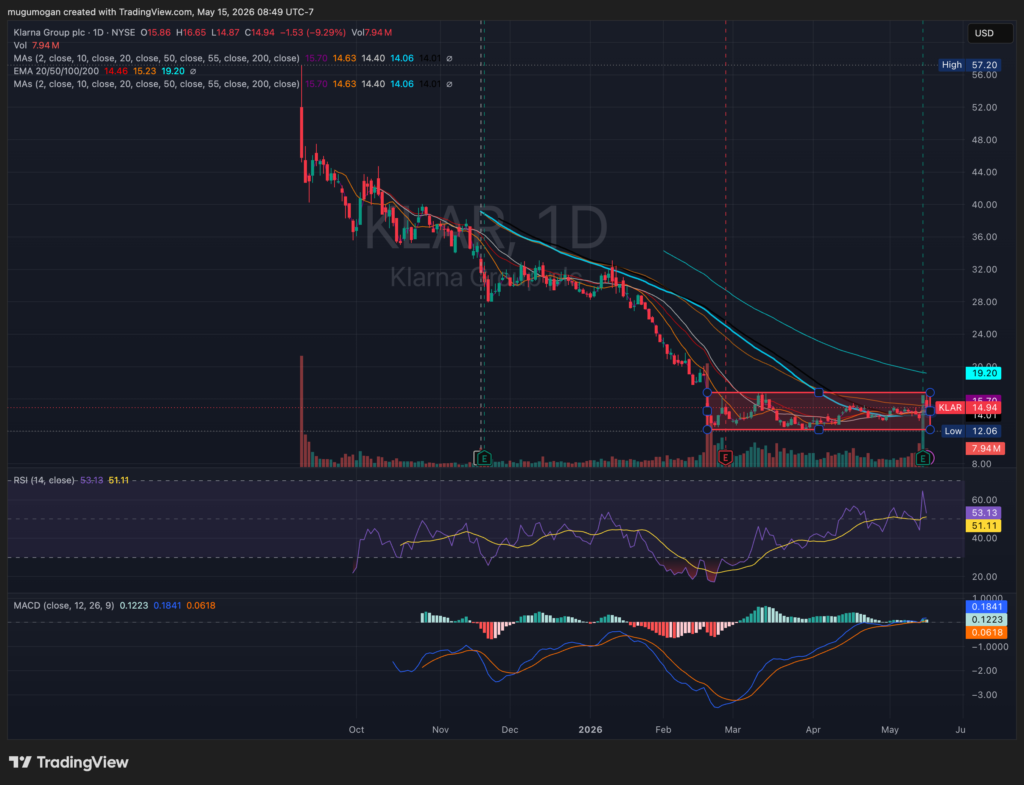
KLAR is not bullish yet despite the sideways stabilization, because the stock is still trapped below every major moving average and remains in a larger post-IPO downtrend from the $50+ collapse. What you are actually seeing is a volatility compression box between roughly $12 and $16, with repeated rejection near resistance and declining momentum expansion — a setup that usually precedes a large directional move. RSI and MACD have improved materially from the February washout, but neither indicator shows real impulse strength yet, so this still looks like accumulation at best, not confirmed trend reversal. A decisive weekly breakout above $16–$17 with volume changes the structure; failure of the $12 floor likely sends it back into price discovery lower because there is very little historical support underneath.