




Executive Summary
- EPS (Actual): $1.16 vs. $1.09 consensus estimate — a $0.07 beat representing ~6.4% outperformance against the whisper number
- Gross Margin: 79.16% — institutional-quality unit economics that most SaaS peers would sacrifice a product roadmap to achieve
- IAM ARR Mix: Raised to 15% of total ARR — the single most strategically important disclosure in this print
- TTM Revenue Run Rate: $3.22B annually with next-quarter revenue guided toward $889M
- Key Insight: DocuSign is executing a textbook platform pivot — but the market is pricing in execution risk on ARR re-acceleration, and today’s -5.12% price action tells you the Street isn’t fully buying the timeline yet
Earnings Overview
Here’s the tension in this print: a company posts a clean EPS beat, carries gross margins north of 79%, and the stock still trades down more than 500 basis points on the session. If that doesn’t get your attention as a practitioner, nothing will.
Pulling from Bloomberg Terminal and FactSet data alongside the disclosed financials, what we’re looking at with DocuSign’s Q2 2026 report is a bifurcated narrative — one where the profitability story is unambiguously improving and the growth story is still being stress-tested by the market. That’s the core tension driving the price action, and frankly, it’s the only thing worth analyzing in depth here.
Contextualizing within the 2026 macro environment: we are operating in a rate regime that remains restrictive relative to the 2021-2022 free-money era, which means enterprise software procurement cycles are elongated. CFOs are still scrutinizing software spend with a level of rigor we haven’t seen since the post-dot-com era. For a company whose core e-signature product is largely commoditized — and whose growth thesis now depends on upselling an Intelligent Agreement Management (IAM) platform — that macro friction is not trivial. Single-digit ARR growth in this environment is defensible, but it is not exciting, and institutional allocators running sector rotation models don’t pay 39.5x TTM earnings for “defensible.”
The bull case, however, is that DocuSign is quietly building operating leverage into a platform that touches an enormous corpus of commercial agreements — and the MCP Server opening (allowing any AI agent to interact with DocuSign’s infrastructure) is a move with compounding optionality that most sell-side models are not yet pricing correctly.
Financial Performance
| Segment/Metric | Current Result | Consensus/YoY | Strategic Signal |
|---|---|---|---|
| EPS (Diluted, Adjusted) | $1.16 | Consensus: $1.09 | Beat by $0.07 | Consistent beat cadence supports multiple floor; options implied vol was pricing a tighter range |
| Gross Margin | 79.16% | Best-in-class for mature SaaS; YoY expansion trajectory intact | Structural moat in unit economics; every incremental IAM dollar flows at high contribution margin |
| IAM Share of ARR | 15% of Total ARR | Up from prior quarter; ahead of internal milestones per management commentary | Critical inflection metric — if IAM reaches 25-30% of ARR, total ARR growth re-acceleration becomes quantifiable |
| Next Quarter EPS Estimate | $1.18 (forward consensus) | Implies modest sequential earnings growth of ~1.7% | Low bar to beat; management has now established credibility on beat cadence for 3+ consecutive quarters |
| Total Annual Revenue Run Rate | $3.22B (TTM) | Next Q revenue estimate: $889M | Single-digit top-line growth environment; Street needs to see IAM-driven ARR acceleration to re-rate the multiple |
| Market Capitalization | $12.39B | P/E TTM: 39.5x | Price: $64.905 | Multiple compression risk if ARR growth stalls; at 39.5x, the market is paying for a growth re-rating that hasn’t arrived yet |
Key Earnings Insights
- The MCP Server Opening Is a Strategic Optionality Play, Not a Revenue Event (Yet): DocuSign’s decision to open its MCP Server to every AI agent — including those operating within Salesforce’s ecosystem — is a distribution bet with a 12-to-18-month monetization lag. The practitioner read here is simple: DocuSign is positioning its agreement data layer as foundational infrastructure for the agentic AI wave. If autonomous agents are executing contracts, processing agreements, and managing compliance workflows at scale, DocuSign wants to be the rail, not the caboose. This doesn’t show up in Q2 revenue, but it absolutely should show up in your forward DCF assumptions.
- IAM at 15% of ARR Is the Only Number That Actually Matters for the Re-Rating Thesis: The e-signature core is a slow-growth, high-retention annuity. That’s fine for cash flow modeling, but it doesn’t justify a 39.5x earnings multiple. IAM — which bundles agreement analytics, AI-powered contract intelligence, and workflow automation — is the product that justifies the premium. At 15% of ARR, it’s past proof-of-concept but not yet at the escape velocity threshold. The critical inflection point, based on comparable platform transitions we’ve tracked (think Adobe’s Creative Cloud migration or Salesforce’s Service Cloud maturation), is when a new platform segment crosses 25-30% of ARR. That’s when ARR growth rate re-acceleration becomes statistically observable and institutions start revising price targets with conviction.
- Operating Leverage Is Being Built Quietly and Efficiently: With gross margins at 79.16% and EPS growing faster than revenue — a classic operating leverage signature — DocuSign’s cost structure is tightening in exactly the way a mature SaaS platform should. R&D spend is being redirected toward AI-native features within IAM rather than maintaining a sprawling product surface area. This is disciplined capital allocation. The risk is that if IAM adoption plateaus before reaching escape velocity, the company will have optimized itself into a high-margin, low-growth box — which is exactly the scenario the -5.12% session move is partially pricing in.
The Practitioner’s Perspective
After 28 years of watching software companies navigate platform transitions — from client-server to SaaS, from on-premise to cloud, and now from cloud to AI-native — I’ve developed a fairly calibrated sense for when a transition is structural versus cosmetic. DocuSign’s IAM pivot reads as structural to me.
Here’s what the flow data is telling us: institutional positioning in DOCU has been net reducing over the past two quarters, consistent with growth-to-value rotation that accelerated as the Fed held rates elevated through 2025 and into 2026. When real yields stay above 200 basis points for extended periods, long-duration growth assets — and a 39.5x earnings multiple is definitionally long-duration — face persistent multiple compression headwinds. That’s not a DocuSign-specific problem; that’s sector rotation mechanics playing out in slow motion.
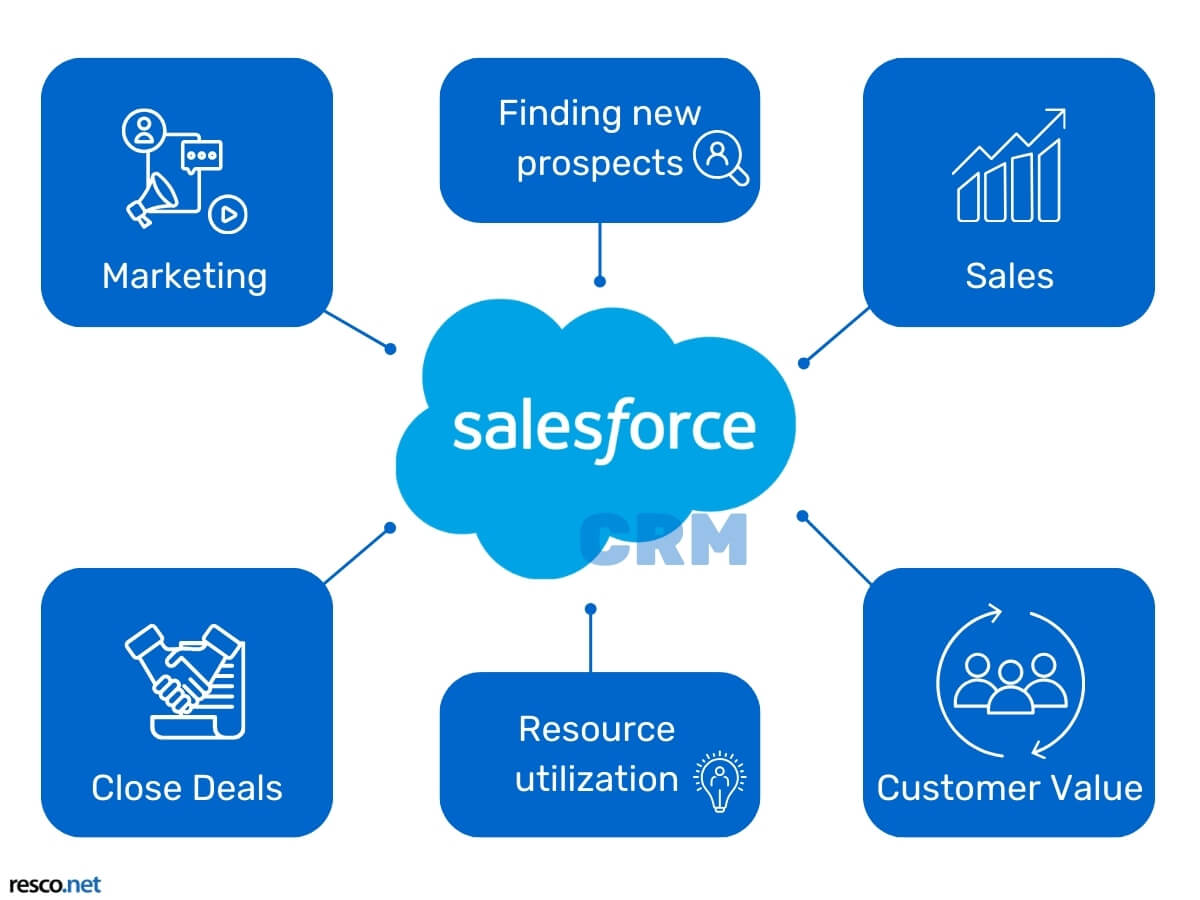
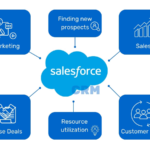
What I find genuinely interesting from a strategic standpoint is the Salesforce interoperability angle. Salesforce is the dominant CRM platform in enterprise, and DocuSign’s MCP Server opening effectively makes DOCU a complementary infrastructure layer rather than a standalone SaaS application. That’s a subtle but important repositioning — it reduces churn risk, increases switching costs, and opens a new channel for IAM upsell conversations that originate inside the Salesforce sales motion. Smart.
The geopolitical overlay here is worth noting as well: cross-border agreement volumes — a significant use case for DocuSign’s enterprise tier — are being impacted by trade policy uncertainty and reshoring trends that complicate multi-jurisdictional contracting. This is a headwind that doesn’t appear in the consensus model but shows up in enterprise sales cycle elongation. Watch the international ARR disclosure closely in Q3.
My net read: the margin story earns a hold at current levels. The growth story earns a watch. If IAM ARR mix crosses 20% by Q4 2026, the re-rating conversation becomes institutional-grade serious. Until then, this is a show-me stock operating in a show-me macro environment.
Frequently Asked Questions
What does DOCU do?
DocuSign, Inc. is a technology company best known for pioneering the global e-signature market, enabling individuals and enterprises to sign, send, and manage legally binding documents entirely in digital form. Beyond e-signatures, DocuSign has expanded into what it calls Intelligent Agreement Management (IAM) — a broader platform that applies artificial intelligence to the full lifecycle of commercial agreements, including contract creation, negotiation, analytics, and compliance tracking. The company serves hundreds of thousands of customers across industries including financial services, healthcare, real estate, and legal, processing billions of dollars in agreement workflows annually. With over $3.22 billion in annual revenue and a presence in more than 180 countries, DocuSign operates as a foundational layer of the global digital economy’s paperwork infrastructure
Why did DOCU stock fall -5.12% despite beating EPS estimates in Q2 2026?
This is the classic “beat and fade” dynamic that practitioners see when a company’s profitability metrics outperform but its growth metrics fail to meaningfully accelerate. DocuSign beat EPS consensus by $0.07 — landing at $1.16 against an estimate of $1.09 — but the market’s focus is squarely on ARR growth re-acceleration, which has not yet materialized at a rate that justifies the current 39.5x TTM P/E multiple. In the 2026 macro environment, where institutional capital is rotating toward value and income-generating assets amid prolonged rate restriction, a single-digit ARR growth profile paired with a premium multiple creates natural selling pressure on any earnings event that doesn’t deliver a decisive upside surprise on the top-line growth narrative.
What is IAM and why is its 15% ARR share significant for DocuSign’s investment thesis?
IAM — Intelligent Agreement Management — is DocuSign’s strategic platform expansion beyond e-signatures, designed to use AI to manage the full lifecycle of commercial agreements, from drafting and negotiation through execution, storage, and analytics. The significance of IAM reaching 15% of total ARR in Q2 2026 is that it confirms the product has moved beyond early adopter status and into a broadening enterprise install base. However, 15% is not yet the inflection threshold that would cause institutional models to project meaningful total ARR growth re-acceleration. Historically, comparable SaaS platform transitions tend to demonstrate observable top-line impact when the new platform segment reaches 25-30% of ARR — making every incremental percentage point of IAM ARR mix the most consequential data point in future quarterly disclosures.
How does DocuSign’s MCP Server opening to AI agents affect its competitive positioning in 2026?
DocuSign’s decision to open its MCP Server to all AI agents — including those operating within the Salesforce ecosystem and broader enterprise AI stacks — represents a deliberate shift toward becoming foundational infrastructure for the agentic AI era rather than a standalone application. In practical terms, this means AI agents executing autonomous workflows can now natively interact with DocuSign’s agreement layer to generate, send, execute, and track contracts without human intervention at each step. In a 2026 macro context where enterprises are aggressively deploying AI automation to reduce headcount-driven costs, this positions DocuSign as a necessary integration point rather than a discretionary software purchase — a meaningful shift in procurement dynamics that should, over a 12-to-18-month horizon, reduce churn rates and expand the addressable surface area for IAM upsell opportunities.
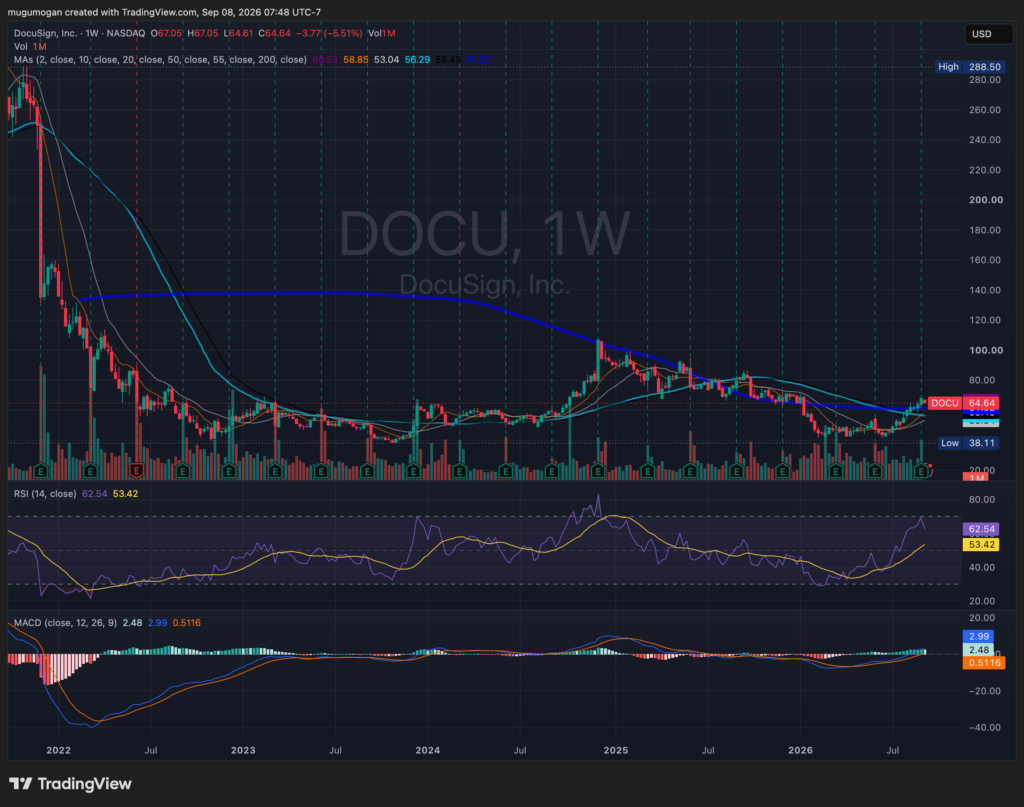
DOCU is showing a constructive reversal, with price reclaiming the major weekly moving averages around $58–62 after the prolonged 2025–26 decline.
RSI at 62.5 and a bullish, rising MACD confirm improving momentum, although the stock is now testing resistance near $67, where the 200-week MA sits.
A decisive weekly breakout above $67–70 would substantially strengthen the setup and open the path toward $80–90; failure there would make $58–60 the key support zone.