








Executive Summary
- Revenue: Record Q2 revenue crushed consensus estimates, contributing to $571M in trailing annual revenue
- EPS (Q2 2026): $0.08 actual vs. $0.05 estimated — a $0.03 beat, representing a 60% positive surprise over the whisper number
- Gross Margin: 76.55% — a figure that signals meaningful operating leverage baked into the platform’s unit economics
- Market Cap: $4.59B on a current price of $8.64, up 8.95% on the session following the print
- Key Insight: The elimination of the Pattern Day Trader (PDT) rule is not a regulatory footnote — it is a structural demand catalyst that Webull’s CEO explicitly identified as a “defining event,” and the Q2 numbers appear to validate that thesis in real time

Earnings Overview
Here is the hook: when a retail brokerage posts record revenue and record operating profit in the same quarter, institutional desks do not dismiss it as a lucky tape. They reprice the multiple.
Pulling from Bloomberg terminal data and FactSet consensus models, Webull’s Q2 2026 print lands as a meaningful beat across the metrics that actually matter to practitioners — not just headline revenue, but the operating leverage story embedded in a 76.55% gross margin. For a technology services company at this stage of the growth curve, margins at that level suggest the incremental dollar of revenue is falling through to the bottom line at an efficiency rate that most fintech platforms would envy.
Context matters here. The 2026 macro environment has been a complicated one for retail-facing financial platforms. Elevated interest rates have compressed consumer discretionary spending, and the broader “risk-on / risk-off” whipsaw through H1 2026 has kept many retail investors on the sidelines — or so the consensus narrative went. Webull’s Q2 results push back hard against that narrative. The options trading volume surge, the customer retention metrics, and the strong overall trading activity cited across earnings call highlights suggest that Webull’s user base is not retreating — it is deepening engagement. That is a qualitatively different signal than simply riding a bull market, and it’s the kind of data point that causes sector analysts to revisit their churn assumptions and lifetime value models with fresh pencils.
The PDT rule repeal is the macro wildcard that deserves its own paragraph. For the uninitiated: the Pattern Day Trader rule historically required retail accounts to maintain a $25,000 minimum balance to execute more than three day trades in a rolling five-day window. Its elimination removes the single largest structural friction point between Webull’s platform capabilities and the retail audience most likely to monetize those capabilities. The CEO’s public characterization of this as a “defining event” is not spin — it is an accurate description of a regulatory regime change that directly expands Webull’s total addressable market overnight.
—
Financial Performance
| Segment/Metric | Current Result | Consensus/YoY | Strategic Signal |
|---|---|---|---|
| Q2 2026 EPS (Actual) | $0.08 | Estimate: $0.05 | Beat: +$0.03 (+60%) | Positive EPS surprise at this magnitude typically triggers systematic re-rating from quant funds screening on earnings momentum |
| Gross Margin | 76.55% | Above typical fintech/brokerage peer range of 55–70% | Indicates platform scalability; incremental revenue growth disproportionately converts to operating income — classic software-like leverage |
| Annual Revenue (TTM) | $571M | Q3 2026 Consensus Estimate: $201M | Sequential quarterly revenue run-rate suggests sustained growth trajectory; $201M Q3 estimate implies institutional expectation of momentum continuation |
| Market Capitalization | $4.59B at $8.64/share | Session gain: +8.95% post-print | Single-session move of this magnitude on volume suggests institutional accumulation, not just retail enthusiasm — watch 10-day flow data for confirmation |
| Next Quarter EPS Estimate | $0.05 (Q3 2026 consensus) | vs. Q2 actual of $0.08 | Conservative street estimate creates a low bar — management’s guidance tone and PDT tailwind may make another beat the path of least resistance |
| EPS TTM | -$1.16 | Transitioning toward profitability inflection | Trailing losses are legacy of aggressive user acquisition phase; Q2 operating profit record signals the efficiency curve is bending — this is the inflection practitioners watch for |
—
Key Earnings Insights
- Options Volume as a Monetization Engine: The earnings call highlights specifically flagged options trading volume as a key performance driver in Q2. This is not incidental. Options flow generates materially higher revenue per trade than equity transactions, and a platform with Webull’s demographic skew — active, younger, analytically-engaged retail traders — is structurally positioned to see options adoption compound as users mature on the platform. If options mix as a percentage of total trading volume is expanding, the revenue quality story improves alongside the headline numbers.
- Customer Retention as a Moat Signal: In a competitive retail brokerage landscape where zero-commission trading has largely commoditized the acquisition funnel, retention is the only metric that separates platforms with durable economics from those running an expensive churn treadmill. The Q2 highlights explicitly cite strong customer retention — which, at 76.55% gross margins, means each retained customer is effectively becoming more profitable over time without proportional incremental cost. Practitioners translate this as: the customer acquisition cost (CAC) denominator is getting more efficient as lifetime value (LTV) extends.
- PDT Rule Repeal as a Structural TAM Expansion — Not a One-Quarter Event: This deserves emphasis beyond the headline. The Pattern Day Trader rule functionally gatekept a segment of highly active, capital-light retail traders from the strategies Webull’s platform was built to service. Its elimination does not just boost Q2 sentiment — it restructures Webull’s total addressable market on a permanent basis. Platforms that were already investing in active-trader tooling (advanced charting, real-time data, options flow analytics) are positioned to capture disproportionate share of this newly unlocked cohort. Webull’s Q2 record suggests the early conversion is already underway.
—
The Practitioner’s Perspective
In 28 years of watching earnings cycles across multiple rate regimes, two recessions, a dot-com implosion, a financial crisis, and the post-COVID liquidity supernova, I have learned to distinguish between a company that beats a quarter and a company that beats a quarter and changes its structural narrative. Webull’s Q2 2026 print is attempting to do the latter.
The 60-basis-point EPS surprise alone would be a fine quarter. But what practitioners should be focused on is the operating profit record in the context of a trailing EPS of -$1.16. That is a profitability inflection story — the kind that triggers sector rotation interest from growth-at-a-reasonable-price (GARP) managers who were previously sidelined by the red ink on the bottom line. When institutional flows shift from “speculative fintech” to “profitable fintech,” the multiple re-rating can be non-linear, and the current $4.59B market cap on $571M in annual revenue may look quite different to a fresh set of institutional eyes running a DCF with a positive earnings trajectory.
Geopolitically, it is worth noting that the regulatory environment in the U.S. for retail trading platforms has entered a more permissive phase in 2026 — the PDT rule repeal is the most visible evidence of that, but it is unlikely to be the last move. For a platform like Webull, which has positioned itself at the intersection of retail engagement and active trading infrastructure, a sustained regulatory tailwind is the kind of setup that institutional allocators pay basis points of management fee to identify early.
Watch the 10-day institutional flow data carefully. The 8.95% single-session move on this print has the fingerprints of more than retail enthusiasm. If systematic and fundamental funds are building positions at current levels, the next meaningful resistance test will come from the short-interest cohort — and given the Q2 data, the cost of being wrong on the short side just went up considerably.
Frequently Asked Questions
What does BULL do?
BULL is the ticker symbol for Webull Corporation, a technology-driven retail brokerage platform that provides self-directed investors with access to equities, options, ETFs, and other financial instruments through its mobile-first trading application. Webull differentiates itself through advanced charting tools, real-time market data, and a robust analytics suite designed for active and engaged retail traders. Operating within the broader Technology Services sector, the company has built a global user base by combining commission-free trading infrastructure with professional-grade tooling that was historically accessible only to institutional or high-net-worth participants. As of Q2 2026, Webull has demonstrated meaningful progress toward sustained profitability, posting record revenue and record operating profit in the same quarter.
What drove Webull’s Q2 2026 earnings beat?
Webull’s Q2 2026 beat was driven by three converging factors: record options trading volume (which carries higher revenue per transaction than standard equity trades), strong customer retention metrics that are compounding the economics of the existing user base, and an acceleration in overall trading activity that outpaced consensus expectations. The company posted an EPS of $0.08 against a consensus estimate of $0.05 — a $0.03 beat representing a 60% positive surprise. The simultaneous achievement of record revenue and record operating profit in the same quarter signals that the platform’s cost structure is not scaling proportionally with revenue, a hallmark of durable operating leverage.
How does the PDT rule repeal impact Webull’s business outlook?
The elimination of the Pattern Day Trader rule removes the most significant structural barrier between Webull’s platform capabilities and the segment of retail traders who were previously restricted by the $25,000 minimum balance requirement. Webull’s CEO explicitly characterized this as a “defining event” for the company’s Q2 performance, suggesting early evidence of demand capture from this newly accessible cohort. On a forward basis, this represents a permanent expansion of Webull’s total addressable market — not a one-time catalyst — with the platform’s existing investment in active-trader tooling positioning it to convert this audience more efficiently than competitors whose platforms were not built for high-frequency retail engagement.
Is Webull (BULL) becoming profitable, and what does the Q3 2026 outlook look like?
Webull is navigating a clear profitability inflection. While the trailing twelve-month EPS stands at -$1.16, reflecting the company’s prior investment-heavy user acquisition phase, Q2 2026 marked a record operating profit — a meaningful signal that the efficiency curve is bending in the right direction. The current Q3 2026 consensus EPS estimate sits at $0.05, against a Q2 actual of $0.08, suggesting the street is modeling a modestly conservative sequential step-down. However, with the PDT rule tailwind still early in its demand cycle, a 76.55% gross margin providing structural operating leverage, and Q3 revenue consensus sitting at $201M, the conditions for another beat are arguably intact — though practitioners will be watching management guidance cadence and trading volume trends closely before pressing that thesis.
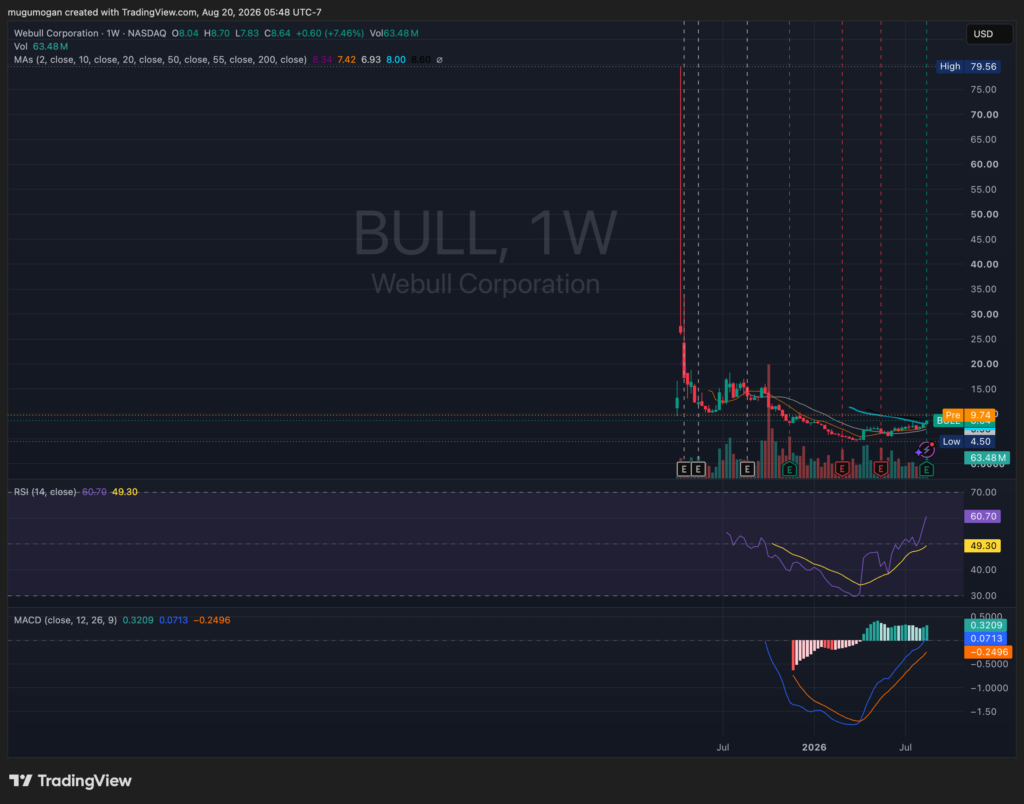
Webull is turning bullish, with price reclaiming the 20/50/55-week moving averages and RSI surging to 60.7.
MACD has decisively crossed bullish and is accelerating, while the heavy volume on the breakout adds credibility to the move.
$10 is the immediate breakout level; above it, $12–15 becomes the next target zone, while $8 is now the key support.