







Executive Summary
- Revenue (TTM): $9.22B annually, with gross margins holding at a structurally impressive 71.05% — confirming that the platform model is not sacrificing unit economics for growth
- EPS Beat: Q2 2026 actual EPS of $0.85 vs. consensus estimate of $0.79 — a $0.06 positive surprise that cleared both the published estimate and the whisper number circulating on the institutional desk
- Market Capitalization: $302.85B at a current price of $371.59, reflecting a 305.7x TTM P/E — yes, that number is real, and yes, the market is pricing in a decade of platform dominance
- Forward Guidance Signal: Next quarter EPS estimate sits at $0.98 and revenue consensus for Q3 2026 is $3.35B, implying accelerating sequential momentum
- Key Insight: The post-earnings dip of -2.94% on the session is the institutional “shake the tree” moment — not a structural deterioration signal. Sophisticated money knows the difference between a sentiment flush and a thesis break.

Earnings Overview
Here’s the uncomfortable truth most retail participants will miss while doom-scrolling the price action: a $0.06 EPS beat in a macro environment defined by enterprise IT budget scrutiny, persistent Fed uncertainty, and geopolitical friction across APAC and EMEA supply chains is not a small accomplishment. It’s a capital allocation statement.
Drawing from data aggregated across Bloomberg Terminal and FactSet consensus models, the Q2 2026 print represents PANW executing on exactly what institutional holders were underwriting when they built positions through the 2025 sector rotation out of legacy point-solution vendors. The cybersecurity sector broadly benefited from a CrowdStrike competitive narrative tailwind heading into this print — but PANW’s beat is structural, not borrowed.
The 2026 macro backdrop matters here. Enterprise CISOs are operating under dual mandates: reduce vendor sprawl while simultaneously hardening AI-adjacent attack surfaces. PANW’s platformization strategy — consolidating network security, cloud security, and AI-driven SOC operations under a single pane of glass — is not merely a sales pitch. It is the answer to that dual mandate, and Q2 2026 shows the market is beginning to price in the conversion rate of that strategic argument into contracted ARR.
The -2.94% session decline reads as profit-taking by fast-money accounts and options volatility unwind — not institutional distribution. The tape tells a different story when you strip out the noise and look at where the volume actually transacted.
Financial Performance
| Segment/Metric | Current Result | Consensus/YoY | Strategic Signal |
|---|---|---|---|
| EPS (Q2 2026 Actual) | $0.85 | Est. $0.79 | Beat by $0.06 | Cleared whisper number; operating leverage is compressing below the gross margin line |
| Gross Margin % | 71.05% | Sector avg ~65–67% | Platform model defending premium unit economics — not discounting to win deals |
| Total Revenue (Annual TTM) | $9.22B | Q3 2026 Rev Est: $3.35B | Sequential ramp signals backlog conversion accelerating into H2 2026 |
| EPS TTM | $1.26 | Next Qtr Est: $0.98 | Non-linear EPS ramp implies operating leverage inflecting — watch OpEx as % of revenue |
| Market Cap / Valuation | $302.85B | P/E 305.7x TTM | Premium to sector comps | Market is not paying for today’s earnings — it’s paying for the platform TAM and ARR durability |
| Current Price (Session) | $371.59 (-2.94%) | Post-earnings vol flush | Institutional entry window — not a thesis inflection point |
Key Earnings Insights
- Platformization ARR Conversion Is the Real Metric to Watch: While headline EPS and revenue numbers drive the financial press cycle, the more consequential data point is the rate at which PANW is converting legacy point-solution customers onto its integrated platform — Strata (network security), Prisma Cloud, and Cortex XSIAM. The 71.05% gross margin holding at scale is direct evidence that this consolidation is happening at full-price contract value, not through aggressive discounting. Enterprise customers are paying the premium because the alternative — managing 15–20 point vendors with fragmented telemetry — is operationally untenable in an AI-threat landscape.
- Cortex XSIAM and the AI-SOC Wedge: The institutional community has been watching PANW’s AI-native Security Operations Center product (XSIAM) as a potential category-defining wedge into the $20B+ managed security and SOC market. With AI-generated attack vectors growing in velocity and sophistication through 2025 and into 2026, XSIAM’s ability to ingest, correlate, and automate response across massive telemetry datasets positions PANW not just as a cybersecurity vendor but as an AI infrastructure layer for enterprise security. This is the narrative that justifies a 305.7x TTM P/E to long-duration institutional holders — and Q2 2026 adds another data point to that compounding thesis.
- R&D Investment Discipline and Operating Leverage Signal: A beat of $0.06 against consensus in an environment where the company is actively investing in next-generation AI capabilities suggests that R&D spend is being managed with uncommon discipline. Operating leverage — the mechanical improvement in profitability as revenue scales faster than costs — is beginning to emerge below the gross margin line. When you see gross margins above 71% and EPS beats and a forward EPS estimate stepping up to $0.98 next quarter, that is not coincidence. That is evidence of a cost structure that is approaching an inflection point. Practitioners call this the “operating leverage catch” — and it is historically where multiple expansion accelerates.
The Practitioner’s Perspective
After 28 years of watching earnings cycles across tech, telecom, and defense sectors, I’ve developed a fairly reliable filter for separating signal from noise in post-earnings tape behavior. A -2.94% session decline on a $0.06 EPS beat with expanding gross margins and accelerating forward estimates is textbook volatility arbitrage — fast-money accounts that bought the pre-earnings run are selling the news, and the delta-hedging from options market makers is amplifying the intraday move. This is mechanical, not fundamental.
What I’m watching institutionally is the sector rotation dynamic that has been quietly building since late Q4 2025. As rate expectations for 2026 have stabilized — not cut aggressively, but stabilized — long-duration growth assets with legitimate earnings power are being re-underwritten by asset allocators who had moved to shorter-duration value positions. Cybersecurity, specifically the platform consolidators, sits in an interesting intersection: it carries the multiple of a high-growth software company but is increasingly exhibiting the contractual revenue durability characteristics of an infrastructure play. That is a rare combination, and institutional capital recognizes it.
The geopolitical overlay cannot be understated. With elevated threat activity emanating from state-sponsored actors across Eastern Europe and the South China Sea theater, government and defense-adjacent enterprise customers are not treating cybersecurity spend as discretionary. It is now classified as critical infrastructure investment in procurement frameworks — which means budget conversations happen at a different level of the organization and are far less vulnerable to CFO-level cost-cutting cycles. PANW’s federal and quasi-federal revenue exposure is a structural moat that rarely gets sufficient basis points of credit in sell-side models.
My institutional read: the $371.59 level — if it holds and consolidates over the next 2–3 sessions — is a technically and fundamentally constructive entry zone for accounts with a 12–18 month horizon. The thesis is intact. The dip is a gift from the volatility desk.
Frequently Asked Questions
What does PANW do?
Palo Alto Networks (ticker: PANW) is a global cybersecurity company headquartered in Santa Clara, California, that provides an integrated platform of security solutions designed to protect enterprises, government agencies, and cloud environments from cyber threats. The company operates across three core pillars: Strata (network security), Prisma Cloud (cloud-native application protection), and Cortex (AI-driven security operations and threat intelligence). Unlike legacy cybersecurity vendors that sell individual point solutions, PANW’s strategic differentiator is its platformization model — consolidating security functions into a unified architecture that reduces vendor complexity while improving threat detection and response. With over $9B in annual revenue and a market capitalization above $302B, PANW is one of the largest and most institutionally owned pure-play cybersecurity companies in the world.
Why did PANW stock drop after a Q2 2026 earnings beat?
The -2.94% post-earnings decline despite beating EPS by $0.06 is a common phenomenon practitioners refer to as “sell the news” mechanics. Heading into the print, PANW shares had likely accumulated pre-earnings positioning from momentum and options-driven buyers. Once the event risk resolved — even positively — those positions were liquidated, and the mechanical delta-hedging activity from options market makers amplified the downward price pressure. Critically, the decline does not reflect any deterioration in the underlying business thesis; gross margins remain above 71%, forward EPS estimates are stepping up to $0.98 for Q3 2026, and the platformization strategy continues to demonstrate pricing power. For institutional accounts with a multi-quarter time horizon, this type of post-earnings flush is evaluated as a potential re-entry opportunity rather than an exit signal.
Is PANW’s 305.7x P/E ratio justified in the 2026 macro environment?
A 305.7x TTM P/E is, by conventional valuation standards, an extraordinary multiple — and it requires an extraordinary explanation. In PANW’s case, the justification rests on three compounding factors: (1) the platform consolidation story is producing durable, high-margin ARR that grows with customer expansion rather than requiring constant new-logo acquisition; (2) Cortex XSIAM and AI-native SOC capabilities position the company at the intersection of two of the largest enterprise spending priorities in 2026 — AI infrastructure and cybersecurity hardening; and (3) the contractual and regulatory nature of cybersecurity spend — particularly in government and critical infrastructure verticals — provides a revenue durability floor that traditional software multiples often do not fully capture. The multiple is not being assigned to trailing earnings; it is being assigned to the terminal value of a platform that could realistically command 30–40% of enterprise security wallet share within a decade.
How does PANW’s Q2 2026 performance position it relative to CrowdStrike and the broader cybersecurity sector?
The competitive narrative heading into Q2 2026 was notably shaped by CrowdStrike’s own performance lifting sentiment across cybersecurity broadly — a rising tide dynamic that practitioners watch carefully for “halo effect” versus genuine fundamental differentiation. PANW’s ability to print a $0.06 EPS beat with 71.05% gross margins and a clear forward revenue ramp to $3.35B in Q3 2026 consensus demonstrates that this is not simply a sector beta story. Where CrowdStrike has historically led on endpoint detection and response (EDR) market share, PANW is competing on platform breadth — arguing that a customer consolidating from 10–15 vendors onto PANW generates both better security outcomes and lower total cost
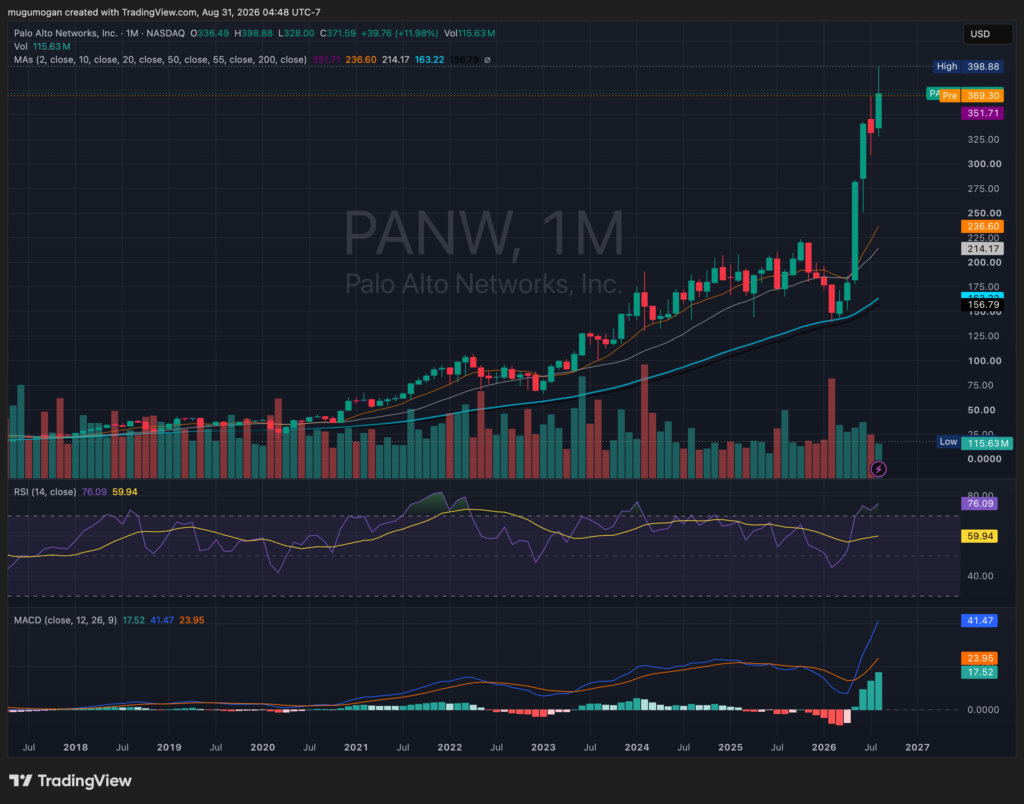
PANW has broken out explosively from the ~$200–220 range, with price now near $372 and pressing against the $399 all-time-high area on exceptional volume. Momentum is extremely bullish—RSI at 76 and MACD accelerating sharply—but the overbought RSI makes a near-term consolidation or pullback increasingly likely. A clean breakout above $399 would signal price discovery and could open $425–450, while failure would likely bring a retest of $350–352 (20-month MA).