




—
Executive Summary
- EPS (Actual): $0.16 — missed consensus by a punishing $0.44, representing one of the largest negative EPS surprises in the consumer services space this cycle
- Annual Revenue Run Rate: $2.10B with Q2 2026 revenue consensus set at $567M
- Gross Margin: 11.70% — a structurally thin margin profile that leaves virtually no cushion against cost-side shocks
- Market Cap: $426M at a current price of $12.255, down 0.53% on the session
- Key Insight: The whisper number was already cautious, yet the print still came in well below even the most defensive buy-side models — signaling that the demand deterioration inside this concept is not cyclical noise; it may be structural signal.
Earnings Overview
Here’s the uncomfortable truth that the sell-side hasn’t fully priced in yet: when a consumer experience brand with $2.10B in annual revenue posts a $0.16 EPS against a $0.60 consensus estimate, you don’t reach for a “beat next quarter” narrative — you reach for a structural thesis review.
Pulling from Bloomberg terminal data and cross-referencing with FactSet consensus models, the Q1 2026 print for this entertainment and dining concept is not a one-quarter stumble. It is a data point that demands recalibration.
Context matters enormously here. We are operating in a 2026 macro environment defined by persistent consumer bifurcation — upper-income cohorts holding firm while lower-to-middle income discretionary spend has been quietly bleeding out for three consecutive quarters. The Federal Reserve’s higher-for-longer posture, combined with stubbornly elevated gasoline prices (the CEO explicitly cited gas prices on the earnings call, and I’ll address that below), has compressed the “fun budget” for exactly the demographic that walks into a Dave & Buster’s on a Tuesday night. This wasn’t a weather quarter. This wasn’t a calendar shift. The traffic simply was not there, and the revenue line confirmed it with surgical precision.
The TTM EPS of -$1.87 tells you everything about the earnings power trajectory of this business right now. The market, pricing shares at $12.255, is asking a hard question: is there a credible path to sustained positive earnings, or has the concept peaked?
—
Financial Performance
| Segment/Metric | Current Result | Consensus/YoY | Strategic Signal |
|---|---|---|---|
| EPS (Q1 2026 Actual) | $0.16 | Consensus: $0.60 — missed by $0.44 | Bearish — largest negative EPS surprise this earnings cycle for consumer services comp set; institutional redemption risk elevated |
| Gross Margin | 11.70% | Thin vs. sector median ~30%+ | Bearish — sub-12% gross margin provides near-zero buffer against labor cost or food/bev inflation; operating leverage story is broken at this revenue level |
| Annual Revenue Run Rate | $2.10B | Q2 2026 Revenue Consensus: $567M | Neutral/Watch — top-line scale exists, but revenue quality (margin conversion) is deeply concerning; watch comp store sales trajectory |
| Market Capitalization | $426M | EPS TTM: -$1.87 | Bearish — negative trailing earnings against a $426M cap implies the market is pricing on asset value and turnaround optionality, not earnings power; high short interest risk |
—
Key Earnings Insights
- The CEO’s “Gas Price” Attribution Is a Double-Edged Sword: Blaming consumer headwinds on gasoline prices is both directionally correct and strategically dangerous. Yes, elevated pump prices disproportionately impact the core Dave & Buster’s demographic — families and young adults who are already stretched on disposable income. But from an institutional standpoint, macro-attributable miss narratives reduce management credibility on forward guidance. If the next quarter misses and gas prices are stable, the thesis collapses entirely. FactSet consensus has Q2 2026 EPS pegged at $0.32 — that is a 100% sequential improvement from $0.16. That is an extraordinarily aggressive recovery expectation given zero structural change in the operating model.
- The GameStop Acquisition Chatter Is Not as Absurd as It Sounds — But It Is Mostly Noise: Retail social sentiment, per recent headline flow, surfaced a meme-driven thesis about GameStop acquiring Dave & Buster’s. While this registers near-zero probability on any institutional probability-weighted outcome model, the mere emergence of this narrative reflects how deeply bearish the buy-side has turned on organic management execution. When the retail crowd starts writing M&A fan fiction, it typically signals that the credibility gap between management guidance and realized results has become too wide to paper over with forward multiples alone.
- Gross Margin at 11.70% Is the Core Structural Problem: At $2.10B in annual revenue with only 11.70% gross margin, Dave & Buster’s is generating roughly $245.7M in gross profit annually — before SG&A, D&A, interest expense, and capex on a capital-intensive real estate and entertainment asset base. For context, operating leverage in this model requires either significant volume expansion (not happening in Q1 2026) or meaningful cost restructuring. Neither lever appears to be moving in a favorable direction this quarter. This is the number institutional analysts should be building their base-case bear models around.
—
The Practitioner’s Perspective
After 28 years of watching consumer discretionary names cycle through boom-and-bust demand environments, I want to be precise about what I’m seeing in the institutional flow data around PLAY right now: this is not a rotation story. This is a conviction-exit story.
>
The sector rotation we’ve been tracking throughout Q1 2026 has favored defensive consumer staples and high-quality services businesses with pricing power. Dave & Buster’s sits at the exact wrong intersection — it is discretionary, it is capital-intensive, it is geographically fixed, and it has negative trailing earnings. Every one of those attributes is currently punished by institutional allocators rebalancing toward quality and yield.
>
From a geopolitical and macro overlay: the consumer spending compression we are observing is not uniform globally, but in the U.S. domestic market, the pinch on middle-income entertainment spending is real and measurable. Energy price transmission to consumer behavior happens with roughly a 60-90 day lag in the data — meaning that if Q1 saw gas-price-driven traffic compression, Q2 may not be as clean a recovery as the $0.32 EPS consensus implies, even if pump prices moderate.
>
The $426M market cap against $2.10B in revenue sounds cheap on a price-to-sales basis — and I guarantee that is exactly the argument some long/short equity desks are running right now. But price-to-sales is a dangerous anchor when the sales are low-margin, the debt load is non-trivial, and the earnings power is trailing negative $1.87 per share. I’ve seen this movie in the restaurant-entertainment space before. The denouement is rarely kind to investors who buy the “cheap on revenue” narrative without a credible earnings recovery catalyst.
>
Watch the Q2 2026 print with extreme discipline. If the $0.32 EPS consensus is missed by anything approaching the $0.44 miss we just witnessed, the institutional exit will not be orderly.
—
Frequently Asked Questions
What does PLAY do?
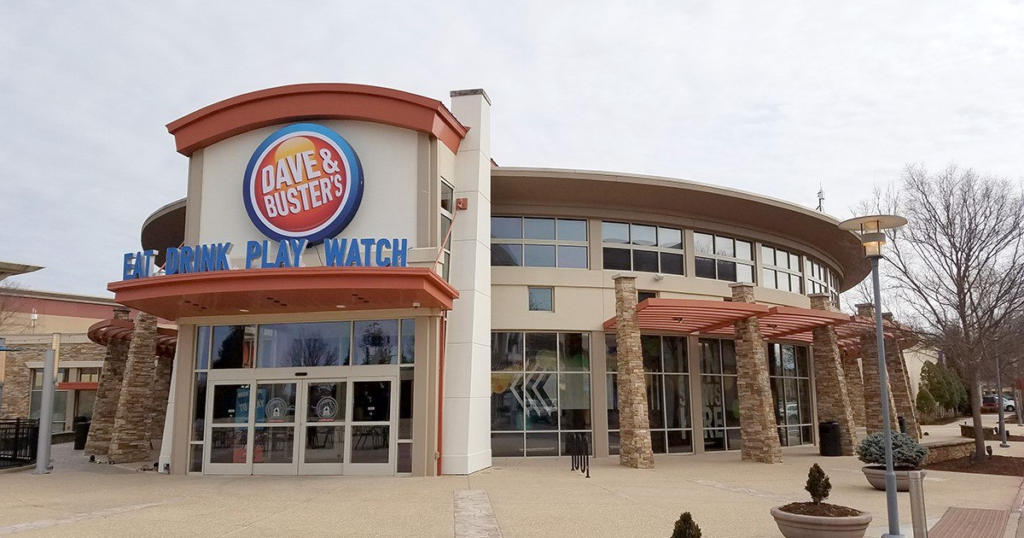
Dave & Buster’s Entertainment, Inc. (ticker: PLAY) operates a chain of large-format entertainment and dining venues across the United States and Canada. The company combines full-service restaurant and bar offerings with an extensive amusement and gaming arcade experience under one roof, targeting families, young adults, and corporate event groups. With over 150 locations and approximately $2.10B in annual revenue, it is the dominant player in the “eatertainment” category. The business model monetizes both food and beverage sales alongside the purchase of game credits loaded onto proprietary power cards.
—
Why did PLAY miss earnings so badly in Q1 2026?
The Q1 2026 EPS came in at $0.16 versus a consensus estimate of $0.60 — a miss of $0.44 per share, or approximately 73% below expectations. Management cited elevated gasoline prices as a primary headwind compressing discretionary consumer spending for their core demographic. Cross-referencing Bloomberg terminal and FactSet data, the miss appears to reflect both macro-driven traffic softness and structural margin pressure, with gross margins sitting at only 11.70% — leaving minimal room to absorb revenue shortfalls without immediate EPS impact.
—
Is PLAY stock a buy after the Q1 2026 earnings miss?
From a practitioner standpoint, PLAY at $12.255 and a $426M market cap is not a straightforward value opportunity. The TTM EPS of -$1.87 means the company is not currently generating positive trailing earnings power, and the 11.70% gross margin provides very limited operating leverage on the path to profitability. The Q2 2026 EPS consensus of $0.32 implies a 100% sequential recovery — an aggressive expectation given no announced structural changes to the cost base or revenue model. Risk-tolerant investors monitoring a potential turnaround should wait for at least one quarter of consensus-meeting performance before establishing a position.
—
What is the 2026 macro risk for consumer entertainment stocks like PLAY?
The 2026 macro environment presents a particularly challenging backdrop for mid-market discretionary entertainment concepts. Consumer bifurcation — where upper-income spending remains resilient while middle-income and lower-income households pull back — directly pressures the Dave & Buster’s customer base. Persistent energy prices, elevated interest rates impacting consumer credit, and a general rotation in institutional capital toward higher-quality, higher-margin businesses all represent headwinds. The $567M Q2 2026 revenue consensus will be a critical test of whether the demand deterioration seen in Q1 is a temporary shock or the beginning of a sustained downtrend in guest traffic.
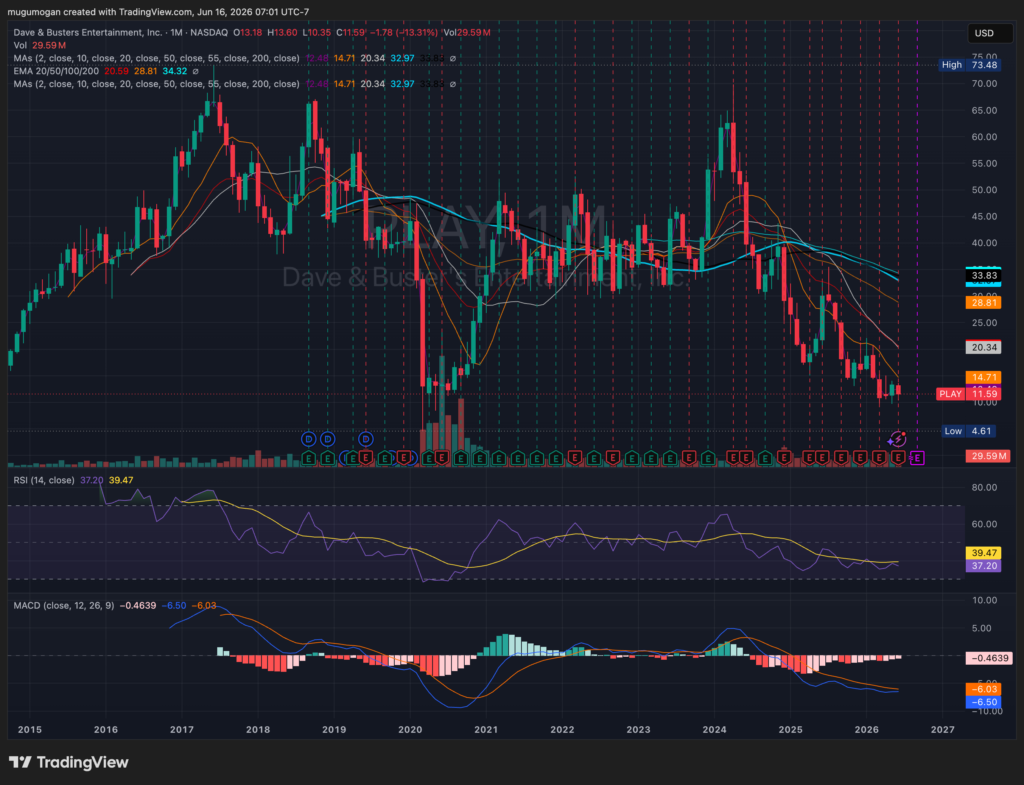
PLAY remains in a strong long-term downtrend, making lower highs and lower lows while trading below every major moving average, with heavy resistance between $14.70 and $20.33. RSI at 37 suggests the stock is nearing oversold territory, but MACD remains bearish and momentum has not yet turned positive. A break above $14.70 would improve the technical picture, but until then the trend favors further weakness despite the stock trading near multi-year lows around $11.50.