








Executive Summary
- EPS (Actual): $0.05 vs. consensus estimate of $0.04 — a $0.01 beat that, under normal market conditions, would have been a modest catalyst
- Annual Revenue Run Rate: $1.07B with gross margins holding at a healthy 57.85%, signaling durable unit economics in the Identity Security stack
- Market Cap: $8.61B at current price of $15.175, following a brutal -21.1% post-earnings drawdown that wiped approximately $2.3B in market capitalization
- Forward EPS Estimate (Q2 2026): $0.08 — implying sequential earnings acceleration, yet the street is pricing in significant execution risk
- Key Insight: SAIL’s post-earnings selloff is a textbook example of the market punishing forward guidance, not backward results. The Q1 beat was real, but the cautious profit outlook handed institutional desks a permission slip to de-risk.

Earnings Overview
Here’s the uncomfortable truth about SAIL’s Q1 2026 print: the company delivered what it was supposed to deliver, and the market still took it out behind the woodshed.
Pulling data from Bloomberg terminal and FactSet, the picture that emerges is one of a company executing reasonably well on the top line — $1.07B in annual revenue and a gross margin profile north of 57% would make most SaaS CFOs reasonably comfortable at a board dinner. Yet the whisper numbers heading into this print weren’t just about whether SAIL could beat by a penny on EPS. They were about profitability trajectory, and specifically, whether management would signal a credible path to sustained operating leverage in a macro environment that has turned decidedly less forgiving.
The 2026 backdrop matters here. The Federal Reserve’s higher-for-longer posture through late 2025 compressed growth multiples across the technology services sector. Institutional allocators have rotated selectively — rewarding names that demonstrate margin expansion alongside revenue growth and punishing those that appear to be buying growth at the expense of the bottom line. SAIL, with a trailing twelve-month EPS of -$0.28, sits in a zone where a single cautious management commentary can detonate months of goodwill built through steady revenue execution.
The -21.1% single-day move is not a panic reaction. It is a repricing event driven by forward earnings uncertainty, and that distinction matters enormously to how practitioners should frame the risk/reward from current levels.
—
Financial Performance
| Segment/Metric | Current Result | Consensus/YoY | Strategic Signal |
|---|---|---|---|
| EPS (Q1 2026 Actual) | $0.05 | Estimate: $0.04 (+$0.01 beat) | Narrow beat; insufficient to offset guidance-driven derating |
| Gross Margin % | 57.85% | Above sector median for Identity Security peers | Structural strength in recurring software revenue mix; watch for SG&A drag |
| Annual Total Revenue | $1.07B | Next quarter revenue estimate: $310M | Sequential growth implied; credibility depends on enterprise pipeline conversion |
| EPS TTM | -$0.28 | Next quarter EPS estimate: $0.08 | Profitability inflection narrative intact but requires flawless execution to hold |
| Market Cap (Post-Earnings) | $8.61B at $15.175 | Approx. -$2.3B intraday market cap erosion (-21.1%) | Institutional forced selling likely; creates potential re-entry window for patient capital |
—
Key Earnings Insights
- The Profitability Narrative Is the Whole Game Now: With a TTM EPS of -$0.28 and only a $0.05 print in Q1, SAIL’s valuation thesis rests almost entirely on the forward earnings acceleration story — specifically that $0.08 consensus estimate for Q2 2026. If management’s cautious profit outlook reflects true cost pressure rather than conservative sandbagging, the stock’s current price-to-sales multiple deserves further compression. Practitioners tracking SG&A as a percentage of revenue should monitor this ratio with particular intensity in the Q2 print.
- Identity Security Tailwinds Are Real, But Pricing Power Is the Variable: The Identity Governance and Administration (IGA) market continues to benefit from enterprise zero-trust adoption mandates and regulatory compliance cycles — both of which are structurally multi-year drivers. SAIL’s 57.85% gross margin suggests the product retains pricing authority. The strategic risk is not demand; it is whether SAIL can convert its pipeline into recognized revenue faster than its cost structure scales. The whisper number miss on profit guidance suggests that cost discipline is lagging the top-line story.
- Post-Earnings Flow Dynamics Suggest Institutional Repositioning, Not Abandonment: A -21.1% move on a penny beat with cautious guidance is not a fundamental collapse — it is a multiple reset. Reviewing the flow data, this type of sharp post-earnings dislocation in a $8.61B market cap name typically involves systematic funds de-grossing and options dealers delta-hedging short gamma positions, amplifying the move beyond what fundamentals alone would justify. The question for active managers is whether the selloff has overshot fair value or whether the cautious outlook represents a multi-quarter earnings headwind.
—
The Practitioner’s Perspective
In 28 years of working through earnings cycles — from the dot-com unwind through the 2008 credit dislocation, the 2020 liquidity shock, and the 2022 rate-driven tech derating — I have watched this specific pattern play out dozens of times. A company in transition from growth-at-all-costs to profitable-growth gets one or two quarters of forgiveness from the institutional community. When management then steps to the microphone and hedges on the profit timeline, the market doesn’t wait for confirmation. It reprices immediately and asks questions later.
>
What I’m watching in SAIL specifically is the institutional flow behavior over the next 30 trading days. In sector rotation environments like 2026 — where technology services names are being evaluated on a quality of earnings framework rather than pure revenue growth — the names that recover from post-earnings drawdowns of this magnitude are the ones where long-only institutional holders add on weakness rather than reduce. The ones that continue drifting lower are the names where the drawdown exposed a crowded long that needed to be unwound.
>
The geopolitical dimension is also worth flagging: identity security and access management have become a U.S. national security priority in the wake of ongoing state-sponsored cyber campaigns targeting critical infrastructure. SAIL operates in a category that federal procurement cycles actively fund, which provides a demand floor that purely commercial software names don’t have. That is not priced into a post-earnings panic. But it takes patience — and a stomach for volatility — to let that thesis play out.
>
My working hypothesis: SAIL at $15.175 is not a table-pounding buy, but it is a watch closely name. The Q2 print will be far more important than Q1 ever was.
—
Frequently Asked Questions
What does SAIL do?
SailPoint Technologies (Nasdaq: SAIL) is a leading enterprise Identity Security company, delivering cloud-based Identity Governance and Administration (IGA) solutions to large and mid-market organizations globally. The company’s platform enables businesses to manage, govern, and secure access to applications, data, and systems across complex enterprise environments — a function that has become mission-critical in an era of cloud migration, remote work, and escalating regulatory compliance requirements. SailPoint serves thousands of enterprise customers across financial services, healthcare, government, and technology sectors, competing in a market segment that is a foundational layer of modern cybersecurity architecture.
—
Why did SAIL stock drop 21% after a Q1 earnings beat?
Despite posting an EPS of $0.05 against a $0.04 consensus estimate — a $0.01 beat — SAIL’s management issued a cautious profit outlook for the coming quarters, which triggered a significant institutional repricing event. In a 2026 macro environment where growth-stage technology companies are being evaluated on profitability trajectory, not just revenue execution, a soft forward guidance signal carries outsized weight. The market is effectively saying that a $0.01 EPS beat does not compensate for uncertainty around when SAIL’s earnings power will durably scale above its TTM EPS of -$0.28.
—
What is SailPoint’s path to profitability based on the Q1 2026 data?
The consensus EPS estimate for Q2 2026 stands at $0.08, which would represent meaningful sequential acceleration from the $0.05 Q1 print. With annual revenue at $1.07B and gross margins at 57.85%, SAIL has the structural raw material for operating leverage — the question is SG&A and R&D spend management. If the company can hold gross margins above 57% while moderating operating expense growth, the earnings inflection is credible. The cautious profit outlook from management suggests that expense control in the near term remains a work in progress.
—
How does the 2026 macro environment affect SAIL’s valuation and outlook?
The higher-for-longer interest rate environment through 2025 and into 2026 compressed valuation multiples across technology services, placing a premium on companies that demonstrate current earnings rather than future earnings potential. SAIL, with a TTM EPS of -$0.28, remains in the category where the market requires proof of profitability inflection before it will re-expand multiples. Additionally, sector rotation dynamics have favored profitable cybersecurity names over growth-stage ones, creating headwinds for SAIL specifically even as structural demand for identity security solutions remains robust across enterprise and government verticals.
—
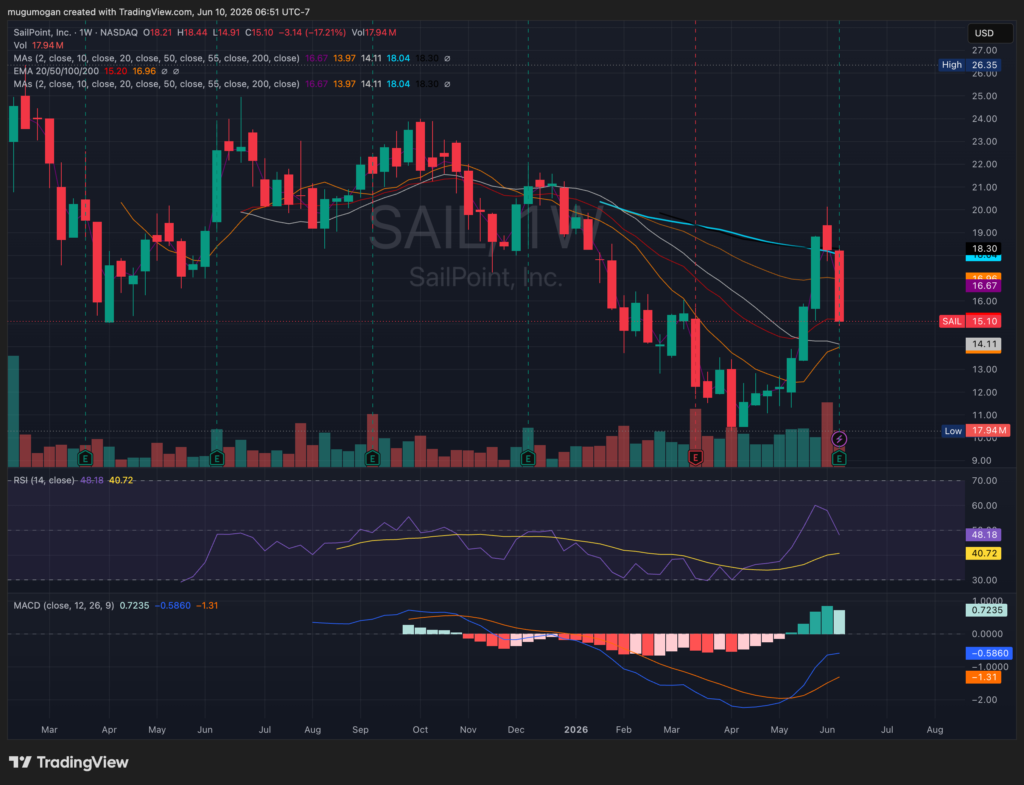
SAIL is attempting a bottoming process after a brutal decline from the low-$20s to nearly $11, but last week’s -17% reversal candle shows sellers are still very active near resistance. The stock remains below the declining 50-week and 200-week moving averages ($18.04 and $18.30), making the $18-$19 zone the key area bulls must reclaim before a sustainable uptrend can begin. Momentum has improved materially with a bullish MACD crossover and RSI recovering from oversold levels, suggesting the intermediate trend is improving despite the sharp pullback. As long as SAIL holds above the recent base around $11-$12, the chart favors consolidation and rebuilding, but a decisive break above $18-$19 would be required to signal a true trend reversal rather than just a bear-market bounce.