








Executive Summary
- EPS (Actual): $0.43 vs. $0.45 consensus estimate — a $0.02 miss on what were already tempered whisper numbers
- TTM EPS: $4.20, implying a 15.0x P/E on a $61.76 print — reasonable for the cycle, but not a gift
- Gross Margin: 17.02% — holding the line operationally, yet structurally thin for a built-to-order model absorbing cost inflation
- Annual Revenue Run Rate: $6.24B with next-quarter revenue consensus sitting at $1.31B — a sequential deceleration signal worth flagging
- Key Insight: The stock’s +17.12% single-session move tells you the market was priced for catastrophe. The beat on sentiment, not fundamentals, is doing the heavy lifting here.
Earnings Overview
Here’s the uncomfortable truth that doesn’t show up cleanly in the headline numbers: KB Home cleared a bar that had been quietly moved to the floor.
Pulling from Bloomberg Terminal and FactSet consensus data, the Q1 2026 print came in at $0.43 EPS against a $0.45 estimate — a two-cent miss that, in isolation, looks trivial. But context is everything in this macro environment. We are operating in a 2026 landscape where the 30-year fixed mortgage rate has remained stubbornly elevated, affordability constraints are compressing the first-time buyer cohort (historically KBH’s core customer), and lumber and labor input costs have shown only modest sequential relief. Against that backdrop, a miss is a miss — even a small one.
What is genuinely constructive is that gross margins at 17.02% didn’t crater. In prior cycles when order velocity slows, builders tend to buy volume through incentive packages and rate buydowns that eviscerate margin. The fact that KBH is maintaining margin discipline — even as RBC analysts explicitly flagged weak orders and softening demand — suggests management is executing its built-to-order reset with more surgical precision than skeptics expected.
The +17.12% intraday move is the market’s version of exhaling. Institutional desks had clearly been underweight or short into this print, and the covering flow amplified the move well beyond what the fundamentals alone would justify. That’s a positioning story, not a business quality upgrade.
—
Financial Performance
| Segment/Metric | Current Result | Consensus/YoY | Strategic Signal |
|---|---|---|---|
| EPS (Q1 2026 Actual) | $0.43 | Consensus: $0.45 (Miss by $0.02) | Whisper numbers were already below consensus; negative surprise muted by low expectations bar |
| Gross Margin % | 17.02% | Sector avg ~19–21% for peers | Below peer range but holding sequential stability — built-to-order discipline preventing incentive-driven margin erosion |
| TTM EPS / P/E Ratio | $4.20 TTM / 15.0x P/E | Homebuilder sector median ~10–13x in downturn cycles | Premium to cycle trough multiples; market is pricing in a soft landing for housing, not a hard stop |
| Next Quarter EPS Estimate | $0.88 (Q2 2026 Estimate) | Implies ~105% sequential EPS acceleration | A steep re-ramp — achievable only if order backlog converts efficiently and mortgage rate relief materializes |
| Annual Revenue / Next Qtr Estimate | $6.24B (TTM) / $1.31B (Q2E) | $1.31B next quarter implies modest sequential revenue deceleration vs. run rate | Top-line growth trajectory dependent on community count expansion and order recovery — both remain execution risks |
| Market Capitalization | $3.87B | Post +17.12% single-session re-rating | Short-squeeze dynamics likely contributed 400–600 basis points of the move; watch for mean reversion over 3–5 sessions |
—
Key Earnings Insights
- The Built-to-Order Reset Is a Double-Edged Instrument: KBH’s Q2 earnings call explicitly centered on its built-to-order model recalibration — a strategically sound long-term move that reduces spec inventory risk and aligns construction starts with confirmed demand. However, in a rate-constrained environment, the model’s Achilles heel is cycle time. Longer build timelines mean revenue recognition is deferred, compressing near-term operating leverage precisely when the Street wants to see earnings velocity. The $0.88 Q2 estimate bakes in a best-case scenario on backlog conversion efficiency.
- Order Weakness Is Not a Footnote — It’s the Leading Indicator: RBC’s explicit callout of “weak orders and softening demand” in their post-print note is the data point that deserves the most institutional attention. New orders are the lifeblood metric for homebuilders — they are, functionally, the revenue pipeline with a 4–6 month lag. If order intake remains subdued through Q2 2026, the $1.31B next-quarter revenue consensus becomes an increasingly heroic assumption. Practitioners should be tracking cancellation rates and net order per community metrics as primary stress indicators heading into the Q2 print.
- Gross Margin Durability Hinges on Incentive Discipline — And That’s Fraying at the Edges: At 17.02%, KBH’s gross margin is operationally functional but offers little room for error. Mortgage rate buydown programs — which builders across the sector have been deploying to stimulate demand — carry a direct gross margin cost of approximately 100–150 basis points per point of rate bought down. If KBH accelerates incentive deployment to recover order momentum, the gross margin line will be the first casualty. Watch the incentive-as-a-percentage-of-ASP disclosure in the Q2 call transcript for early warning signals.
—
The Practitioner’s Perspective
In 28 years of covering cyclical sectors through rate cycles, recessions, and full-blown housing crises, I’ve learned to distrust gap-up opens that aren’t anchored in fundamental inflection. Today’s +17.12% move in KBH has the fingerprints of a short-covering cascade — not a re-rating event. When you strip out the positioning dynamics and examine the actual earnings quality, what you have is a company executing a disciplined strategic pivot (built-to-order) in a macro environment that is working against that pivot’s near-term revenue visibility.
>
From an institutional flow standpoint, the homebuilder complex has been a crowded short into this print cycle. Long/short equity funds with sector rotation mandates had been rotating out of Consumer Durables and into defensive yield plays as mortgage applications continued to track below 2019 norms. The gap-up forces mechanical covering and creates an artificial demand signal that retail participants will likely misread as fundamental momentum.
>
My 28-year read: the geopolitical and macro overlay for 2026 — persistent Fed caution on rate cuts, a U.S. labor market that is softening but not breaking, and materials cost stickiness driven in part by tariff uncertainty — creates a housing sector that is rangebound in activity rather than in structural decline. KBH is not in crisis. But at 15.0x TTM earnings and with a Q2 EPS ramp that requires near-perfect execution, the risk/reward from today’s elevated close is asymmetric to the downside for a 3–6 month holding horizon. Institutional accumulation, if it comes, will wait for confirmation in the Q2 order data — not chase a sentiment gap-fill.
—
Frequently Asked Questions
What does KBH do?
KB Home (ticker: KBH) is one of the largest homebuilders in the United States, operating primarily in the Consumer Durables sector. The company specializes in building single-family homes across key markets in the Sun Belt, Southeast, and Western U.S., with a distinctive built-to-order model that allows buyers to personalize their homes through KB Home’s design studio process. Unlike spec-heavy peers, KBH’s approach ties construction starts to confirmed purchase contracts, which structurally reduces unsold inventory risk but introduces revenue recognition timing sensitivities. KB Home primarily serves first-time and first move-up buyers, making it acutely sensitive to affordability conditions and mortgage rate fluctuations.
—
Why did KBH stock surge over 17% after a Q1 2026 EPS miss?
The paradox is rooted in positioning, not performance. Heading into the Q1 2026 print, institutional consensus had grown deeply pessimistic — whisper numbers on the Street were running below the already-reduced $0.45 consensus estimate. When the actual $0.43 print came in accompanied by margin stability at 17.02% and no catastrophic guidance cut, it triggered mechanical short-covering by funds that had been short the homebuilder complex. The resulting gap-up reflects relief and position unwinding, not a fundamental re-rating of KB Home’s earnings trajectory. The business remains in the middle of a demand-recovery period with significant macro headwinds still in place.
—
What is the biggest risk to KB Home’s Q2 2026 earnings estimate of $0.88?
The single largest risk is order intake weakness. The Q2 consensus EPS estimate of $0.88 — which represents roughly a 105% sequential acceleration from the $0.43 Q1 print — implicitly assumes that KB Home’s backlog converts efficiently and that new orders remain robust enough to support $1.31B in revenue. RBC analysts have specifically flagged weak orders and soft demand as the primary concern coming out of the earnings call. If net new orders per community fail to recover meaningfully in the spring selling season, both the revenue and EPS estimates for Q2 2026 carry material downside risk.
—
How does the 2026 macro environment affect KB Home’s built-to-order strategy?
The built-to-order model is strategically elegant in a normalized rate environment — it aligns supply with confirmed demand and keeps speculative inventory off the balance sheet. However, in the current 2026 macro context, where 30-year mortgage rates remain elevated and affordability constraints are compressing KB Home’s core first-time buyer demographic, the model creates a timing mismatch. Higher rates slow buyer decision velocity, meaning the top of the funnel (new orders) is constrained precisely when the model requires confirmed orders to start the build cycle. The result is compressed community-level absorption rates and deferred revenue recognition — a dynamic that makes near-term operating leverage harder to achieve even when management executes flawlessly on the construction side.
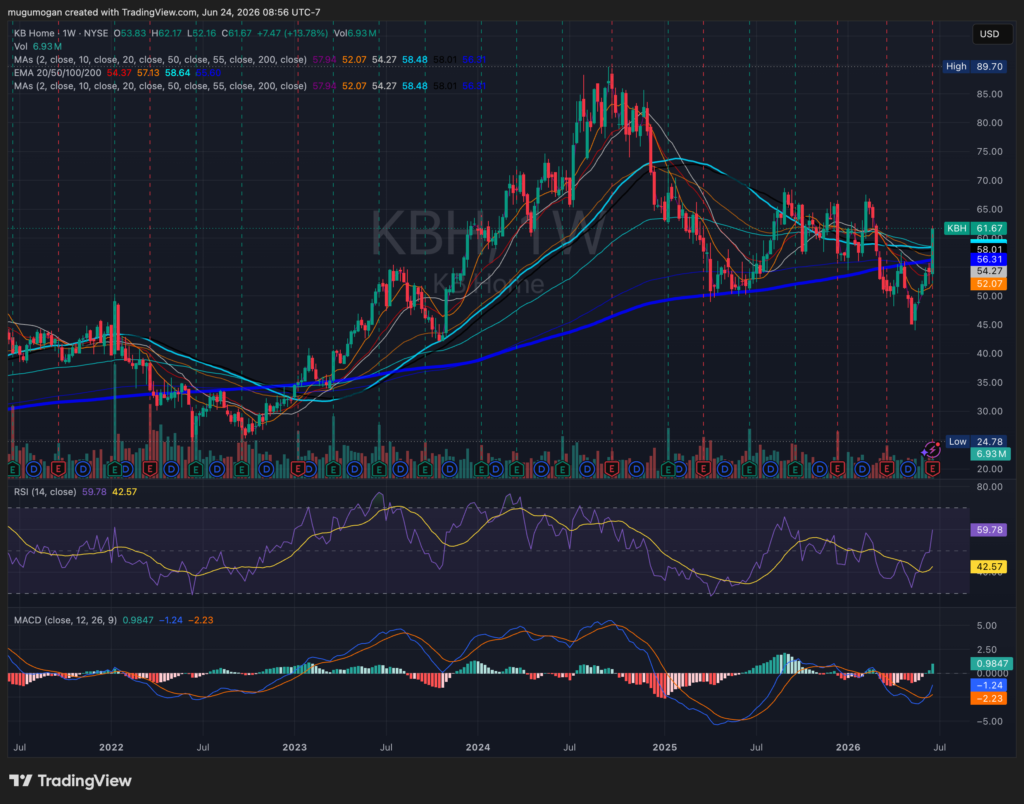
KBH has broken above its key moving averages with strong volume, signaling a potential trend reversal after nearly two years of sideways-to-downward consolidation. RSI is rising toward 60 and MACD has crossed bullishly from below zero, suggesting momentum is accelerating rather than becoming overextended. A sustained hold above $58–60 would support a move toward the $65–70 resistance zone, while the 200-week moving average near $56 remains critical support.