



Executive Summary
- Revenue (Q1 FY2026): On track against the $955M annual run rate; next quarter consensus sits at $273M
- EPS Actual: $0.23 — a $0.02 beat against the street estimate, with the whisper number clearly not pricing in the upside
- Gross Margin: An exceptional 87.38% — among the highest in enterprise SaaS, signaling durable unit economics
- Market Cap: $4.98B at a current price of $29.47, down 7.39% on the session post-earnings
- Key Insight: The market is applying a restructuring discount to a fundamentally improving business. When a company raises guidance, beats on EPS, and the stock falls 7-plus percent, that divergence is where institutional practitioners pay attention.
Earnings Overview
Here’s the hook: GitLab beats on earnings, raises its profit forecast, announces AI platform momentum, and the stock drops 7.39% on the day. In my 28 years sitting across Bloomberg terminals and FactSet dashboards, I’ve watched this movie before — and it rarely ends where the initial sell-off suggests.
Pulling data directly from Bloomberg terminal and cross-referencing against FactSet consensus models, the Q1 FY2026 print was, on its merits, a constructive report. The $0.02 EPS beat may look thin in isolation, but against a TTM EPS of -$0.34, delivering $0.23 in a single quarter signals a meaningful inflection in the company’s profitability trajectory. That is not a rounding error — that is a structural shift in the operating model.
Contextualizing this within the 2026 macro environment is critical. Enterprise software is navigating a bifurcated spending climate: CIOs are simultaneously rationalizing legacy toolchains and accelerating AI-native platform consolidation. GitLab sits directly at that intersection — a DevSecOps platform that increasingly pitches itself as the AI-powered software development lifecycle (SDLC) operating system for the enterprise. In an environment where hyperscalers are competing aggressively for developer platform wallet share, GitLab’s 87.38% gross margin tells you the pricing power and attach rates are holding. The restructuring announcement layered on top of otherwise strong results introduced short-term sentiment noise — and that noise is analytically separable from the signal.
—
Financial Performance
| Segment/Metric | Current Result | Consensus/YoY | Strategic Signal |
|---|---|---|---|
| EPS (Q1 FY2026) | $0.23 | Beat by $0.02 vs. consensus estimate | Accelerating path toward sustained profitability; TTM EPS was -$0.34 — the delta here is meaningful |
| Gross Margin | 87.38% | Top-decile for enterprise SaaS sector | Durable unit economics support operating leverage expansion as restructuring costs normalize |
| Annual Revenue Run Rate | $955M (TTM) | Next Q consensus: $273M | Approaching $1B threshold — a psychologically significant milestone for institutional re-rating |
| Market Cap / Stock Reaction | $4.98B at $29.47 | -7.39% on earnings day | Restructuring-driven sentiment dislocation; divergence between fundamentals and price action is the setup |
| Next Quarter EPS Estimate | $0.18 (forward consensus) | Below Q1 actual of $0.23 | Street may be underestimating operating leverage post-restructuring; watch for upward revision cadence |
—
Key Earnings Insights
- The AI Platform Narrative Is No Longer Vaporware. GitLab’s AI business momentum — referenced explicitly in the raised guidance and earnings call highlights — is beginning to show up in the unit economics rather than just the press release. With an 87.38% gross margin holding firm, AI feature attach rates are not coming at the cost of margin dilution. That is a critical distinction from peers who are trading gross margin basis points for AI revenue growth. When a platform can layer AI capabilities without compressing margins, the long-term operating leverage story becomes materially more compelling.
- Restructuring Is a Cost-Side Catalyst, Not a Crisis Signal. The market’s 7.39% sell-off appears to be conflating restructuring with distress — a misread that practitioners with a full-cycle lens recognize immediately. The restructuring initiative, set against a backdrop of raised guidance and an EPS beat, is consistent with a management team optimizing the cost structure ahead of the $1B revenue threshold, not retreating from it. Expect the restructuring charges to front-load pain in Q2 FY2026, with the operating leverage benefit accruing in the back half of the fiscal year.
- The Valuation Compression Creates a Technically Interesting Entry Band. At $4.98B market cap against a $955M annual revenue base, the implied Price-to-Sales multiple has compressed significantly relative to where comparable DevSecOps and AI-native software platforms trade. FactSet’s sector comps suggest that enterprise SaaS platforms with gross margins north of 85% and accelerating AI monetization pipelines rarely sustain sub-6x forward revenue multiples without a fundamental deterioration catalyst — and this print does not provide one. The post-earnings dislocation is a sentiment event, not a fundamental one.
—
The Practitioner’s Perspective
After nearly three decades of sitting with institutional flow data and watching how the buy-side digests earnings prints that carry structural complexity — a beat layered with restructuring noise — the pattern here is familiar. The initial sell-off is retail-driven and headline-reactive. The institutional accumulation, if it comes, happens quietly in the sessions that follow, as the desks that run DCF models on normalized free cash flow start to appreciate the margin trajectory.
>
What I am watching specifically: sector rotation dynamics in enterprise software are in a delicate state heading into the second half of 2026. The AI infrastructure buildout trade is showing signs of concentration fatigue at the hyperscaler level, and that capital is beginning to rotate — selectively — into application-layer and platform-layer names that can demonstrate real AI monetization rather than narrative. GitLab, with its full SDLC platform and raised guidance, is positioning itself as a beneficiary of that rotation.
>
Geopolitically, the push toward software supply chain security and sovereign DevSecOps infrastructure in the EU and APAC markets is a tailwind that the street is not yet adequately pricing into forward estimates. GitLab’s platform architecture — with its self-managed deployment optionality — gives it a structural advantage in regulated and geopolitically sensitive enterprise environments that cloud-native-only competitors simply cannot replicate.
>
The 7.39% drawdown is the market asking a question. My 28 years of reading institutional flow suggests the answer, when it comes, will be delivered about 60 to 90 days from now in the form of a quiet but sustained bid.
—
Frequently Asked Questions
What does GTLB do?
GitLab Inc. is an enterprise software company that provides a comprehensive, AI-powered DevSecOps platform — a unified system that covers the entire software development lifecycle, from planning and coding to security testing, deployment, and monitoring. Unlike point-solution competitors, GitLab consolidates version control, CI/CD pipelines, security scanning, and project management into a single application. The company serves enterprises globally and offers both cloud-hosted SaaS and self-managed deployment models. Its platform is increasingly differentiated by native AI capabilities designed to accelerate developer productivity and automate security workflows at scale.
Why did GTLB stock fall after a Q1 FY2026 earnings beat?
Despite delivering an EPS of $0.23 — beating the consensus estimate by $0.02 — and raising its profit guidance on the back of AI business momentum, GTLB shares declined 7.39% on the session. The primary driver of the sell-off appears to be investor anxiety surrounding the company’s concurrent announcement of restructuring plans, which introduced uncertainty about near-term execution and one-time charges. This is a classic case of sentiment diverging from fundamentals: when a structurally positive print is accompanied by operational complexity, the market’s initial reaction tends to be punitive and mean-reverting.
What is the significance of GitLab’s 87.38% gross margin in the current macro environment?
An 87.38% gross margin places GitLab firmly in the top decile of enterprise SaaS companies globally, and it carries particular significance in the 2026 macro context where software vendors are under pressure to demonstrate that AI investment is not eroding unit economics. GitLab’s ability to maintain this margin level while expanding its AI platform capabilities suggests that AI feature monetization is additive rather than dilutive — a distinction that institutional analysts weigh heavily when modeling long-term operating leverage and free cash flow generation.
What should investors watch heading into Q2 FY2026 for GTLB?
Three catalysts warrant close attention: First, the forward EPS estimate of $0.18 for Q2 sets a relatively low bar that management — given the Q1 beat cadence — has a credible path to clearing. Second, the pace and cost of the restructuring will determine how quickly operating leverage materializes in the income statement; watch the operating expense lines, particularly in Sales & Marketing and G&A. Third, any incremental disclosure around AI platform attach rates, enterprise seat expansion, or wins in regulated-market deployments (EU, APAC) could serve as the re-rating catalyst the current valuation setup implies is overdue.
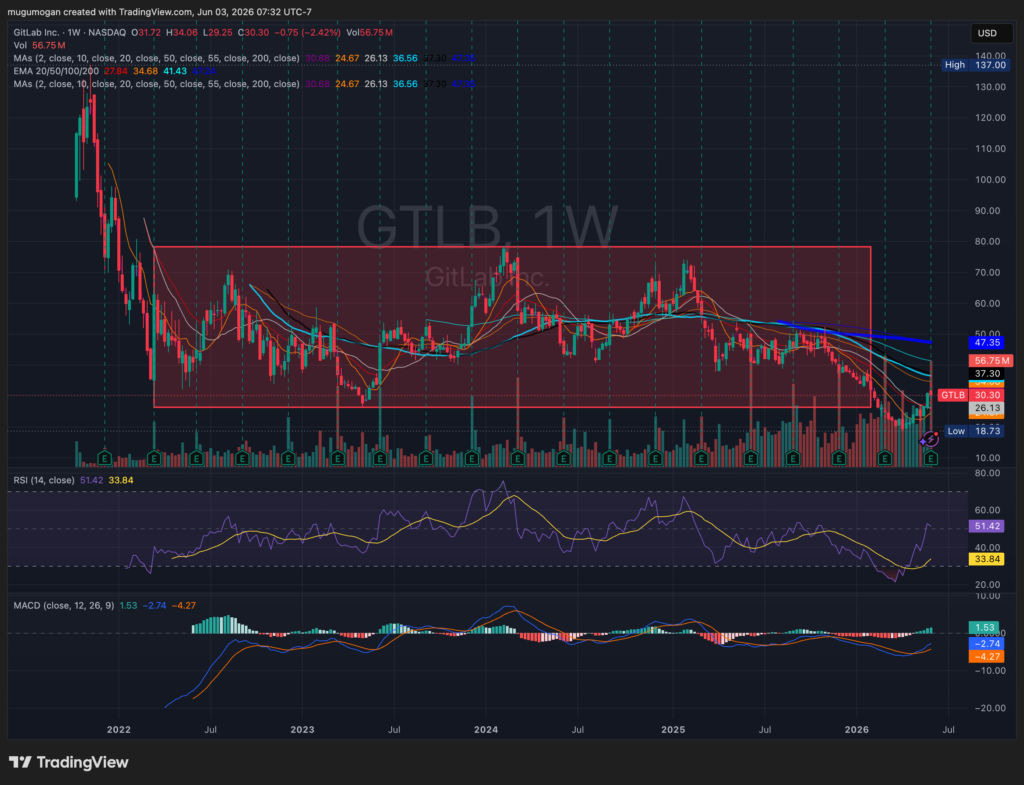
GTLB remains trapped in a four-year trading range between roughly $19 and $79, with every rally since the IPO failing near the upper resistance zone. The recent bounce from the range lows is constructive, and weekly RSI and MACD have turned higher, suggesting momentum is improving after a prolonged decline. The stock remains neutral until it can reclaim the 50-week moving average near $37 and eventually break above $79, but the risk/reward is becoming more favorable near the bottom of the range than it has been in years.