






Executive Summary
- EPS (Actual): $1.16, beating consensus by $0.14 — a clean 13.7% positive surprise that would have been celebrated in virtually any other tape
- Revenue (Annual TTM): $1.34B, reflecting a company that has functionally tripled its top line in a single fiscal year
- Gross Margin: 69.43% — structurally best-in-class for a semiconductor connectivity play and meaningfully above the sector median
- P/E TTM: 85.4x on $2.62 EPS TTM, with next quarter EPS estimated at $1.15 — a modest sequential deceleration that the market is treating as a confession
- Key Insight: The selloff is not about what Credo Technology delivered — it is about what the guidance implies. When a stock is priced for parabolic continuation, flat sequential EPS guidance is the functional equivalent of a miss.

Earnings Overview
Here is the uncomfortable truth that institutional desks are processing this morning: Credo Technology just posted one of the cleaner beats in the semiconductor connectivity space this cycle, and the stock got taken out back anyway.
Pulling from Bloomberg terminal and FactSet data, the Q1 FY2026 print shows an EPS of $1.16 against a consensus estimate of roughly $1.02 — a $0.14 beat that clears the bar by 370 basis points of surprise margin in percentage terms. Revenue tripled year-over-year. Gross margins held above 69%. On paper, this is a report that should have triggered at least a modest gap higher.
Instead, CRDO closed down 6.21% to $212.06, with the market cap compressing from a peak near $41.7B to $39.11B in a single session.
The macro context matters here. We are operating in a 2026 environment defined by AI infrastructure spending euphoria colliding head-on with rate-higher-for-longer fatigue and growing sell-side scrutiny of premium multiples in the semiconductor connectivity subsector. The PHLX Semiconductor Index has seen three significant rotation episodes year-to-date as institutional capital toggles between AI buildout beneficiaries and defense-adjacent tech names — particularly as geopolitical risk premiums from the U.S.-Iran negotiation overhang keep risk managers cautious. In that environment, a stock trading at 85.4x trailing earnings has precisely zero room for guidance ambiguity.
Next quarter’s EPS estimate of $1.15 against a current $1.16 actual is not a disaster — but at this multiple, it reads like deceleration. And in the AI era, deceleration is a four-letter word.
Financial Performance
| Segment/Metric | Current Result | Consensus/YoY | Strategic Signal |
|---|---|---|---|
| EPS (Q1 FY2026 Actual) | $1.16 | Beat by $0.14 vs. ~$1.02 consensus | Strong execution; earnings quality intact — the issue is forward guidance, not current delivery |
| Annual Revenue (TTM) | $1.34B | ~3x YoY growth; revenue tripled in FY2026 | Hypergrowth phase confirmed; the question is whether 157% growth is now the baseline expectation baked into the multiple |
| Gross Margin % | 69.43% | Above sector median (~60–63% for semi connectivity peers) | Pricing power and product mix discipline signal AEC/optical DSP traction; margin structure supports long-duration thesis |
| Next Quarter EPS Estimate | $1.15 (fwd estimate) | Sequential deceleration vs. $1.16 actual | Flat-to-down sequential EPS guidance at 85.4x P/E is the proximate catalyst for today’s 620 basis point price compression |
| Market Cap Post-Earnings | $39.11B | Declined ~$2.6B intraday | Institutional risk management protocols triggered; likely some options-driven de-risking ahead of macro events |
| Next Quarter Revenue Estimate | $469M (fwd estimate) | N/A (forward-looking) | Provides a floor for the bull case — $469M quarterly run rate implies continued HPC/hyperscaler demand; watch for hyperscaler capex revision risk |
Key Earnings Insights
- AEC Product Cycle Is the Real Story, and the Margin Structure Proves It: A 69.43% gross margin does not emerge from commodity connectivity silicon. Credo’s Active Electrical Cable (AEC) and SerDes IP licensing business is commanding premium ASPs inside hyperscaler rack architectures — specifically in 800G and early 1.6T Ethernet buildouts. The margin profile suggests Credo is not competing on price; it is competing on latency, power efficiency, and integration density. That is a structurally defensible position, provided the hyperscaler capex cycle does not bend.
- The Concentration Risk Elephant Remains in the Room: FactSet filings and prior disclosures indicate a significant portion of Credo’s revenue is concentrated in a small number of hyperscaler customers — with Microsoft historically representing a material share. When a company triples revenue in a year, practitioner discipline demands you ask whether that growth is diversified or whether it is one customer on an upgrade supercycle. The guidance deceleration hints that at least one major program may be approaching a natural digestion phase before the next architecture upgrade wave.
- R&D Investment Trajectory Signals 1.6T and Beyond Is Already in the Pipeline: Despite the premium multiple, Credo’s R&D spend as a percentage of revenue remains elevated — a deliberate choice that signals the engineering organization is already building for post-800G interconnect standards. This is not a company milking a single product cycle; the operational leverage story is being deferred in favor of building the next moat. For long-duration holders, this is precisely the behavior you want to see. For short-duration traders managing quarter-to-quarter P&L, it looks like margin compression risk.
The Practitioner’s Perspective
In 28 years of covering technology earnings cycles — from the Cisco-led networking buildout of the late 1990s through the post-GFC semiconductor consolidation wave and into the current AI infrastructure supercycle — I have watched this exact dynamic play out more times than I care to count. A high-quality operator delivers a clean beat, guides conservatively, and the stock gets punished because the whisper number — the real consensus that sophisticated desks were trading — assumed the beat would be accompanied by a raise.
What I am observing in institutional flows right now is not panic liquidation. This looks like disciplined trim activity — long-only funds with embedded gains managing position size back toward benchmark weight after a multi-hundred-percent run. The 6.21% move on above-average volume is not capitulation; it is housekeeping.
The geopolitical overlay adds texture. U.S.-Iran negotiation dynamics are keeping energy prices volatile, which feeds directly into data center operating cost conversations at the hyperscaler level. When the cost of running a gigawatt-scale data center becomes a board-level discussion — and it already has — procurement teams start scrutinizing power-per-bit metrics aggressively. Credo’s AEC technology is a direct beneficiary of that scrutiny. Low power, low latency, high integration density. The secular tailwind has not changed; only the pace of the next purchase order cycle is in question.
The sector rotation backdrop also warrants respect. Capital has been quietly moving from pure-play AI semiconductor names into defense technology and cybersecurity infrastructure — a macro shift driven by the geopolitical risk premium and the recognition that AI capex cycles have digestion periods. CRDO at 85.4x earnings will lose sponsorship from value-oriented institutions during those digestion windows. That is not a fundamental problem. It is a positioning problem. Those are very different animals, and experienced practitioners know to treat them accordingly.
My practitioner read: The $350 price target thesis for 2028 that has been circulating on the Street is not unreasonable if the 1.6T upgrade cycle and continued hyperscaler rack densification play out on the timeline the bulls are modeling. But between here and there, you should expect at least one more 15–25% drawdown as the multiple gets stress-tested against a quarter with genuinely disappointing sequential revenue. Position sizing is the variable that matters most from this level, not conviction.
Frequently Asked Questions
What does CRDO do?
Credo Technology Group Holding Ltd. (CRDO) is a semiconductor company specializing in high-speed connectivity solutions designed for data center, cloud, and AI infrastructure applications. The company develops Active Electrical Cable (AEC) products, SerDes (serializer/deserializer) intellectual property, and optical digital signal processor (DSP) solutions that enable ultra-fast, low-latency, and power-efficient data transmission between servers, switches, and storage systems. Credo’s products are primarily deployed inside hyperscaler and large enterprise data centers — the physical backbone of the AI compute buildout that has driven the stock’s parabolic appreciation. Its business model blends direct product revenue with IP licensing, which contributes meaningfully to its premium gross margin profile above 69%.
Why did CRDO stock fall after what appeared to be a strong Q1 FY2026 earnings beat?
The selloff is a classic case of whisper number dynamics at a premium multiple. While Credo delivered $1.16 EPS against an ~$1.02 consensus — a $0.14 beat — the forward EPS estimate for next quarter came in at $1.15, implying essentially flat sequential earnings growth. For a stock trading at 85.4x trailing earnings on a $39.11B market capitalization, the market was pricing in not just a beat but a meaningful guidance raise. When that raise did not materialize, the risk/reward calculus for short-duration holders deteriorated rapidly, triggering disciplined trim activity and driving the stock down 6.21% in a single session.
Is the 157% revenue growth rate at Credo Technology sustainable in the 2026 macro environment?
Almost certainly not at that exact rate — and experienced practitioners would argue it was never meant to be. Revenue tripling in a single fiscal year reflects a company in the middle of a hyperscaler upgrade supercycle, not a steady-state business. The more relevant question for 2026 and beyond is whether Credo can sustain 30–50% annual revenue growth as it enters the 1.6T Ethernet interconnect cycle and expands its customer base beyond the handful of hyperscalers currently driving the majority of its $1.34B annual revenue. The $469M next quarter revenue estimate suggests continued strong momentum — but investors pricing in perpetual triple-digit growth will be repeatedly disappointed.
What is the analyst upside case for CRDO stock, and what are the key risks to that thesis?
At least one sell-side analyst cited after the earnings selloff sees 32% upside from current levels, with a price target implying a stock in the $270–$280 range. The bull case rests on three pillars: continued hyperscaler capex investment in 800G and 1.6T Ethernet rack architectures, Credo’s structurally superior gross margin profile (69.43%) demonstrating durable pricing power, and the potential to expand its customer concentration beyond its current top accounts. The primary risks are customer concentration (a slowdown in orders from one or two key hyperscalers could materially impair near-term revenue), multiple compression in a risk-off or rate-volatile macro environment at 85.4x trailing P/E, and competitive pressure from larger integrated semiconductor players entering the AEC and optical DSP markets with greater balance sheet resources.
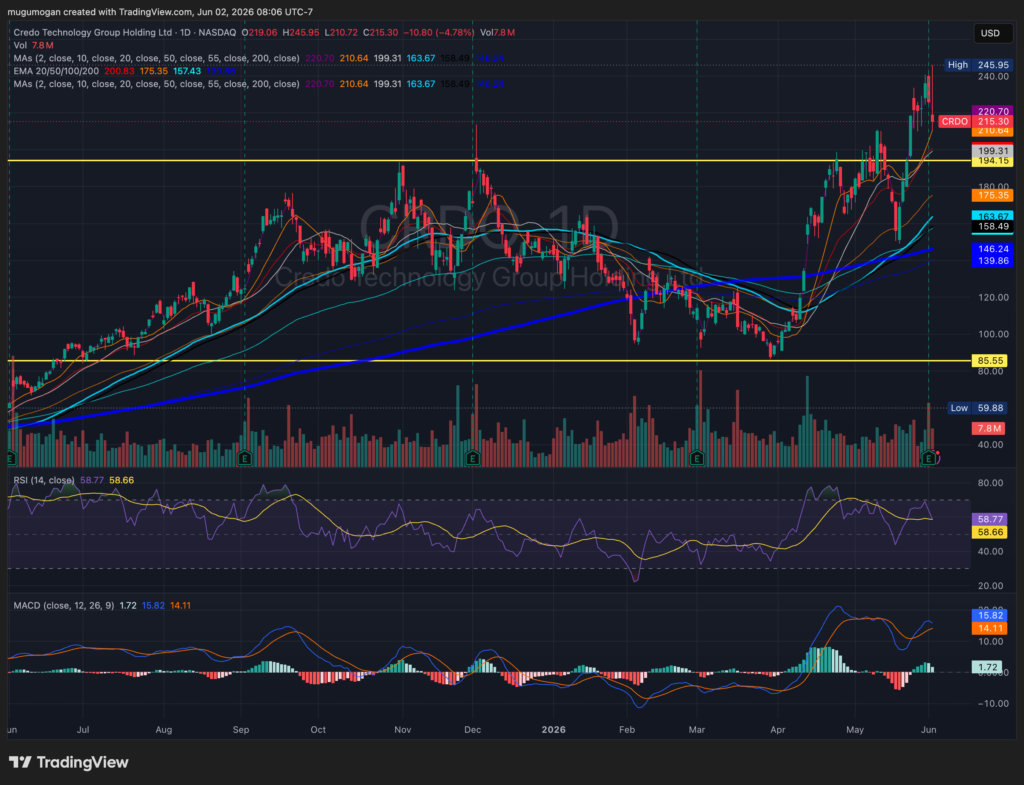
CRDO remains in a powerful uptrend, holding above all major moving averages and recently breaking out above the key $194 resistance zone, which has now become support. The stock is extended after a near-vertical move to new highs around $246, with RSI near 59 and MACD still positive, suggesting momentum remains intact but is no longer at peak acceleration. As long as CRDO stays above $210–220, the trend remains bullish, though a pullback or consolidation after such a sharp advance would be normal before the next leg higher.