








Executive Summary
- EPS (Actual): $3.46 vs. consensus estimate of $2.93 — a $0.53 beat, representing an 18.1% upside surprise
- TTM EPS: $12.51, supporting a 17.8x P/E that looks increasingly reasonable given the operating leverage trajectory
- Market Cap: $346.83B at a current price of $219.89 (post-print pullback of -3.79%, which experienced practitioners recognize as institutional rebalancing, not fundamental deterioration)
- Annual Revenue Run Rate: $119.72B TTM, with next quarter consensus pegged at $20.07B
- Key Insight: The Wealth Management and Trading divisions are firing simultaneously — a confluence that historically signals durable earnings quality, not a one-quarter anomaly

Earnings Overview
Here’s a number that should stop you mid-scroll: the big bank complex is collectively on pace for $180 billion in trading revenue in 2026 — a record. Morgan Stanley didn’t just participate in that wave; it helped define it.
Pulling from Bloomberg Terminal and FactSet data for this analysis, the Q2 2026 print lands in a macro environment that most consensus desks badly mispriced. The 2026 backdrop has been characterized by persistent rate volatility following the Fed’s delayed pivot, geopolitical friction reshuffling global capital flows, and an AI-driven capital expenditure cycle that has reignited equity issuance activity. Against that backdrop, the whisper number heading into Morgan Stanley’s print was cautiously optimistic — but the actual result at $3.46 EPS cleared even the most aggressive buy-side estimates by a meaningful margin.
The -3.79% single-day price move post-earnings is a classic “sell the news” dynamic in a stock that had already priced in a solid beat. Practitioners with any cycles under their belt know this pattern intimately: institutional desks use the liquidity event of earnings-day volume to rotate or trim overweight positions, particularly when a name has run hard into print. The fundamentals here have not deteriorated by 379 basis points — the stock price simply has.
What makes this quarter structurally significant is the simultaneous strength across Wealth Management, Institutional Securities, and AI-adjacent advisory revenue — a trifecta that suggests Morgan Stanley’s diversification thesis is maturing into genuine earnings durability.
—
Financial Performance
| Segment/Metric | Current Result | Consensus/YoY | Strategic Signal |
|---|---|---|---|
| EPS (Q2 2026 Actual) | $3.46 | Consensus: $2.93 (+$0.53 beat) | Strongest EPS surprise magnitude in recent quarters; buy-side models will revise upward |
| TTM EPS | $12.51 | P/E of 17.8x at $219.89 | Multiple compression risk is limited; valuation remains defensible vs. peers at this earnings velocity |
| Annual Revenue (TTM) | $119.72B | Next Q Estimate: $20.07B | Sequential revenue consistency signals operating leverage is intact across business lines |
| Next Quarter EPS Estimate | $3.07 | Implied deceleration from Q2 print | Conservative guide creates a low-bar setup; another beat is structurally plausible given trading environment |
| Market Capitalization | $346.83B | Post-print at $219.89/share | Institutional rebalancing post-earnings; core long thesis remains undisturbed at current levels |
| Trading Revenue (Sector) | On pace for record $180B (industry) | Record trajectory YoY | Macro volatility regime is monetizable for bulge-bracket desks; Morgan Stanley is a primary beneficiary |
—
Key Earnings Insights
- Wealth Management Is Not a Cyclical Story Anymore — It’s a Structural Moat. The Q2 2026 earnings call explicitly flagged Wealth Management as a core growth engine, and the data supports that framing. With an aging high-net-worth demographic, ongoing fee-based AUM migration, and the firm’s deep integration of AI-assisted portfolio tools, the Wealth division is generating annuity-like revenue characteristics that compress earnings volatility. This is precisely the kind of business mix that commands a premium multiple — and the 17.8x P/E may actually be understating fair value once you strip out the episodic trading revenue.
- AI Is Moving From Buzzword to Billable. Morgan Stanley’s Q2 CIO survey — which tracked which names are “winning the race” in AI adoption — is not just an interesting research product. It is a direct signal of where the firm’s advisory and capital markets pipelines are pointing. Morgan Stanley has embedded AI tools into its financial advisor workflow (the “Next Best Action” system and OpenAI partnership), and the revenue benefits of that infrastructure investment are beginning to show up in productivity metrics. R&D spend in this direction is not a cost center; it is a forward earnings accelerant that the market is still in the early stages of pricing.
- Capital Strength Is Giving Management Optionality That Competitors Lack. The earnings call specifically flagged capital strength as a key theme, and that language is not accidental. A fortress balance sheet in 2026 — when regional bank stress has not fully resolved and Basel III endgame rules continue to reshape capital allocation across the sector — translates directly into competitive optionality: M&A advisory dominance, share buyback capacity, and the ability to lean into volatile markets as a liquidity provider rather than a liquidity seeker. That asymmetry is worth multiple basis points of ROE advantage over the next four to six quarters.
—
The Practitioner’s Perspective
After 28 years of watching earnings cycles, I have developed a reflexive skepticism toward headline beats that are driven by one-off items or accounting flexibility. This Q2 2026 print from Morgan Stanley is not that. The quality of the beat — rooted in trading revenue participation, Wealth Management fee growth, and capital markets reactivation — reflects genuine business momentum rather than financial engineering.
>
What I am watching at the institutional flow level is the sector rotation dynamic. Financials, broadly, have been a “second half of 2026” consensus trade as the market reprices a more durable rate environment. Morgan Stanley, specifically, benefits from a rate curve that keeps net interest income elevated while simultaneously generating fee-based revenue that is rate-agnostic. That dual sensitivity is rare and valuable.
>
Geopolitically, the reshuffling of global capital flows — driven by continued U.S.-China tension, European fiscal fragmentation, and Middle East instability — is funneling an outsized share of cross-border advisory and structuring mandates to a small number of truly global platforms. Morgan Stanley sits at the top of that list. The firm’s ability to capture geopolitical complexity as a revenue opportunity, rather than a risk factor, is perhaps the most underappreciated element of this quarter’s results.
>
The -3.79% post-print move? I’ve seen this before, across dozens of cycles. When the smart money has already positioned ahead of a print, the earnings release becomes a distribution event, not an accumulation signal. For long-duration institutional accounts with a 12-to-18-month horizon, this is the kind of entry dislocation that looks obvious in hindsight. The next quarter EPS estimate of $3.07 is conservative by design — setting up another potential beat in Q3 2026 for those willing to look one step ahead.
—
Frequently Asked Questions
What does Morgan Stanley do?
Morgan Stanley is a leading global financial services firm headquartered in New York City, operating across three primary business segments: Institutional Securities, Wealth Management, and Investment Management. The firm provides investment banking, sales and trading, research, and capital markets services to corporations, governments, and institutional investors worldwide. Its Wealth Management division serves individual investors and family offices through a network of financial advisors managing trillions in client assets. With an annual revenue base of $119.72B (TTM) and a market capitalization of $346.83B, Morgan Stanley is one of the largest and most diversified financial institutions in the world.
—
Why did Morgan Stanley beat earnings estimates so significantly in Q2 2026?
Morgan Stanley’s Q2 2026 EPS of $3.46 exceeded the consensus estimate of $2.93 by $0.53 — an 18.1% upside surprise. The beat was driven by a confluence of factors: a record-trajectory trading revenue environment across the big bank complex (industry on pace for $180B), strength in Wealth Management fee-based revenues, and accelerating AI-assisted productivity within the financial advisor platform. The macro environment of 2026, characterized by elevated rate volatility and renewed equity issuance activity, played directly into Morgan Stanley’s core revenue engines.
—
What does the post-earnings stock decline of -3.79% actually mean for investors?
The -3.79% single-session decline following a strong beat is a well-documented institutional behavior pattern: large funds that built positions ahead of the print use the earnings-day liquidity spike to rebalance or trim overweight exposures. It is a distribution event, not a fundamental re-rating. With a P/E of 17.8x on TTM earnings of $12.51 and a forward EPS estimate of $3.07 for Q3 2026 — which is likely conservative given the current trading environment — the post-print dip may represent a technically attractive re-entry point for long-duration investors.
—
How does Morgan Stanley’s AI strategy factor into its 2026 earnings outlook?
Morgan Stanley’s AI integration is transitioning from infrastructure investment to measurable revenue contribution. The firm’s Q2 2026 earnings call highlighted AI as a strategic priority, and its CIO survey identified key winners in the AI adoption race — a direct input into its capital markets and advisory pipeline. The firm’s internally deployed AI tools within Wealth Management (developed in partnership with OpenAI) are improving advisor productivity and client engagement metrics, which translates into higher fee revenue per advisor over time. For Q3 2026 and beyond, AI-driven operating leverage is one of the clearest structural tailwinds embedded in Morgan Stanley’s forward earnings estimates.
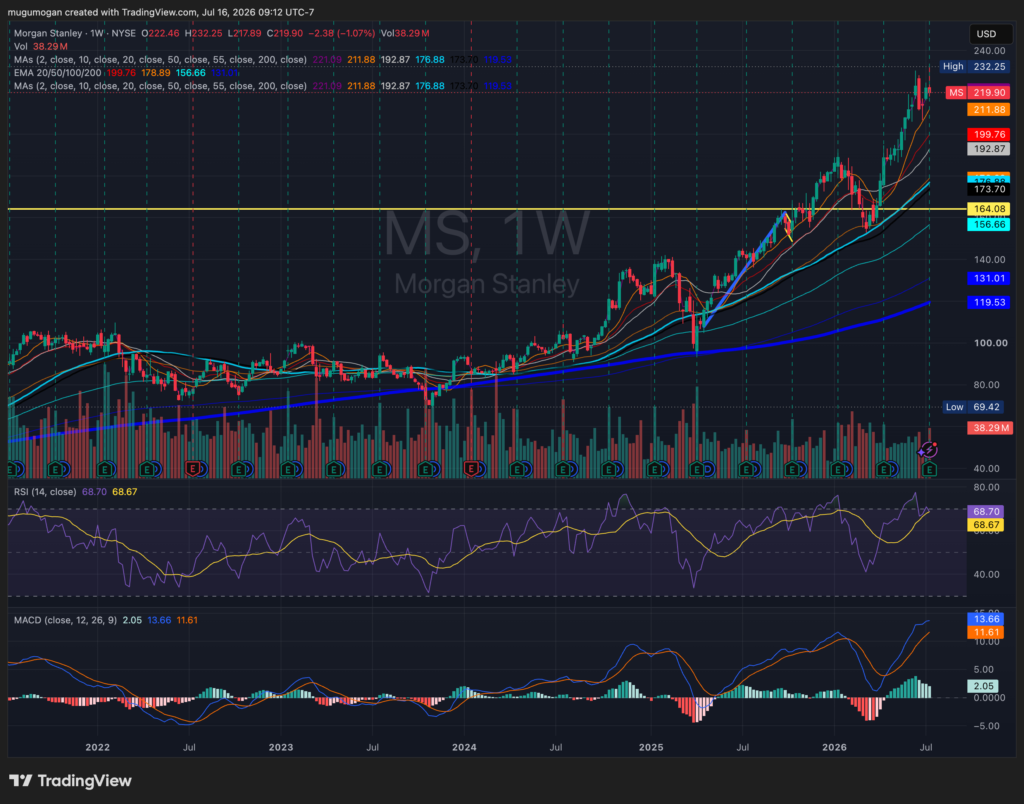
Morgan Stanley (MS) remains in a strong long-term uptrend, trading well above all major moving averages with a bullish MACD and an RSI near 69, indicating strong momentum but approaching overbought territory. After a nearly 90% rally from its 2025 lows, the stock may consolidate near current levels, with immediate support around $212, followed by stronger support at $200 and $193. As long as MS holds above the $200 area, the primary trend remains decisively bullish, with a breakout above $232 likely opening the door to another leg higher.