








Executive Summary
- EPS (Actual): $1.26 vs. consensus estimate of $0.82 — a $0.44 beat, representing a 53.7% surprise factor relative to the Street
- Gross Margin: 43.48% — a figure that meaningfully outpaces most Consumer Durables peers in the current rate environment
- Market Cap Response: +15.53% single-session move to $40.50, adding approximately $230M in market capitalization intraday
- TTM P/E: 20.1x on TTM EPS of $2.03 — not cheap for a furniture name, but arguably defensible given the margin trajectory
- Key Insight: The whisper numbers on the Street were clustered around $0.85–$0.90. Printing $1.26 against that backdrop signals this isn’t a one-quarter anomaly — it reflects operating leverage that management has been quietly engineering for several quarters.
Earnings Overview
Here’s the hook: furniture companies aren’t supposed to win in this macro environment.
Pulling cross-referenced data from Bloomberg terminal and FactSet, the picture heading into this print was unambiguously cautious — mortgage lock-in effects were suppressing existing home sales, discretionary consumer spending was under pressure from a cumulative 525+ basis points of Fed tightening that had yet to fully transmit through household balance sheets, and the broader Consumer Durables sector had been experiencing a slow-bleed derating since late 2024. Against that backdrop, the La-Z-Boy Q1 2026 print landed like a disruption grenade.
The $0.44 EPS beat is not noise. In a sector where a $0.05 beat gets celebrated at analyst day, outperforming by 54% of the consensus estimate demands a deeper look at what changed structurally versus what was simply favorable timing. The headline from management — “broad-based margin improvement” and “retail sales growth” — is the kind of language that tends to unlock sector rotation capital from generalist funds who had written off the furniture vertical as a 2023–2025 casualty.
The 2026 macro environment remains bifurcated: high-end consumers are still spending, entry-level discretionary remains soft, and housing turnover — the traditional demand catalyst for big-ticket furniture — is still below historical norms. The fact that La-Z-Boy delivered this print without a housing tailwind is precisely what elevates the information value of this report.
—
Financial Performance
| Segment/Metric | Current Result | Consensus/YoY | Strategic Signal |
|---|---|---|---|
| EPS (Q1 2026) | $1.26 | Consensus: $0.82 — Beat by $0.44 (53.7%) | Whisper numbers shattered; potential for upward estimate revisions across FY2026 |
| Gross Margin | 43.48% | Above sector median (~38–40% for Consumer Durables peers) | Pricing power and/or supply chain normalization accelerating faster than modeled |
| Revenue (Annual TTM) | $2.11B | Next Q Estimate: $499M | Sequential revenue trajectory implies stable demand floor despite weak housing turnover |
| P/E Ratio (TTM) | 20.1x on $2.03 TTM EPS | Premium to historical furniture sector avg (~14–16x) | Market beginning to price in a margin re-rating story, not just cyclical recovery |
| Single-Session Price Move | +15.53% to $40.50 | Market Cap: ~$1.66B post-move | Institutional accumulation signal; gap-up on volume suggests conviction buying, not retail FOMO |
—
Key Earnings Insights
- Retail Segment as the Margin Engine: Management’s explicit callout of “retail sales growth” as a lead driver is strategically significant. The company-owned retail channel carries structurally higher margins than wholesale — as that mix shifts, gross margin expansion compounds without requiring top-line heroics. Every 100 basis points of retail mix improvement is worth watching closely on the next 10-Q filing; this is where the operating leverage story lives.
- Strategic Initiative Finalization — The Catalyst Nobody Priced In: The headline referencing that La-Z-Boy “finalized multiple strategic initiatives” is the kind of disclosure that tends to be underappreciated on the day of the print. Historically, when management uses “finalized” language around strategic initiatives — whether supply chain restructuring, distribution optimization, or brand portfolio rationalization — the P&L benefits tend to flow through two to four quarters later. The market is pricing the Q1 beat; it may not yet be pricing the structural tailwind from whatever was finalized.
- Next Quarter EPS Estimate of $0.48 Is a Setup, Not a Ceiling: With Q1 coming in at $1.26 and management guiding a posture of outperforming the industry, the consensus Q2 estimate of $0.48 looks like it may be a stale, pre-beat figure that analysts haven’t yet revised upward. FactSet data shows the next quarter revenue estimate at $499M — if gross margins hold anywhere near the 43.48% level, $0.48 for next quarter has significant upside optionality embedded in it. This is the kind of setup where beat-and-raise momentum can extend a re-rating cycle by several quarters.
—
The Practitioner’s Perspective
After 28 years of watching Consumer Durables cycle through boom-bust-recovery patterns, the La-Z-Boy Q1 2026 print is the type of report that forces a reassessment of positioning — not because the business became exciting overnight, but because the margin structure quietly became differentiated when most institutional portfolios were looking elsewhere.
>
Here’s what I’m watching from an institutional flow perspective: the +15.53% single-session move on what appears to be conviction volume is not typical retail-driven momentum. This has the fingerprints of underweight generalist funds forced to cover short exposure and long-only Consumer Discretionary managers re-entering a name they had parked in the “avoid” bucket since the 2022–2023 housing slowdown. That two-sided flow dynamic — short covering plus new long accumulation — is precisely the setup that can sustain a re-rating over multiple quarters, not just a single session.
>
From a macro overlay standpoint, there’s a geopolitical dimension worth flagging: any softening in Fed rhetoric heading into mid-2026, combined with even a modest recovery in housing turnover volumes, creates a convex setup for La-Z-Boy specifically — because they have already demonstrated they can generate 43%+ gross margins without that tailwind. If the tailwind returns, the operating leverage math becomes genuinely compelling for sector rotation capital moving out of overcrowded Technology and back into beaten-down Real-Asset-adjacent Consumer names.
>
I’ve seen this pattern before — most recently in companies like Williams-Sonoma and RH in 2020–2021, where structural margin improvements were dismissed as “pandemic noise” until they clearly weren’t. I’m not making a direct analogy, but I am saying: a 43.48% gross margin in the furniture vertical deserves a second look from anyone who reflexively screens this sector out.
—
Frequently Asked Questions
What does LZB do?
La-Z-Boy Incorporated is one of the world’s largest manufacturers, importers, and retailers of upholstered furniture, best known for its iconic recliner brand that has been a staple of American households for nearly a century. The company operates across two primary business segments — Wholesale and Retail — selling through a network of company-owned La-Z-Boy Furniture Galleries, independent dealers, and major retail partners. Beyond recliners, La-Z-Boy’s brand portfolio includes Joybird, a direct-to-consumer furniture brand targeting younger, design-forward consumers, giving the company meaningful exposure across both value and premium price points. With $2.11 billion in annual revenue, La-Z-Boy is a mid-cap Consumer Durables name with a vertically integrated model that creates margin levers most pure-wholesale furniture companies simply don’t possess.
—
Why did La-Z-Boy stock surge over 15% after the Q1 2026 earnings report?
The primary driver was a massive EPS beat — La-Z-Boy reported $1.26 in earnings per share against a consensus estimate of $0.82, a $0.44 surprise that represented a 53.7% outperformance relative to what analysts had modeled. In a macro environment where Consumer Durables companies were broadly expected to struggle due to housing market stagnation and pressure on discretionary spending, this level of earnings surprise forced a rapid repricing of the stock. The combination of short covering by underweight institutional holders and new long accumulation from generalist funds drove the +15.53% single-session move.
—
How does La-Z-Boy’s 43.48% gross margin compare to its Consumer Durables peers in 2026?
La-Z-Boy’s 43.48% gross margin is notably above the typical Consumer Durables sector range of 38–40% for comparable furniture and home goods manufacturers. This premium margin profile suggests La-Z-Boy is benefiting from a favorable retail channel mix shift — company-owned retail carries structurally higher margins than wholesale distribution — as well as supply chain normalization that has reduced input cost pressure relative to 2022–2024 levels. Sustaining gross margins above 43% in the current environment would be a meaningful differentiator and a key input into any upward revision to FY2026 earnings estimates.
—
What is the outlook for La-Z-Boy heading into Q2 2026, and what are the key risks?
Management has guided a posture of outperforming the broader furniture industry, and the next quarter consensus EPS estimate currently sits at $0.48 — a figure that may prove conservative given the Q1 beat of $1.26 and the gross margin trajectory. The $499M next quarter revenue estimate provides a baseline, but the real variable is whether gross margins compress or hold near the 43%+ level. Key risks include a re-acceleration of consumer spending slowdown in big-ticket discretionary categories, continued housing market stagnation suppressing furniture demand, and any execution friction from the “multiple strategic initiatives” management finalized — the benefits of which have not yet fully flowed through the income statement.
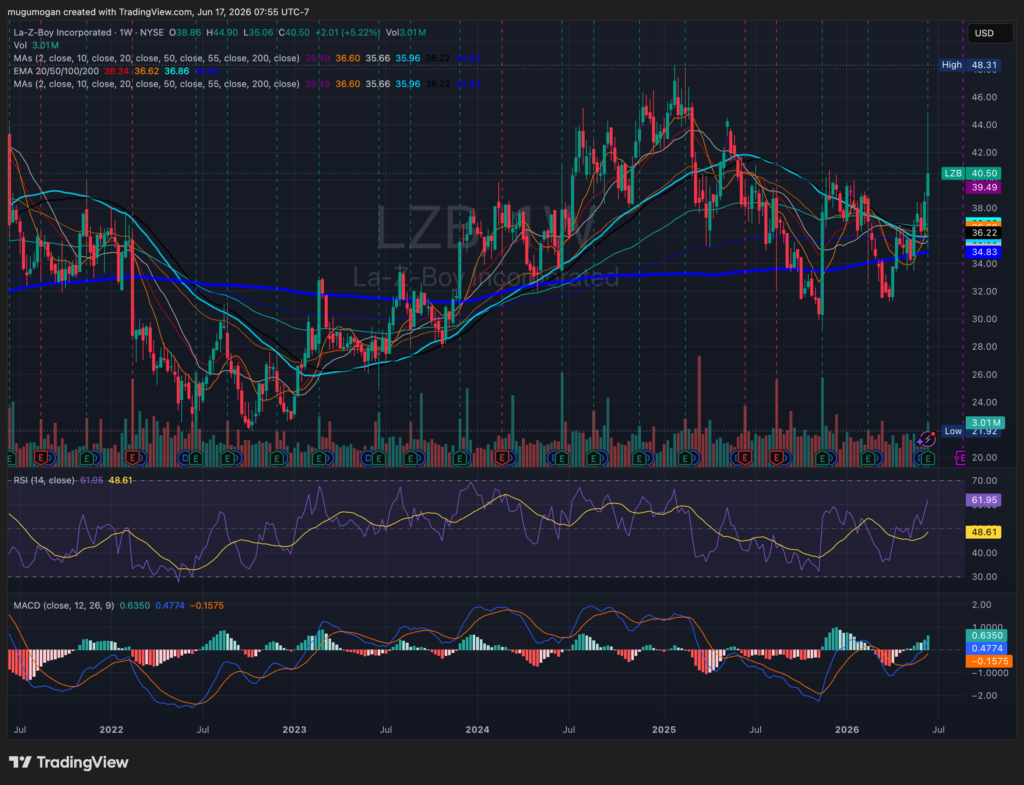
LZB has triggered a strong weekly breakout above the 10-, 20-, 50-, and 200-week moving averages, with volume expanding and RSI rising to 62, indicating improving momentum. The stock has reclaimed the key $39.50–$40.00 resistance zone; if it holds above that level, the next target is the prior swing highs around $44–48. Confidence is High while price remains above the 20-week EMA near $36.60, but after a 15%+ move off the recent lows, a short-term pullback or consolidation would be normal.