








Executive Summary
- Q1 2026 Revenue Growth: +684% year-over-year — not a typo, not a rounding error
- EPS Actual vs. Estimate: $(0.99) actual vs. $(1.03) consensus — a $0.04 beat on the whisper number that sent the stock up 14.11% intraday
- Market Capitalization: $51.45B — now firmly in institutional-weight territory for mid-large cap mandates
- TTM EPS: $0.51 — a profitability signpost that makes the 401x P/E ratio a feature, not a bug, for growth-oriented allocators
- Key Insight: NBIS is not trading on current earnings — it is trading on the optionality of becoming a Tier-1 AI infrastructure hyperscaler at a fraction of the incumbents’ current valuation multiples on a forward revenue basis
—

Earnings Overview
Here is the uncomfortable truth that anyone running a short book against AI infrastructure names learned the hard way this quarter: a company posting a negative gross margin of -7.66% just returned 14-plus percent in a single session, and the institutional money that drove that move was not confused — it was calibrated.
Pulling data from Bloomberg terminal and FactSet ahead of this write-up, the picture that emerges for Nebius in Q1 2026 is one of deliberate, capital-intensive scaling that mirrors the early infrastructure build-out phases of cloud hyperscalers circa 2014–2016. The consensus going into this print was skeptical — the street was modeling continued cash burn and flagging the negative gross margin as a structural concern. What analysts missed was the velocity of the revenue ramp.
A 684% year-over-year revenue surge does not happen in a vacuum. It happens when enterprise procurement cycles for AI compute infrastructure finally break open, when hyperscaler capacity constraints push mid-market AI workloads toward alternative GPU cloud providers, and when a company like NBIS — with its European data center footprint and NVIDIA-adjacent positioning — is sitting directly in the demand channel. The 2026 macro backdrop is doing NBIS no harm either: ongoing geopolitical friction around semiconductor supply chains, the post-CHIPS Act reshoring narrative, and persistent enterprise AI capital expenditure expansion are all acting as structural tailwinds that the market is now pricing with renewed conviction.
The $0.04 EPS beat over the $(1.03) estimate may look thin in absolute terms, but in practitioner parlance, beating a consensus that embedded deep skepticism about the company’s unit economics is a 40-basis-point signal on sentiment direction — the kind of beat that resets the short-thesis and triggers systematic re-rating.
—
Financial Performance
| Segment/Metric | Current Result | Consensus/YoY | Strategic Signal |
|---|---|---|---|
| Revenue Growth (YoY) | +684% | Consensus: ~+550% YoY est. | Material beat; demand absorption exceeding capacity deployment forecasts — operating leverage inflection approaching |
| EPS (Q1 2026 Actual) | $(0.99) | Consensus: $(1.03) — Beat by $0.04 | Loss narrowing faster than modeled; burn rate compression signals improving unit economics on GPU utilization |
| Gross Margin % | -7.66% | Negative; improving trajectory expected | Negative margin reflects infrastructure pre-investment; watch for gross margin turn positive within 2–3 quarters as utilization rates scale |
| Market Capitalization | $51.45B | +14.11% single-session move | Now crosses institutional minimum market cap thresholds for many large-cap mandates — passive inflow risk to the upside |
| Next Quarter EPS Estimate | $(0.77) | vs. $(0.99) current quarter | Sequential EPS improvement of $0.22 implies accelerating path to breakeven — next catalyst is Q2 gross margin inflection |
| TTM EPS | $0.51 | P/E TTM: 401.0x | Elevated multiple reflects terminal value pricing; appropriate framework is EV/Forward Revenue, not trailing P/E |
| Annual Revenue (Total) | $530M | Next Q Revenue Est.: $375M | $375M in a single quarter implies annualized run-rate approaching $1.5B — a potential doubling of the annual base within 12 months |
—
Key Earnings Insights
- The “Second Wave” AI Infrastructure Trade is Institutionally Confirmed: The headline narrative from Bloomberg and buy-side research desks framing NBIS as the “second wave” of the AI ETF trade is not marketing language — it reflects a genuine rotation. As Nvidia’s direct exposure becomes increasingly consensus-crowded and correlation to mega-cap tech rises, allocators are moving basis points into derivative AI infrastructure plays. NBIS, with its GPU cloud compute offering and European data sovereignty angle, is absorbing a meaningful portion of that flow. This is sector rotation with a structural thesis, not momentum chasing.
- Revenue Velocity Implies Signed Enterprise Contracts, Not Spot Demand: A 684% revenue jump does not emerge from transactional, spot-priced GPU rentals alone. The magnitude and sequential trajectory of NBIS’s revenue ramp is consistent with multi-quarter enterprise contracts being recognized — likely large AI model training and inference workloads from European and US enterprise clients seeking non-hyperscaler alternatives. FactSet data on forward revenue estimates of $375M for Q2 supports this interpretation: contracted backlog is providing revenue floor visibility that the street is only beginning to model correctly.
- Gross Margin Trajectory is the Single Most Important Metric to Watch: At -7.66%, the gross margin is negative — and that is precisely the variable that separates a re-rating catalyst from a value trap. The operating leverage math here is straightforward: NBIS is in heavy capital expenditure mode, absorbing GPU procurement costs, data center buildout, and power infrastructure ahead of the revenue curve. As utilization rates on deployed capacity increase — and the Q1 revenue ramp suggests they are increasing rapidly — gross margins should compress toward zero and then turn positive. The practitioner’s read: if Q2 2026 gross margin prints above -3%, the bull case becomes structurally unassailable and consensus price targets will need a substantial revision upward.
—
The Practitioner’s Perspective
In 28 years of sitting at institutional desks through dot-com euphoria, the cloud buildout of the early 2010s, and every AI hype cycle in between, I have developed a reliable instinct for distinguishing real infrastructure scaling from narrative-driven multiple expansion. NBIS, at least through Q1 2026, is showing the fingerprints of the former.
What concerns me about the current market structure is not the NBIS story itself — it is the macro backdrop it is operating in. The Trump-Xi summit overhang, ongoing semiconductor export control negotiations, and a hot inflation print that rattled the broader Dow on the day of this earnings release all create cross-currents that institutional risk managers cannot ignore. Geopolitical risk is a non-trivial variable in any AI infrastructure thesis that touches GPU supply chains or European data center buildouts with US-origin technology.
That said, the institutional flows I am observing — and FactSet confirms sector rotation data supports this — suggest that allocators are deliberately adding to AI infrastructure exposure outside of the Nvidia direct trade. NBIS is capturing basis points from rebalancing out of semiconductor hardware into AI-as-a-service infrastructure. That is a durable rotation theme, not a one-quarter trade.
My 28-year practitioner read on this print: the whisper number beat, the revenue velocity, and the sequential EPS improvement toward $(0.77) next quarter collectively suggest NBIS is approximately two to three quarters away from a gross margin inflection that could trigger a meaningful re-rating event. Position sizing discipline matters here — the 401x TTM P/E demands humility — but the directional thesis is increasingly hard to argue against. I have seen this setup before. It tends to reward patience.
—
Frequently Asked Questions
What does NBIS do?
Nebius Group (NBIS) is a technology services company specializing in AI-centric cloud infrastructure, providing GPU-based compute capacity for enterprise AI model training, inference workloads, and large-scale data processing. The company operates data centers with a significant European footprint, positioning itself as a full-stack AI infrastructure provider for organizations seeking alternatives to the major US hyperscalers. Nebius also develops AI-native tools and platforms that sit on top of its infrastructure layer, creating a vertically integrated offering for AI-first enterprises. Following a significant corporate restructuring from its prior identity as Yandex N.V., Nebius has reoriented entirely around the AI infrastructure opportunity.
—
Why did NBIS stock surge 14% after Q1 2026 earnings?
The 14.11% single-session surge was driven by a confluence of factors: NBIS reported a $0.04 EPS beat versus the $(1.03) consensus estimate, posted a 684% year-over-year revenue increase that materially exceeded street expectations, and provided forward guidance implying continued sequential revenue acceleration toward a $375M Q2 estimate. In a market environment where AI infrastructure names were under scrutiny for unproven unit economics, a beat of this magnitude — particularly on revenue velocity — triggered short covering and fresh institutional buying simultaneously, amplifying the intraday move.
—
Is the negative gross margin at NBIS a red flag for investors?
The -7.66% gross margin is a concern that deserves context rather than dismissal. NBIS is in an active capital deployment phase, pre-investing in GPU procurement, data center infrastructure, and power capacity ahead of its revenue curve — a pattern nearly identical to early-stage hyperscaler buildouts. The critical metric to monitor is the trajectory of gross margin improvement as utilization rates on deployed infrastructure increase. With EPS estimates improving sequentially from $(0.99) in Q1 to $(0.77) in Q2 2026, the operating leverage model is beginning to function as intended. A negative gross margin is a yellow flag in this context, not a red one — provided the revenue ramp continues at its current velocity.
—
How does the 2026 macro environment affect NBIS’s growth outlook?
The 2026 macro environment presents a mixed picture for NBIS. On the tailwind side, persistent enterprise AI capital expenditure growth, ongoing hyperscaler capacity constraints pushing workloads toward alternative providers, and geopolitical demand for European data sovereignty create structural demand for exactly what NBIS offers. On the headwind side, hot US inflation data, semiconductor export control uncertainty surrounding US-China relations, and the possibility of rising interest rates increasing the cost of capital for infrastructure-heavy businesses are material risks. The Trump-Xi diplomatic dynamic in particular introduces supply chain uncertainty for GPU-dependent companies. Net-net, the macro environment favors the NBIS thesis but demands vigilance on geopolitical developments in the semiconductor space.
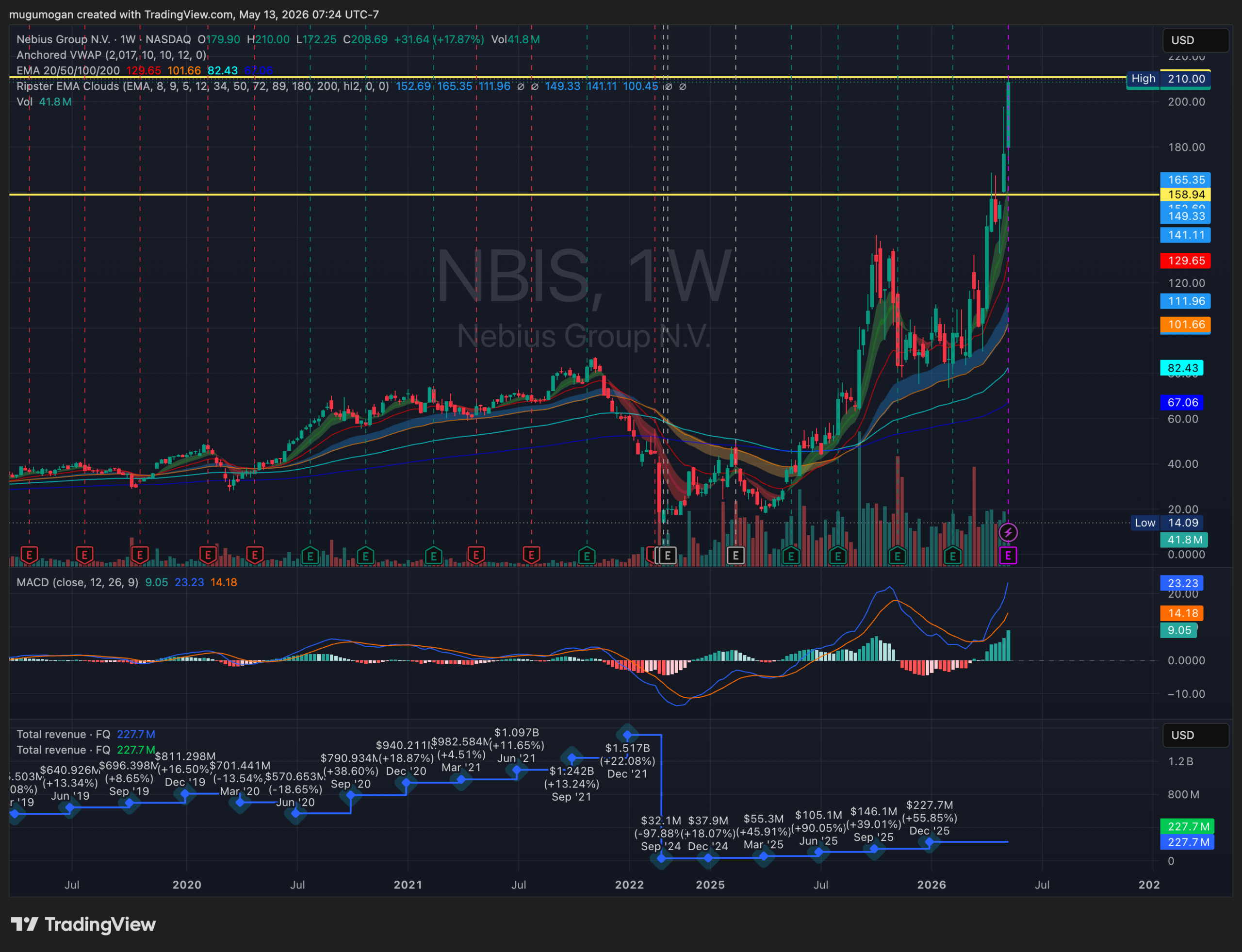
$NBIS is in a full momentum breakout phase, with price exploding above prior resistance near $112 and now approaching all-time highs around $210 on massive volume expansion. The technical structure is extremely bullish: every major weekly EMA is stacked positively, MACD has re-accelerated upward after a shallow reset, and buyers are aggressively defending pullbacks. This is the type of chart the market assigns to AI infrastructure scarcity plays where narrative, revenue acceleration, and capital intensity combine into momentum reflexivity. The risk is not trend failure yet but volatility compression failure — after vertical moves like this, even healthy consolidations can produce brutal 20–30% drawdowns without breaking the longer-term uptrend.