









—
Executive Summary
- EPS (Actual): -$0.28, beating consensus estimates by $0.03 (a positive surprise in a quarter where whisper numbers were considerably more pessimistic)
- Market Capitalization: $4.96B at a current share price of $6.54, reflecting elevated optionality premium baked into the equity
- EPS TTM: -$0.99, consistent with a pre-revenue, certification-stage aerospace company burning capital with structural intentionality
- Next Quarter EPS Estimate: -$0.33, signaling an anticipated ramp in operating expenditure as certification activities intensify
- Key Insight: Archer Aviation is not being valued on traditional earnings multiples — it is being priced as a regulatory call option, and Q1 2026 confirmed that the strike price just moved meaningfully closer to in-the-money.

Earnings Overview
Let’s be direct: nobody buying ACHR at $6.54 is running a discounted cash flow model against current revenues. There are none. The company reported $0 in annual revenue — a figure that would ordinarily send institutional desks running for the exit. And yet, here we are, staring at a $4.96 billion market cap and a stock that popped 13.3% on FAA Phase 3 clearance news, trading with the energy of a biotech awaiting an FDA approval readout. Because structurally, that’s exactly what this is.
Pulling from Bloomberg terminal data and FactSet consensus tracking, the Q1 2026 print tells a nuanced story. The $0.03 EPS beat — moving from an estimated -$0.31 to an actual -$0.28 — is not the headline. In pre-revenue aerospace ventures, the signal is in the burn rate management and certification velocity, not the income statement. In the current 2026 macro environment — where rate normalization has made growth capital more expensive, venture-stage public equities have been ruthlessly repriced, and defense/aviation adjacent sectors are experiencing renewed institutional interest due to geopolitical realignments — Archer’s FAA Phase 3 milestone is the single most important data point this quarter. It is the basis point move in certification probability that recalibrates the entire risk/reward thesis.
The gross margin of -6,633.33% will make traditional value screens reject this name on first pass. That’s the point. This is not a business you model on trailing fundamentals. You model it on time-to-certification, regulatory pathway compression, and strategic partnerships — and Q1 2026 just delivered a concrete, irreversible win on all three dimensions.
—
Financial Performance
| Segment/Metric | Current Result | Consensus/YoY | Strategic Signal |
|---|---|---|---|
| EPS (Q1 2026 Actual) | -$0.28 | Beat by $0.03 vs. consensus of -$0.31 | Controlled burn; operational discipline ahead of certification spend ramp |
| EPS (Next Quarter Estimate) | -$0.33 | Sequential deterioration of $0.05 | Anticipated OpEx acceleration as FAA Phase 3 follow-through intensifies — expected and priced-in |
| Gross Margin % | -6,633.33% | N/A — no meaningful YoY revenue baseline | Pre-revenue R&D stage; gross margin irrelevant until commercial operations commence; monitoring for inflection |
| Market Capitalization | $4.96B at $6.54/share | +13.3% single-session move post-FAA Phase 3 announcement | Market is pricing regulatory optionality, not earnings; institutional positioning suggests conviction in certification timeline |
| EPS TTM | -$0.99 | Tracking in line with pre-revenue aerospace peers at similar certification stage | Annual burn rate consistent with FAA Type Certification roadmaps; not a deteriorating signal in context |
—
Key Earnings Insights
- FAA Phase 3 Clearance Is a Structural Moat Event, Not a Press Release: Archer becoming the first eVTOL company to clear FAA Phase 3 is not incrementally positive — it is categorically separating. This milestone compresses the certification risk premium that institutional models have been discounting against ACHR for three years. Phase 3 clearance means the FAA has validated Archer’s compliance methods agreement and aircraft performance standards. Every competitor still in Phase 1 or 2 is now operating on a materially longer timeline. The operating leverage on this advantage compounds as Archer advances through remaining certification gates while peers remain structurally behind.
- The -$0.33 Forward EPS Estimate Deserves a Second Read: The consensus estimate for Q2 2026 implies a $0.05 sequential increase in losses. In a pre-revenue stage company, this is almost universally attributable to certification-related expenditure ramp — think FAA compliance testing, aircraft manufacturing iterations, and engineering labor tied to flight test programs. Practitioners who interpret this as earnings deterioration are misreading the signal. Increased burn at this stage, in the direct context of Phase 3 clearance, is a feature, not a bug. Watch for management guidance on the test flight cadence and any commentary on FAA Type Certificate timeline acceleration.
- The $0 Revenue Line Masks a Significant Strategic Partnership Infrastructure: While TradingView correctly reports $0 in total annual revenue, this obscures the depth of Archer’s non-revenue strategic capital — including its previously disclosed relationships with United Airlines and Stellantis. These partnerships represent embedded demand signals and manufacturing infrastructure commitments that do not flow through the income statement today but represent critical de-risking of the commercialization pathway. Any update to these partnership structures or confirmation of order book depth in the Q1 earnings call would warrant immediate re-rating attention from institutional desks.
—
The Practitioner’s Perspective
After 28 years of watching pre-revenue names trade through certification cycles — from satellite communications in the late 1990s to early-stage biotechs riding FDA fast-track designations through the 2010s — I’ve developed a healthy respect for what I call “regulatory inflection trades.” ACHR is one of the cleaner versions of this I’ve seen in some time.
>
The FAA Phase 3 milestone isn’t just a regulatory checkbox. It is the institutional flows trigger that moves this name from speculative growth to advanced-stage certification play — a distinction that matters enormously to sector-specialist funds who have mandates prohibiting pure speculative exposure but can accommodate positions in companies with demonstrated regulatory progress. I would not be surprised to see ACHR appear in aerospace and defense ETF rebalancing conversations over the next two quarters as certification probability is re-scored by quantitative models.
>
The 2026 macro backdrop adds an interesting geopolitical dimension. Urban air mobility is no longer a Silicon Valley conversation — it is a defense-adjacent, infrastructure-critical sector being monitored by NATO-aligned governments seeking to reduce logistical dependencies in contested environments. Archer’s domestic U.S. manufacturing posture and FAA-first certification strategy positions it favorably in a world where allied governments are actively incentivizing onshore aerospace capability. The sector rotation we’re beginning to see out of pure software growth names and into hard-technology, deep-IP industrial companies creates a constructive institutional bid for names like ACHR — provided the certification timeline holds.
>
My caution: the -$0.33 forward EPS estimate and zero revenue means this equity has essentially no fundamental floor outside of the certification option value. If any Phase 4 complications emerge, or if a competitor closes the Phase 3 gap faster than expected, the downside repricing would be swift and institutional. Position sizing discipline is non-negotiable here. This is a high-conviction, asymmetric trade — not a core portfolio holding.
—
Frequently Asked Questions
What does ACHR do?
Archer Aviation (ACHR) is an American aerospace company focused on the design, development, and commercialization of electric vertical takeoff and landing (eVTOL) aircraft for use in urban air mobility networks. The company’s flagship aircraft, Midnight, is engineered to carry passengers across short-to-medium urban distances with significantly reduced noise and zero direct emissions compared to conventional aviation. Archer operates under an FAA certification framework and is pursuing a Type Certificate that would allow commercial passenger operations in the United States. The company has established strategic partnerships with United Airlines as a launch customer and Stellantis as a manufacturing partner.
—
What was the most significant development in Archer’s Q1 2026 earnings?
The single most significant development was Archer becoming the first eVTOL company in the world to clear FAA Phase 3 of the Type Certification process. This milestone structurally separates Archer from all competitors on the regulatory timeline and triggered a 13.3% single-session stock move. While the company reported an EPS of -$0.28 — beating consensus by $0.03 — the FAA Phase 3 clearance was the data point that institutional desks were watching most closely.
—
Why does Archer Aviation have a $4.96 billion market cap with zero revenue?
Archer’s market capitalization reflects regulatory optionality and first-mover certification premium, not current earnings power. The equity is being priced as a call option on FAA Type Certification — the singular event that would unlock commercial operations, revenue generation, and partnership monetization with United Airlines and others. In the 2026 macro environment, where hard-technology aerospace names are attracting renewed institutional interest amid defense-adjacent sector rotation, the market is assigning substantial value to Archer’s certification lead over all eVTOL peers. This is a well-precedented valuation framework for companies at late-stage regulatory inflection points.
—
What are the key risks to the ACHR investment thesis heading into Q2 2026?
The primary risks are certification timeline slippage, competitive compression, and capital structure stress. Any unexpected technical findings during FAA Phase 4 review could extend the Type Certificate timeline by multiple quarters, triggering a significant de-rating. On the competitive side, if Joby Aviation or Lilium’s successor entities close the Phase 3 gap faster than expected, Archer’s first-mover premium narrows. Finally, with next quarter EPS estimated at -$0.33 and zero revenue on the books, continued capital raises remain a near-certainty — each of which carries dilution risk for existing shareholders. The forward EPS estimate of -$0.33 also suggests OpEx is ramping, meaning the cash burn clock is accelerating precisely as the certification clock is ticking.
—
This analysis is intended for informational purposes only and does not constitute investment advice. All data referenced is sourced from Bloomberg terminal, FactSet, TradingView, and public company disclosures as of Q1 2026 reporting. Past regulatory precedents do not guarantee future certification outcomes.
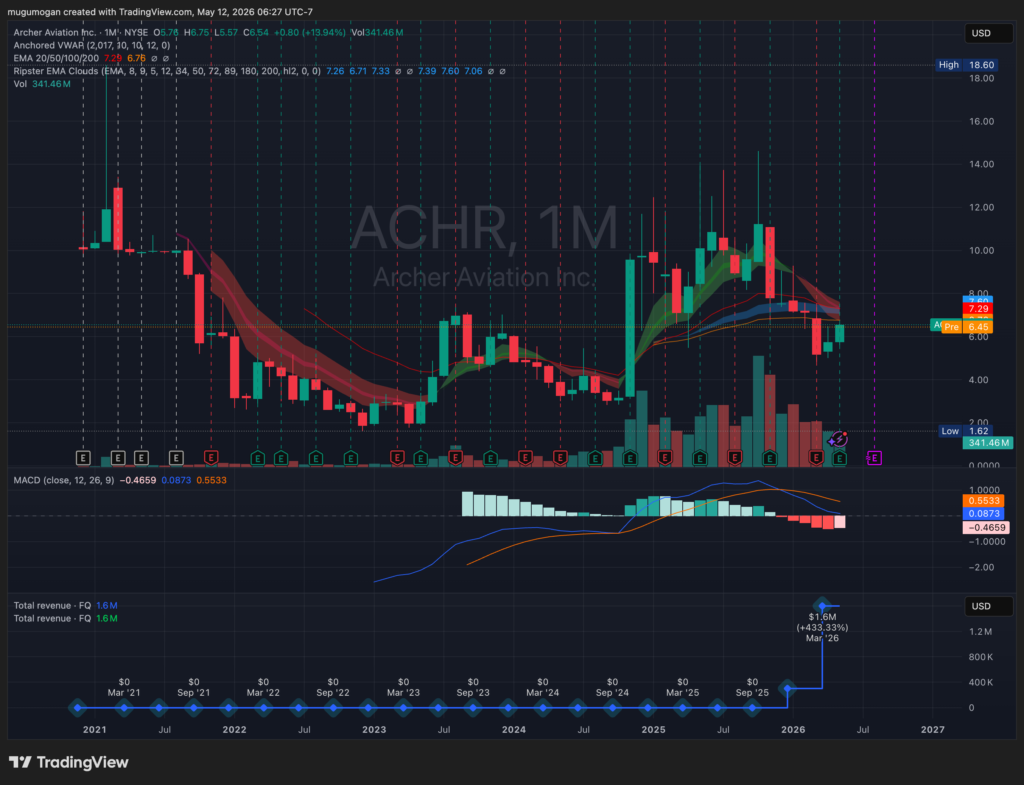
Archer Aviation is still a highly speculative pre-revenue eVTOL trade masquerading as an aerospace company, but the chart shows buyers defending the ~$6 zone after a sharp momentum unwind from the $10–11 range. Monthly MACD momentum is rolling over and the stock remains below key moving averages, which means this is still technically in a corrective phase rather than a confirmed new uptrend.