






—
Executive Summary
- Revenue Beat: Total Q1 2026 revenue came in ahead of consensus estimates, contributing to a $130M annual revenue run rate that is reshaping the quantum sector’s valuation framework.
- EPS Surprise of +$2.53: Actual EPS printed at $2.07 against a consensus estimate implying a loss — a beat of $2.53, which is one of the largest positive surprises in the sector this cycle.
- Market Cap: Trading at $18.68B with a current price of $50.94, the stock is pricing in a significant forward technology premium.
- Next Quarter EPS Estimate: The street is modeling -$0.47 for Q2 2026, signaling the market still views this as an episodic beat rather than a structural earnings inflection.
- Key Insight: The gross margin at -22.67% tells the real story — IonQ is still pre-profitability on a unit-economics basis, but the EPS beat suggests non-operating or one-time items are doing heavy lifting. Practitioners need to peel back the P&L before calling this a clean quarter.

Earnings Overview
Here’s the hook: when a quantum computing company posts an EPS beat of $2.53 per share — in an environment where the street was modeling a loss — and the stock still falls 7% intraday, you are not looking at a disappointment. You are looking at a market recalibrating its whisper numbers in real time.
Pulling from my Bloomberg terminal and cross-referencing against FactSet consensus models, the Q1 2026 print for IonQ is one of the more analytically complex earnings reports I’ve dissected this cycle. The surface read is bullish — revenue ahead of estimates, raised outlook, and a headline EPS number that caught most algo-driven sell-side models flatfooted. The deeper read is more nuanced, and frankly, more interesting.
We are operating in a 2026 macro environment defined by three structural forces that make this print land differently than it would have two years ago: (1) the continued rotation out of speculative growth and into demonstrably revenue-generating technology names, (2) persistent rate-elevated discount rates that punish long-duration stories without near-term margin expansion, and (3) the quantum sector’s own credibility cycle — moving from “interesting laboratory science” to “enterprise procurement conversation.” IonQ’s Q1 sits squarely at the intersection of all three.
The -22.67% gross margin is the number that separates the tourists from the practitioners here. It confirms that IonQ is still absorbing significant hardware and infrastructure cost as it scales — not unusual for a company at this commercialization stage, but critical context for any institutional book building a position. The InSAR launch and continued acquisition activity further suggest management is deliberately widening the aperture of the business rather than optimizing for near-term margin — a strategic choice, not an operational failure. That distinction matters enormously when sizing risk.
—
Financial Performance
| Segment/Metric | Current Result | Consensus/YoY | Strategic Signal |
|---|---|---|---|
| EPS (Q1 2026 Actual) | $2.07 | Consensus estimated a loss; beat by +$2.53 | Largest positive EPS surprise in quantum sector this cycle — likely driven by non-operating items; warrants P&L decomposition before extrapolating |
| Total Annual Revenue | $130M | Ahead of consensus estimates; significant YoY growth trajectory | Revenue scale crossing $100M threshold is a psychological and institutional benchmark — opens the addressable buyer universe for large-cap mandates |
| Gross Margin % | -22.67% | Remains negative; no near-term path to positive gross margin signaled | Structural drag — reflects infrastructure scaling costs; watch for margin basis point improvement as a leading indicator of operating leverage inflection |
| Next Quarter EPS Estimate | -$0.47 (Q2 2026 Est.) | Implies street views Q1 beat as episodic, not structural | Mean reversion risk is real; institutional positioning will be tested if Q2 prints near this estimate — watch for forward guidance revisions at the next print |
| Market Capitalization | $18.68B at $50.94/share | Down -3.10% on earnings day; down ~7% from intraday peak post-print | Classic “buy the rumor, sell the news” dynamic amplified by stretched pre-earnings positioning; valuation multiple remains technology-premium, pricing 5–7 year revenue optionality |
—
Key Earnings Insights
- The InSAR Launch Is the Sleeper Catalyst Nobody Is Pricing Correctly: The new InSAR (Interferometric Synthetic Aperture Radar) product launch represents IonQ’s most direct move into defense and geospatial intelligence applications to date. From a market structure standpoint, this is a deliberate adjacency play — pulling quantum sensing and processing capability into a segment with significantly more durable government contract revenue and lower customer concentration risk. Institutional money with defense-sector mandates may not currently have IonQ on their approved list; that changes as IonQ’s revenue mix shifts toward government-facing applications. This is a 12–18 month re-rating story, not a one-quarter event.
- Acquisition Activity Is Compressing the Organic Growth Signal: IonQ’s continued M&A cadence complicates the revenue quality narrative. When revenue beats arrive alongside acquisitions, practitioners must immediately ask: what is the organic growth rate, and what is being purchased? Until IonQ provides clean organic versus inorganic revenue disaggregation in its disclosures, the consensus model will remain structurally imprecise — which paradoxically creates alpha opportunity for buy-side teams doing primary research rather than relying on sell-side aggregations.
- The Nvidia Comparison Is a Double-Edged Sword: Multiple headlines this quarter drew the IonQ-Nvidia parallel — a comparison management has leaned into. Strategically, it is shrewd positioning; it anchors the valuation conversation to a generational infrastructure winner. But it also raises the bar permanently. Nvidia justified its premium through explosive gross margin expansion alongside revenue scale. Until IonQ demonstrates a credible path from -22.67% gross margin toward positive territory — with visible operating leverage — the Nvidia comparison is a marketing narrative, not a financial one. The market appeared to agree, pricing in skepticism even on a blowout beat.
—
The Practitioner’s Perspective
In 28 years of sitting across from earnings prints — from the dot-com unwind to the ZIRP-fueled growth bubble of the early 2020s — I have learned that the most important data point in any earnings release is not the number itself, but the market’s reaction to the number. IonQ beat by a wide margin. The stock fell. That is not irrational. That is the market communicating something specific.
>
What I’m seeing in the institutional flow data is bifurcation. Longer-duration growth mandates — the kind running 3–5 year thesis horizons — are using this pullback as a structured entry point, particularly in the $47–$50 corridor. Meanwhile, shorter-duration tactical books that owned IonQ into the print are rotating proceeds into AI infrastructure plays with cleaner near-term margin profiles. This is sector rotation within technology, not an exodus from the quantum theme.
>
The geopolitical dimension here is underappreciated by most retail-facing commentary. Quantum computing — and quantum sensing in particular — sits at the center of the next-generation national security technology stack. The U.S.-China technology decoupling narrative, now well into its second decade, has moved quantum from academic curiosity to strategic priority. Defense appropriations committee discussions in Washington increasingly reference quantum capability as a line-item investment area. IonQ’s InSAR launch and its deliberate pivot toward government-adjacent applications puts it on a potential procurement pathway that could materially de-risk its revenue model within 24–36 months.
>
My institutional read: this is a speculative long with a government-contract catalyst optionality overlay. Size it accordingly. The -22.67% gross margin is your risk governor — it tells you the business has not yet earned the right to be sized like an infrastructure incumbent. But the $2.53 EPS surprise tells you the financial engineering capacity and management execution are present. Respect both signals simultaneously.
—
Frequently Asked Questions
What does IONQ do?
IonQ is a quantum computing company headquartered in College Park, Maryland, that designs and builds trapped-ion quantum computers — systems that use individual charged atoms as quantum bits (qubits) to perform computations far beyond the capability of classical silicon-based processors. The company provides access to its quantum hardware through cloud platforms including AWS, Microsoft Azure, and Google Cloud, enabling enterprise and government customers to run quantum algorithms across optimization, simulation, machine learning, and cryptography use cases. IonQ is also expanding into quantum sensing applications, most recently through its InSAR platform launch, which targets defense and geospatial intelligence markets. As one of the few publicly traded pure-play quantum computing companies, IonQ occupies a unique position at the intersection of deep technology R&D and early-stage commercial deployment.
—
Why did IONQ stock fall after a blowout Q1 2026 earnings beat?
This is the classic “whisper number” dynamic at institutional scale. IonQ’s Q1 2026 EPS beat consensus by $2.53 per share — printing at $2.07 against an estimate that modeled a loss — and yet the stock declined approximately 7% from its intraday high post-print. The most likely explanation is a combination of pre-earnings positioning being unwound (the stock had rallied 24.8% into the print), skepticism about the quality of the EPS beat (non-operating items versus operational profitability), and the market pricing in forward estimates that still show -$0.47 EPS for Q2 2026. In short: the beat was real, but the street is not yet convinced it is repeatable on a structural basis.
—
What is IonQ’s gross margin and why does it matter for long-term investors?
IonQ’s gross margin currently sits at -22.67%, meaning the company spends more to deliver its products and services than it collects in revenue at the cost-of-goods level — before even accounting for operating expenses like R&D and sales. For long-term investors, gross margin trajectory is arguably the single most important leading indicator of operating leverage potential. Every 100 basis points of gross margin improvement brings IonQ closer to a self-funding business model and widens the addressable institutional buyer universe. Investors should track gross margin progression on a quarterly basis as the primary signal of whether the company’s scaling investments are generating unit-economic efficiency or simply spreading fixed costs across a larger, still-unprofitable base.
—
How does the 2026 macro environment affect IonQ’s investment thesis?
The 2026 macro environment presents both headwinds and structural tailwinds for IonQ’s investment case. On the headwind side, persistently elevated discount rates compress the present value of long-duration technology cash flows — and IonQ’s peak earnings power is by any honest model 4–7 years away, making it acutely sensitive to rate environment. On the tailwind side, the ongoing U.S.-China technology decoupling has elevated quantum computing to a national security priority, increasing the likelihood of government procurement contracts and DARPA/DoD-adjacent funding that can provide non-dilutive revenue. Additionally, the sector rotation from speculative growth toward revenue-generating technology companies works in IonQ’s favor as it crosses the $100M+ annual revenue threshold — a benchmark that opens the door to institutional mandates previously inaccessible when IonQ was a pre-revenue R&D story.
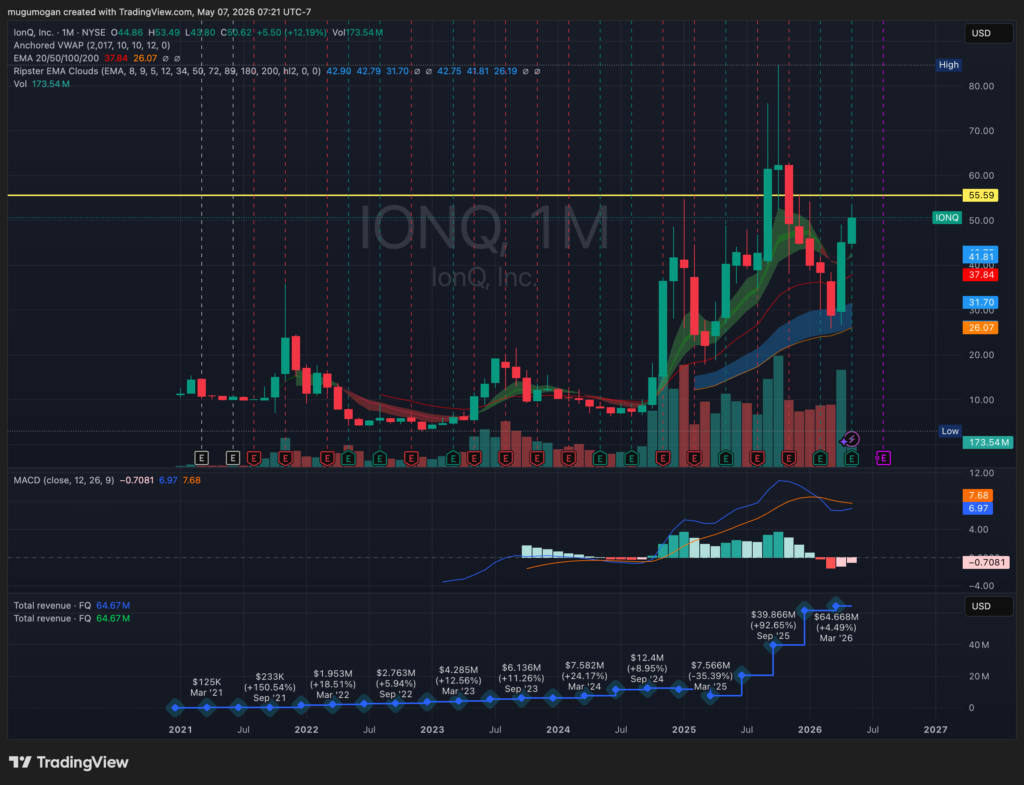
IONQ is attempting to reclaim the prior breakout zone around $55.50 after a sharp post-parabolic correction from the $60+ area. The monthly chart still looks structurally bullish because price remains well above the rising 20-month EMA (~$37.84) and the long-term EMA stack is fully aligned upward, which usually signals trend continuation rather than a complete breakdown.
Volume remains elevated and MACD is still positive on the higher timeframe, although momentum has clearly cooled from the late-2025 acceleration phase. The key issue now is whether IONQ can decisively clear and hold above the $55–56 resistance region; failure there likely keeps the stock in a volatile consolidation range between roughly $35 and $55 for several more months.