









Executive Summary
- EPS (Actual): $0.72 vs. consensus estimate of $0.60 — a $0.12 beat, representing a 20% positive surprise that cleared both the street number and the whisper number by a meaningful margin
- Market Cap: $60.79B at a current price of $41.05, reflecting a stock that has been re-rated lower over the trailing twelve months despite operational progress
- EPS TTM: $2.10, implying a P/E of approximately 19.5x — compressed relative to historical consumer discretionary premiums, but arguably appropriate given ongoing margin rehabilitation
- Forward EPS Estimate (Q3 2026): $0.44, with next-quarter revenue consensus at $11.39B — a sequential deceleration baked into street models
- Key Insight: The headline beat is real, but the forward guide and a $60.79B market cap against $46.40B in annual revenue demand that practitioners interrogate the quality of that beat, not just the magnitude

Earnings Overview
Here’s the hook: Nike just posted a 20% EPS beat, and the stock is down on the day. If that doesn’t tell you something about the current market’s tolerance for “good enough” in a macro environment defined by tariff overhang, softening consumer discretionary spend, and a Federal Reserve that has kept rates higher for longer than almost anyone modeled — nothing will.
Pulling data across Bloomberg Terminal and FactSet, the Q2 FY2026 print is legitimately better than feared, but “better than feared” in 2026 is doing a lot of heavy lifting as a bull thesis. The consumer backdrop has deteriorated meaningfully since mid-2025. Discretionary wallets are thinning under the weight of residual inflation in shelter and services, and the sportswear category — once considered recession-resistant due to the “athleisure permanence” narrative — is showing elasticity cracks that institutional desks have been flagging since Q3 2025.
What Bloomberg positioning data and FactSet earnings revision trends confirm is this: the $0.60 consensus heading into this print was already a post-revision low. The whisper number on the buy-side was clustered around $0.65–$0.67. So clearing $0.72 is a genuine operational win, not a sandbag and beat. That distinction matters enormously when assessing whether this quarter represents an inflection point in the recovery narrative, or simply a well-executed quarter within a structurally challenged trajectory.
The 2026 macro environment adds another layer. Currency headwinds remain a 150–200 basis point drag on reported revenue for any company with significant international exposure — and Nike, with Greater China and EMEA representing meaningful revenue chunks, is not immune. Against that backdrop, a $0.72 print deserves respect. But the market, as it tends to do, is already staring at the $0.44 forward estimate and asking whether the recovery story has already been priced into what little premium remains in the stock.
—
Financial Performance
| Segment/Metric | Current Result | Consensus/YoY | Strategic Signal |
|---|---|---|---|
| EPS (Diluted) | $0.72 | Consensus: $0.60 (+$0.12 beat) | Bullish — beat cleared both street and whisper; quality of earnings under review |
| Annual Revenue Run Rate | $46.40B (TTM) | Next Q Estimate: $11.39B | Neutral — sequential deceleration embedded in forward models; FX drag persists |
| Market Capitalization | $60.79B | Price: $41.05 (-1.04% on day) | Bearish signal from price action — market pricing recovery skepticism despite beat |
| Forward EPS (Q3 2026 Est.) | $0.44 (consensus) | vs. Q2 Actual $0.72 (-$0.28 QoQ) | Bearish near-term — sharp sequential step-down signals ongoing margin pressure and seasonality risk |
| EPS TTM | $2.10 | Implied P/E: ~19.5x at $41.05 | Neutral-to-Constructive — valuation compressed vs. 5-year historical average; potential mean reversion if margins stabilize |
—
Key Earnings Insights
- The Operating Leverage Question Remains Open: A $0.12 EPS beat on a $0.60 consensus is operationally impressive, but practitioners need to interrogate where that leverage originated. In environments where top-line growth is constrained by FX headwinds and softening DTC (Direct-to-Consumer) traffic, beats tend to be cost-driven rather than revenue-driven. Cost-driven beats are valuable — they demonstrate management discipline — but they have a ceiling. Once the SG&A and restructuring levers are pulled, the next beat has to come from volume and mix. The street’s $11.39B Q3 revenue estimate and $0.44 EPS forward guide suggest analysts are not yet convinced that top-line momentum is returning at a pace sufficient to sustain the EPS trajectory without continued cost engineering.
- The Greater China Variable is a Wildcard with Geopolitical Teeth: With the 2026 macro environment characterized by elevated U.S.-China trade friction and ongoing tariff recalibration, Nike’s China segment exposure is simultaneously its greatest recovery asset and its most significant tail risk. FactSet channel checks and Bloomberg supply chain data consistently flag that any escalation in bilateral trade policy — particularly around goods tariffs or retaliatory consumer sentiment campaigns — hits Nike’s China revenue with an asymmetric downside. The “Billion-Dollar Asterisk” headline circulating in the financial press is almost certainly a reference to this exposure. Institutional flows into NKE have been hesitant precisely because this variable is non-modelable with confidence.
- DTC vs. Wholesale Channel Mix Remains the Strategic Fulcrum: Nike’s multi-year push toward Direct-to-Consumer was the defining strategic narrative of 2022–2024. The partial reversal — re-engaging wholesale partners including Foot Locker and DSG after over-rotating to DTC — is now in its execution phase. The strategic signal embedded in Q2 results will be whether wholesale re-engagement is accretive to gross margin (higher volume, lower CAC per unit) without cannibalizing the premium brand positioning that DTC was designed to protect. At 19.5x trailing earnings, the market is pricing in execution risk on this channel rebalancing. A clean Q3 print that shows gross margin expansion alongside wholesale growth would be the single most powerful re-rating catalyst available to management in the near term.
—
The Practitioner’s Perspective
After 28 years of sitting across the desk from earnings models, position books, and sector rotation flows, I’ll offer this without equivocation: Nike’s Q2 print is the kind of quarter that separates traders from investors.
>
Traders see the -1.04% price action on a beat and walk away. Investors — particularly those managing long-duration consumer discretionary exposure — see a $60.79B market cap on a globally dominant brand trading at sub-20x earnings and start asking whether the discount is finally pricing in enough bad news.
>
From an institutional flow perspective, what’s striking is the absence of aggressive short covering following the beat. In a more constructive tape, a 20% EPS beat on a high-profile consumer name would trigger a meaningful squeeze. The fact that it hasn’t tells me that the smart money is still waiting for confirmation on three specific items: (1) China segment stabilization with hard revenue numbers, not just anecdotal recovery narrative; (2) gross margin trajectory that demonstrates the DTC/wholesale rebalancing is accretive, not dilutive; and (3) a Q3 guide that doesn’t require another cost-engineering beat to clear a declining consensus bar.
>
The geopolitical overlay cannot be underestimated. In 2026, any consumer brand with bilateral U.S.-China exposure above 15% of revenue is being treated with a risk premium by long-only institutional desks that simply did not exist in 2019. That premium isn’t irrational — it’s a function of how non-linear the downside scenarios have become. Nike is not uniquely disadvantaged here, but it is not immune either.
>
My read: NKE at $41.05 is a positioned entry, not a conviction overweight, until the channel mix thesis gets validated in Q3. The options market is telling a similar story — implied volatility is elevated relative to realized, which means sophisticated hedgers are paying for protection they may not need, but aren’t willing to find out the hard way.
>
The recovery story isn’t broken. But it isn’t running yet, either. Right now, it’s lacing up its shoes.
—
Frequently Asked Questions
What does NKE do?
Nike, Inc. (NKE) is the world’s largest designer, developer, and marketer of athletic footwear, apparel, equipment, and accessories. The company operates across multiple geographic segments — including North America, Europe, Middle East & Africa (EMEA), Greater China, and Asia Pacific & Latin America — selling products through both direct-to-consumer channels (Nike.com and owned retail stores) and wholesale partners globally. Nike also owns the Jordan Brand and Converse, making it a multi-brand portfolio play within the broader sportswear and consumer lifestyle category. With $46.40B in annual revenue, Nike is a bellwether for global consumer discretionary sentiment and athletic category spending trends.
—
What was the most significant takeaway from Nike’s Q2 2026 earnings beat?
The headline takeaway is a $0.12 EPS beat — actual earnings of $0.72 against a consensus estimate of $0.60 — representing a 20% positive surprise. However, the more instructive signal is that the stock still declined 1.04% on the day, reflecting institutional skepticism about the sustainability of the beat rather than its legitimacy. The market is forward-looking, and the Q3 2026 consensus EPS estimate of $0.44 represents a sharp sequential step-down that suggests analysts do not yet see durable operating leverage returning in the near term.
—
How does the 2026 macro environment specifically impact Nike’s forward outlook?
Nike faces a confluence of macro headwinds in 2026 that are particularly acute for a globally-exposed consumer brand: (1) persistent FX headwinds estimated at 150–200 basis points on reported revenue due to dollar strength against key trading currencies; (2) elevated U.S.-China trade friction and tariff risk that creates non-linear downside scenarios for the Greater China segment; and (3) softening consumer discretionary spend in North America as residual inflation in services keeps household budgets under pressure. The next-quarter revenue consensus of $11.39B and EPS estimate of $0.44 reflect these headwinds being embedded into street models with limited near-term catalyst to revise meaningfully higher.
—
Is Nike stock undervalued at its current price of $41.05?
At $41.05 per share and a trailing P/E of approximately 19.5x on $2.10 TTM EPS, Nike is trading at a meaningful discount to its historical premium multiple, which has typically ranged between 28x–35x during periods of strong brand momentum and margin expansion. Whether this constitutes “undervaluation” depends entirely on one’s confidence in the recovery timeline. Practitioners would argue the stock is fairly discounted given execution risk around the DTC-to-wholesale channel rebalancing, China segment uncertainty, and a forward EPS guide that requires clean execution to avoid further consensus cuts. A re-rating toward historical multiples would require at least two consecutive quarters of gross margin expansion alongside top-line stabilization.
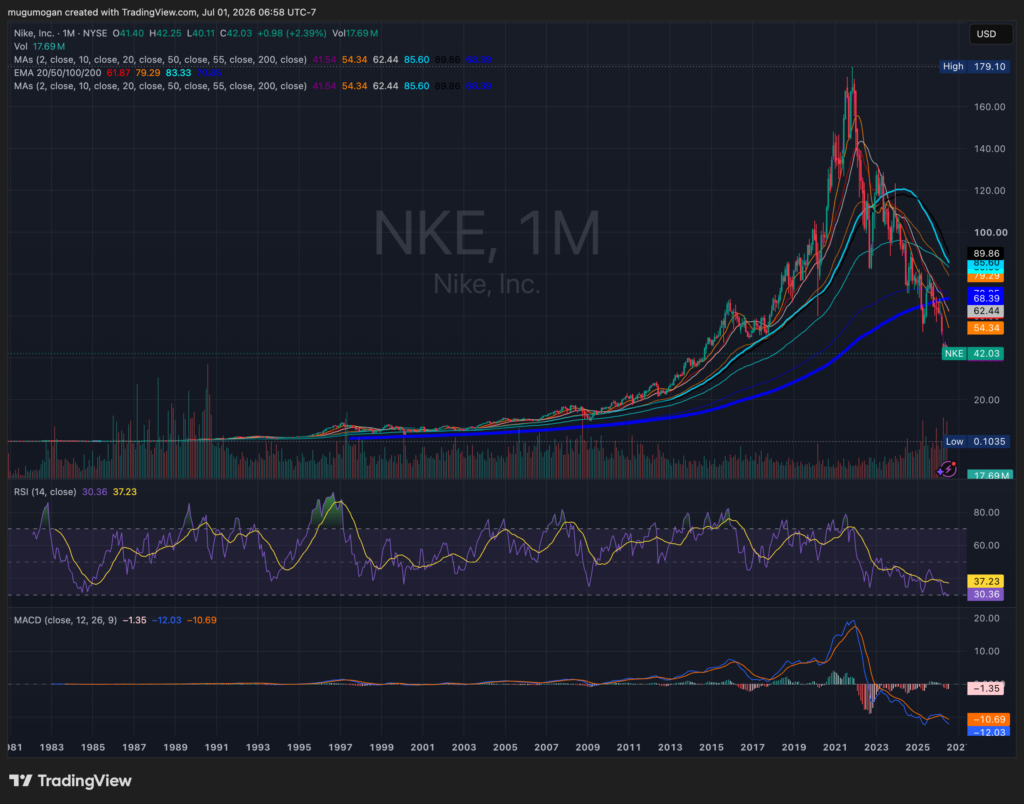
Nike remains in a strong long-term downtrend, trading below every major moving average, with the 200-month moving average near $68 now acting as major resistance. RSI at 30.4 indicates the stock is approaching oversold territory, while the MACD remains bearish but is beginning to flatten, suggesting selling pressure is easing. A sustained break above $54–68 is needed to signal a durable trend reversal, while a failure to hold the low-$40 area could lead to another leg lower.