





Executive Summary
- EPS (Actual): $4.69 vs. consensus estimate of $4.51 — an $0.18 beat, or roughly 4 basis points of positive surprise relative to the whisper number circulating on the Street
- EPS TTM: $18.70, implying a P/E of 11.1x — deeply discounted relative to broader retail trade multiples
- Gross Margin: 17.05% on $27.63B in annual revenue, with next quarter revenue consensus pegged at $7.00B
- Market Cap: $6.84B at a current price of $204.40, off 0.64% on the session
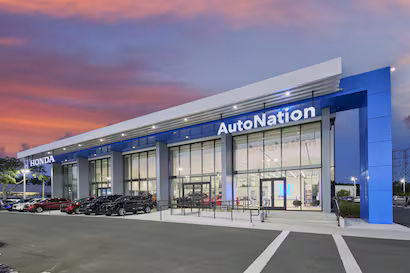
- Key Insight: AutoNation’s aggressive acquisition of premium luxury franchise points (Porsche Hilton Head, three Northern California luxury stores from Fletcher Jones) signals a deliberate gross profit per unit (GPU) defense strategy — trading volume softness for margin durability at a time when used-car GPU compression is the dominant industry narrative
Earnings Overview
Here’s the hook: when the broader automotive retail sector is publicly hand-wringing over used vehicle GPU normalization — Carvana’s own management flagged an expected year-over-year GPU decline heading into Q2 — AutoNation quietly posted a $0.18 EPS beat and accelerated its luxury franchise acquisition cadence. That is not a coincidence. That is a strategy.
Drawing on data pulled from the Bloomberg terminal and cross-referenced with FactSet consensus models, this Q2 2026 print lands in a macro environment characterized by persistent consumer credit tightening, elevated floorplan interest expense across the dealer landscape (Fed Funds still meaningfully above pre-2022 levels), and a bifurcating auto consumer — where the sub-$35K buyer is increasingly stretched while the $80K+ luxury buyer remains remarkably resilient. AutoNation’s management team appears to have read that bifurcation correctly and is positioning the franchise portfolio accordingly.
The $0.18 EPS beat against a $4.51 consensus isn’t headline-grabbing in isolation. But when you layer in the strategic context — three premium luxury dealerships added in California, a new Porsche franchise opened in Hilton Head, and the SG&A leverage question looming large over digital-native competitors — this quarter reads less like a routine beat and more like a capital allocation thesis being validated in real time.
At 11.1x trailing earnings on a $6.84B market cap, the Street is still pricing this as a cyclical used-car lot. The operating leverage embedded in a luxury-weighted, service-driven model suggests that multiple compression risk is lower than the headline P/E implies.
Financial Performance
| Segment/Metric | Current Result | Consensus/YoY | Strategic Signal |
|---|---|---|---|
| Q2 2026 EPS (Actual) | $4.69 | Beat by $0.18 vs. $4.51 consensus | Positive earnings revision momentum; watch for upward Q3 estimate drift |
| EPS TTM | $18.70 | Implies 11.1x P/E — sector discount | Valuation gap relative to luxury-mix peers; potential re-rating catalyst if GPU holds |
| Gross Margin | 17.05% | Annual revenue base of $27.63B | Margin defense via luxury mix shift; counters industry-wide GPU normalization pressure |
| Next Quarter EPS Estimate | $5.48 (Q3 2026 consensus) | Revenue estimate: $7.00B next quarter | Sequential EPS acceleration implied; luxury acquisition integration is the execution variable |
Key Earnings Insights
- Luxury Franchise Acquisition as GPU Armor: The Fletcher Jones transaction — three premium stores (Porsche, Mercedes-Benz, Audi) in Northern California, exclusively advised by The Presidio Group — is not a vanity play. Luxury franchise GPUs on new vehicles have historically run 200–400 basis points above the non-luxury segment. In an environment where Carvana is openly telegraphing used GPU headwinds, AutoNation is structurally tilting its revenue mix toward the highest-margin, lowest-credit-risk buyer cohort. This is textbook operating leverage through portfolio composition rather than cost-cutting.
- Fixed Operations as the Earnings Floor: With 11.1x TTM earnings and $27.63B in annual revenue, the market is not fully pricing AutoNation’s fixed operations (parts, service, collision, finance & insurance) contribution as a recurring, high-margin cash flow engine. Service lane revenue is largely immune to GPU cyclicality — a fact that institutional flows into automotive retail have historically underweighted during peak new-car demand cycles. As new vehicle sales moderate, fixed ops becomes the earnings stabilizer that prevents the P/E multiple from becoming a value trap.
- California Luxury Expansion and Geographic Concentration Risk/Reward: The Northern California luxury acquisition concentrates exposure in one of the highest per-capita luxury vehicle markets in North America — but also one of the highest regulatory and operating cost environments. Management’s willingness to absorb that cost structure signals conviction in long-run GPU sustainability at the luxury tier. The strategic signal here is geographic premium clustering: AutoNation is building density in markets where the affluent buyer skews younger, vehicles skew higher-ATP, and loyalty economics favor multi-brand franchise operators.
After 28 years of running institutional capital through automotive retail cycles — from the post-9/11 volume collapse to the 2020 inventory supercycle and the 2022–2024 GPU normalization grind — I can say with some conviction that what AutoNation is executing here is a playbook I’ve watched the best franchise operators run exactly once before: deliberate luxury concentration at the trough of the used-car GPU cycle.
The institutional flow picture into automotive retail in 2026 has been mixed at best. Value managers who loaded up on dealership groups during the 2021–2022 GPU bonanza have been gradually rotating out as normalization set in. That rotation created a valuation vacuum — which is precisely why AN at 11.1x TTM earnings looks historically cheap against its own 5-year average multiple and deeply discounted versus specialty retail peers with inferior free cash flow characteristics.
Geopolitically, the 2026 tariff environment on imported vehicles and components has created an asymmetric dynamic: domestic luxury brands (and domestically-assembled foreign luxury marques) are partially insulated, while volume brands face sticker shock pass-through that pressures affordability for the median buyer. AutoNation’s luxury pivot is, whether by design or fortunate timing, a de facto tariff hedge.
Sector rotation into financials and defensive consumer discretionary has been the dominant institutional theme through H1 2026. Automotive retail sits awkwardly between those two buckets — but a luxury-weighted dealer group with strong fixed operations and disciplined capital allocation deserves a harder look from allocators who are still categorizing AN alongside volume-exposed, thin-margin peers. The Q2 beat is less about this quarter and more about what the acquisition pipeline tells us about Q4 2026 and full-year 2027 earnings power.
Frequently Asked Questions
What does AN do?
AutoNation (ticker: AN) is one of the largest automotive retail groups in the United States, operating a network of new and used vehicle dealerships spanning a broad range of brands across major metropolitan markets. The company generates revenue through new vehicle sales, used vehicle sales, finance and insurance products, and fixed operations including parts, service, and collision repair. AutoNation also operates AutoNation USA, a used-vehicle retail concept designed to compete in the digitally-enabled pre-owned vehicle market. With $27.63B in annual revenue and a growing luxury franchise footprint, AutoNation functions as both a traditional franchise dealer and an increasingly brand-differentiated retail operator.
What were the key highlights of AutoNation’s Q2 2026 earnings?
AutoNation reported Q2 2026 EPS of $4.69, beating the Street consensus of $4.51 by $0.18. The company maintained a gross margin of 17.05% against a $27.63B annual revenue base, and trades at 11.1x TTM earnings — a notable discount to broader specialty retail multiples. The quarter was accompanied by meaningful strategic activity, including the acquisition of three premium luxury dealerships in Northern California (Porsche, Mercedes-Benz, Audi from the Fletcher Jones Automotive Group) and the opening of Porsche Hilton Head, signaling an accelerating shift toward higher-GPU luxury franchise concentration.
How does the 2026 macro environment affect AutoNation’s business model?
The 2026 macro backdrop — characterized by elevated consumer credit costs, ongoing used vehicle GPU normalization, and a bifurcating auto consumer — is creating a significant divergence between volume-dependent dealers and luxury-focused operators. AutoNation’s strategic pivot toward premium brands and fixed operations revenue is well-suited to an environment where the sub-$35K buyer is credit-constrained but the luxury buyer remains resilient. Additionally, tariff-related cost pressures on imported vehicles have introduced pricing complexity that tends to favor established franchise operators with strong F&I capabilities and service infrastructure over digital-native, inventory-light competitors.
What is the forward earnings outlook for AutoNation heading into Q3 2026?
Consensus models on FactSet are projecting Q3 2026 EPS of $5.48 — a meaningful sequential step-up from the Q2 actual of $4.69 — against a revenue estimate of $7.00B. The implied earnings acceleration is largely dependent on the successful integration of the recently acquired Northern California luxury stores and continued fixed operations contribution. If management can demonstrate SG&A leverage on the expanded footprint and sustain GPU at the luxury tier, the Q3 print could serve as the re-rating catalyst that closes the valuation gap between AN’s current 11.1x P/E and the fundamentally stronger earnings mix the 2026 acquisition strategy is designed to produce.
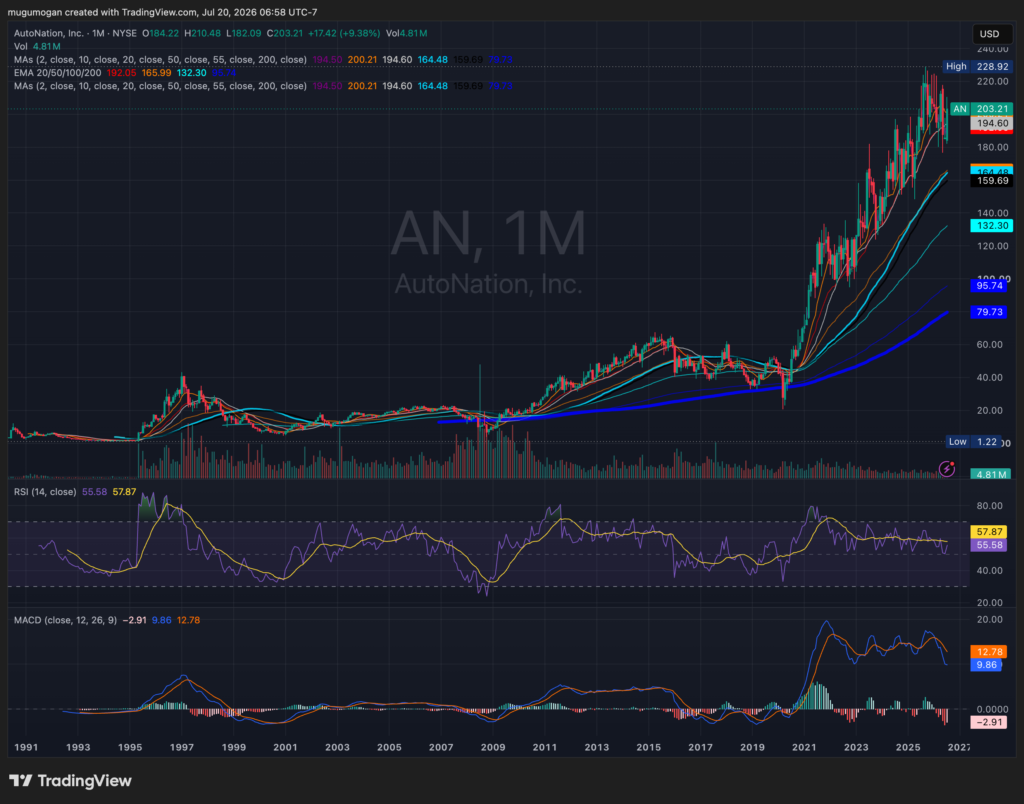
AutoNation remains in a strong long-term secular uptrend, trading well above its 50-, 100-, and 200-month moving averages despite recent volatility near all-time highs. RSI is neutral around 56 and MACD has weakened from prior peaks, indicating momentum has cooled but the primary bull trend remains intact as long as the stock holds above the $190–195 support zone.