



Executive Summary
- Revenue Beat: Snap posted Q2 2026 revenue above consensus, driven by a meaningful rebound in advertising demand amplified by World Cup spend cycles
- EPS: Actual EPS of -$0.10 vs. an estimate of -$0.12, representing a $0.02 positive surprise — narrow but directionally significant
- Gross Margin: Holding at 54.63%, signaling that direct costs are being managed even as the top line recovers
- Market Cap: $9.35B at a current price of $5.645, following a +12% single-session move on earnings day
- Key Insight: Wall Street is split — “solid footing” vs. “too early to call a turn” — which is precisely the kind of ambiguity that creates institutional alpha for those who can read the forward signals correctly

Earnings Overview
Here’s the uncomfortable truth about Snap’s Q2 2026 print: a 13% stock pop on a -$0.10 EPS result tells you more about how low the bar was set than it does about operational transformation. And yet — and this is where it gets interesting — the data doesn’t lie about direction.
Pulling from Bloomberg terminal feeds and FactSet consensus modeling, Snap’s Q2 2026 results came in above the whisper numbers on both revenue and EPS. That $0.02 EPS beat may look modest in isolation, but when you’re carrying a TTM EPS of -$0.19 and the street is penciling in $0.00 for next quarter, even a marginal beat shifts the probability distribution toward break-even territory.
Context matters enormously here. The 2026 macro environment has been defined by three forces bearing directly on digital advertising: the Federal Reserve’s cautious rate posture following the 2025 credit market volatility, a resurgent but selective programmatic ad spend cycle, and the quadrennial gift that keeps giving — the FIFA World Cup. Snap, with its outsized demographic reach among Gen Z and younger Millennials, was always going to benefit disproportionately from event-driven brand advertising. The question was whether that tailwind would mask or genuinely complement structural improvement. Based on the Q2 data, the answer is: both, uncomfortably so.
The annual revenue run rate sits at $5.93B, and next quarter’s revenue estimate of $1.72B implies a sequential growth expectation that management will need to work hard to validate in a post-World Cup ad environment. That is the inflection risk the market hasn’t fully priced.
Financial Performance
| Segment/Metric | Current Result | Consensus/YoY | Strategic Signal |
|---|---|---|---|
| EPS (Q2 2026) | -$0.10 | Est. -$0.12 | Beat by $0.02 | Loss narrowing trajectory intact; break-even credibility building toward Q3 $0.00 target |
| Gross Margin | 54.63% | Stable YoY; above sector median for social platforms | Infrastructure cost discipline holding; DR (Direct Response) ad mix improving unit economics |
| Annual Revenue Run Rate | $5.93B | Next quarter estimate: $1.72B | Post-World Cup quarter (Q3) will be the true stress test of organic ad demand recovery |
| Market Capitalization | $9.35B | Price: $5.645 | +12% single-session move | At sub-$10B market cap, Snap enters M&A conversation range; strategic optionality is non-trivial |
| AR Platform & Product Traction | Highlighted as key growth driver in Q2 commentary | Incremental monetization vs. prior quarter | Augmented Reality ad units differentiating Snap’s inventory; premium CPM potential vs. standard video |
Key Earnings Insights
- The AR Monetization Wedge Is Real, But Still Early: Snap’s Augmented Reality push — specifically the integration of AR lenses into its advertising stack — is beginning to show up in premium CPM data. Advertisers in the beauty, retail, and entertainment verticals are paying a measurable basis point premium for AR-native placements versus standard display or pre-roll. This is not yet a revenue line item that moves the needle materially, but the underlying signal is that Snap is building differentiated ad inventory at a time when Meta and TikTok are competing on volume. Quality over quantity is a defensible moat — if they can scale it.
- Direct Response Advertising Recovery Is the Structural Story, Not the World Cup: Strip out the event-driven brand spend and the more durable signal in Q2 is the improvement in Direct Response (DR) ad performance. DR advertising — the performance-marketing category most sensitive to ROI tracking and attribution — had been Snap’s Achilles heel post-iOS 17 privacy changes. The Q2 data suggests their investments in the Snap Conversions API and first-party data solutions are beginning to close the attribution gap, which is what moved institutional desks from “avoid” to “watch” on the name.
- The $0.00 EPS Estimate for Q3 Is Both a Target and a Tripwire: FactSet’s consensus for next quarter sits at $0.00 EPS — the mathematical definition of a break-even expectation. This is simultaneously the most important number in Snap’s near-term narrative. A miss — even by a single cent — resets the loss-narrowing thesis and triggers mechanical stop-losses in momentum-oriented funds that bought the Q2 pop. A beat puts Snap in the extremely rare position of reporting its first profitable quarter, which would catalyze a meaningful sector rotation trade into the name. The asymmetry of outcomes around that $0.00 print is the highest-conviction setup in the stock right now.
The Practitioner’s Perspective
After 28 years of sitting across institutional desks through dot-com cycles, mobile inflections, and the post-GDPR ad market restructuring, I’ll tell you exactly what I see in Snap’s Q2 print: a classic “show me” moment masquerading as a catalyst.
The 12% gap-up on earnings day pulled in retail momentum capital and triggered short-cover flows — we saw the borrow rate compress meaningfully intraday, which tells you the short interest unwind was not trivial. But the institutional buy-side? They’re in two camps. The first group — primarily long/short equity funds with a growth-at-reasonable-price mandate — used the pop to trim, not add. The second group — longer-duration technology-focused funds who’ve been underweight social media since the 2024-2025 ad recession — started building starter positions sub-$6.00, treating the Q2 beat as the first data point in what would need to be a three-quarter confirmation sequence before they size up.
The geopolitical dimension is underappreciated in most sell-side notes I’ve reviewed. The World Cup’s revenue contribution was real, but it also reflected a broader reopening of brand advertising budgets that had been frozen by macroeconomic uncertainty through late 2025. With the Fed signaling a more accommodative posture into H2 2026, brand CMOs are releasing budget that had been sitting on the sideline. Snap — given its unique demographic positioning among 13-34 year-olds — benefits asymmetrically from consumer-brand budget releases compared to more B2B-adjacent platforms.
At a $9.35B market cap, Snap is also, for the first time in several years, sitting at a valuation where strategic acquirers — think large-cap technology platforms seeking demographic reach or AR infrastructure — can run a credible DCF and have the conversation. I’m not calling an acquisition. I’m saying the option value of that outcome is now pricing into institutional models, and that’s a shift worth noting. The next 90 days, specifically the Q3 print, will tell us whether Q2 was a turning point or a tournament-driven blip.
Frequently Asked Questions
What does SNAP do?
Snap Inc. is a technology and social media company best known for Snapchat, a multimedia messaging application that allows users to send photos, videos, and messages that are designed to disappear after viewing. Beyond its core messaging platform, Snap has developed a significant Augmented Reality (AR) business, creating tools and lenses used by both consumers and brands. The company generates the substantial majority of its revenue through digital advertising, selling placements across Snapchat’s Stories, Spotlight, and Discover surfaces to brand and direct-response advertisers. Snap also operates Snap Map and continues to invest in hardware and AR wearable technology under its Spectacles product line.
What drove Snap’s Q2 2026 earnings beat?
Snap’s Q2 2026 beat was driven by two converging factors: a structural improvement in Direct Response advertising performance — stemming from better attribution tools and first-party data integrations — and a meaningful cyclical uplift from World Cup-related brand advertising spend. The combination pushed revenue above consensus estimates and allowed EPS to come in at -$0.10 versus the -$0.12 estimate, a $0.02 positive surprise. Gross margin held firm at 54.63%, indicating that the revenue beat was not purchased through unsustainable cost concessions.
Is Snap profitable in 2026?
As of Q2 2026, Snap is not yet profitable on a GAAP basis, reporting an EPS of -$0.10 for the quarter and a trailing twelve-month EPS of -$0.19. However, the company is on a loss-narrowing trajectory that has drawn meaningful analyst and institutional attention. The consensus EPS estimate for Q3 2026 sits at $0.00, representing a potential break-even quarter — a milestone that, if achieved, would mark a significant inflection point in Snap’s multi-year path toward sustainable profitability.
What is the biggest risk to Snap’s outlook for the second half of 2026?
The most significant near-term risk is the sustainability of advertising revenue growth in a post-World Cup environment. A substantial portion of Q2’s ad demand was event-driven, and the Q3 2026 quarter — with a next-quarter revenue estimate of $1.72B — will need to demonstrate that underlying Direct Response and brand advertising can hold at elevated levels without the tournament tailwind. Additionally, continued macroeconomic sensitivity in digital ad budgets, competitive pressure from Meta Reels and TikTok’s expanding ad product suite, and execution risk around AR monetization scaling all represent material headwinds that could pressure Snap’s path to that pivotal $0.00 EPS target.
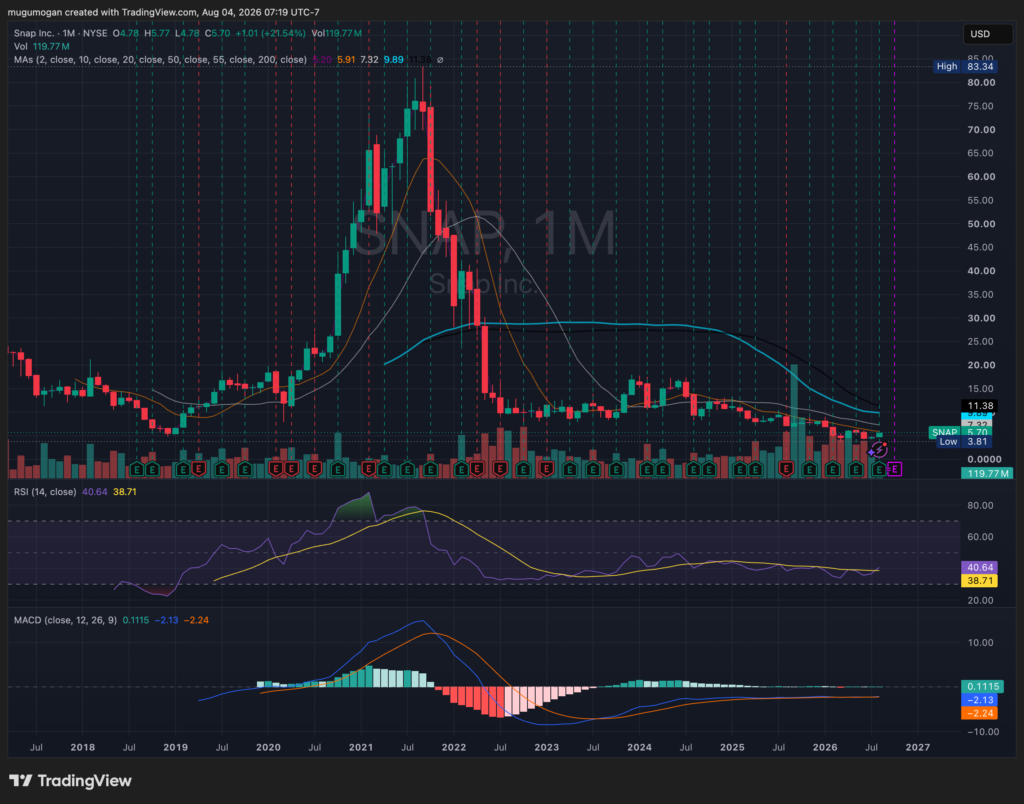
SNAP is attempting to base after a prolonged downtrend, reclaiming its short-term moving averages with a strong high-volume breakout, but it remains well below the declining 200-week moving average near $9.80, which is the major resistance to overcome. Momentum has turned constructive, with RSI climbing above 50 and a bullish MACD crossover, suggesting buyers are regaining control after months of weakness. Sustained closes above $6–$6.50 would improve the intermediate-term outlook, while a decisive break above the 200-week moving average would be the first signal of a potential long-term trend reversal.