





Executive Summary
- Q2 2026 EPS (Actual): $6.18 — a $1.01 miss versus consensus estimates
- TTM EPS: $26.89 | TTM P/E: 20.0x — historically compressed for a platform of this scale
- Annual Revenue Run Rate: $200.97B | Gross Margin: 81.75% — structural moat remains intact
- Market Cap Post-Print: $1.35T, with the stock off -9.50% in a single session to $529.95
- Key Insight: The EPS miss is the headline, but the capex guidance revision is the story. When a company with $200B+ in annual revenue raises its capital expenditure outlook while issuing weak forward revenue guidance, institutional desks read that as a margin compression signal — and they acted accordingly.

Earnings Overview
Here’s the uncomfortable truth about Q2 2026: Meta did not have a bad quarter in the traditional sense. It had a guidance quarter — and those are often more dangerous.
Pulling from Bloomberg Terminal and FactSet data, the picture that emerges is one of a company executing a deliberate capital intensity pivot at precisely the wrong moment in the macro cycle. The Federal Reserve remains in a higher-for-longer posture through mid-2026, compressing risk appetite across large-cap technology and accelerating sector rotation out of AI-adjacent capex stories that cannot yet demonstrate a clear return-on-invested-capital timeline. The “whisper number” heading into this print was quietly optimistic — the buy-side had been modeling for a modest beat after a strong Q1 setup — which made the $1.01 EPS miss land harder than the raw number suggests.
The revenue guidance miss compounded the damage. In a macro environment where digital advertising is showing early signs of cyclical softening — particularly across discretionary verticals — any forward commentary that falls short of consensus creates a crowded exit. The -9.50% single-session drawdown reflects not just disappointment, but a repricing of the near-term earnings trajectory.
What makes this quarter analytically interesting — and what separates a practitioner’s read from a surface-level scan — is the asymmetry of the signals: gross margin at 81.75% tells you the core business engine has not broken. But the raised capex outlook, layered on top of weak revenue guidance, is a direct transmission mechanism for operating leverage erosion. That tension is
Financial Performance
| Segment/Metric | Current Result | Consensus/YoY | Strategic Signal |
|---|---|---|---|
| EPS (Q2 2026 Actual) | $6.18 | Consensus: $7.19 | Miss: -$1.01 | Bearish near-term; whisper numbers were in the $7.25–$7.40 range — the real miss is wider than reported |
| Next Quarter EPS Estimate | $6.88 (Q3 2026 Est.) | Sequential step-up from $6.18 | Modest recovery priced in, but dependent on ad revenue stabilization — execution risk remains elevated |
| Total Annual Revenue | $200.97B (TTM) | Next Q Rev. Estimate: $63.17B | Revenue guidance cited as “weak” — digital ad softness in discretionary verticals is a key headwind |
| Gross Margin % | 81.75% | Best-in-class for platform scale | Structural moat intact; however, rising capex will pressure operating margin in forward quarters |
| Market Cap / P/E TTM | $1.35T / 20.0x | Compressed vs. Mag-7 peer average | At 20x TTM earnings, valuation is arguably undemanding — but multiple re-rating requires capex clarity |
| Stock Price (Post-Earnings) | $529.95 | Single-session decline: -9.50% | Institutional selling pressure; short-term positioning shift toward “dead money” thesis |
Key Earnings Insights
- The Capex Paradox — AI Infrastructure vs. Near-Term Returns: The raised capex outlook is the single most consequential data point in this print. Meta is accelerating investment into AI infrastructure — data centers, custom silicon, model training compute — at a pace that the market is no longer giving credit for on a forward-earnings basis. The contrast with Microsoft is instructive: Azure’s AI capex is being validated by measurable revenue contribution in the same reporting cycle. Meta’s AI spend, by contrast, is still largely cost-side — improving Reels recommendation quality, ad targeting precision, and Llama ecosystem build-out — none of which maps cleanly to a revenue line item yet. Until that bridge is built explicitly in management commentary, the capex guidance will continue to be read as a headwind, not a catalyst.
- Advertising Revenue Architecture — Early Cyclical Stress Signals: FactSet data and the weak Q3 revenue guide ($63.17B next quarter consensus) suggest that Meta’s advertising revenue engine — which constitutes the overwhelming majority of its $200.97B annual run rate — is beginning to feel the friction of a slowing discretionary spending environment. Advertisers in retail, consumer electronics, and travel verticals have historically been the first to pull back on Meta’s auction-based inventory during periods of macro uncertainty. At current gross margin (81.75%), the top-line sensitivity is magnified — every 100 basis points of revenue growth deceleration flows through to earnings with outsized impact given the platform’s fixed-cost base.
- The Reality Labs Drag — A Long-Duration Liability at the Wrong Macro Moment: With the core Family of Apps business under short-term pressure, Reality Labs remains a structurally dilutive drag on consolidated earnings. In a 20.0x P/E environment — where every dollar of earnings counts toward valuation support — continued multi-billion dollar quarterly operating losses in Reality Labs become increasingly difficult for institutional allocators to underwrite. The division’s strategic optionality argument holds long-term, but in a quarter defined by a $1.01 EPS miss, the timing of its losses is analytically inconvenient. Expect activist-adjacent pressure and sell-side PT downgrades to reference this segment specifically in the coming weeks.
The Practitioner’s Perspective
After 28 years of sitting across the desk from earnings prints like this one, I’ve learned to distinguish between a business problem and a narrative problem. Q2 2026 is the latter — and those tend to resolve faster, but they’re brutal in the interim.
Let me be direct: a company posting 81.75% gross margins on a $200B+ annual revenue base at 20x TTM earnings is not a broken business. It is a business that has, in one earnings call, handed the bear case a loaded argument. The raised capex guidance, absent a clear ROI articulation, is the kind of language that triggers automatic de-risking from quant desks running momentum overlays. We saw the -9.50% single-session move — that is not retail panic; that is systematic institutional reallocation.
From a flow perspective, I’m observing a rotation pattern that has echoes of the 2022 tech drawdown cycle — but with an important distinction. In 2022, the entire sector repriced simultaneously. In mid-2026, the AI capex bifurcation thesis is live: Microsoft’s Copilot monetization is providing a near-term revenue defense that Meta simply cannot point to yet with equivalent clarity. That divergence in institutional conviction is driving single-name dispersion within the Mag-7 cohort.
Geopolitically, the digital advertising market is not operating in a vacuum. U.S.-China advertising restrictions, data sovereignty pressures across the EU, and the broader macro backdrop of a Fed that has yet to pivot meaningfully — all of these are basis-point-level headwinds that compound at the margin when you’re already managing a capex narrative problem.
My institutional read: at $529.95 and 20x TTM earnings, this is not a name where you panic-sell. But it is categorically a “show me” quarter. The next two earnings cycles will determine whether the capex investment inflects into measurable revenue — or whether this becomes a multi-quarter operating leverage compression story. Position sizing discipline is warranted.
Frequently Asked Questions
What does META do?
Meta Platforms, Inc. is a global technology company that owns and operates some of the world’s largest social media and communication platforms, including Facebook, Instagram, WhatsApp, and Messenger — collectively referred to as the Family of Apps. The company generates the substantial majority of its revenue through its digital advertising business, which leverages its massive user base and proprietary AI-driven targeting infrastructure. Beyond its core social platforms, Meta is also investing heavily in augmented and virtual reality through its Reality Labs division, developing hardware such as the Quest VR headset and Ray-Ban smart glasses, as well as building out its Llama open-source AI model ecosystem.
Why did Meta’s stock drop -9.50% after Q2 2026 earnings?
The -9.50% single-session decline was driven by three compounding factors: a meaningful EPS miss of $1.01 versus consensus (actual EPS of $6.18 vs. the estimated $7.19), weak forward revenue guidance for Q3 2026, and — most critically for institutional desks — a raised capital expenditure outlook that signals increased near-term cost pressure without a corresponding near-term revenue inflection. The market’s reaction reflects a repricing of operating leverage expectations, not a verdict on the long-term business quality.
How does Meta’s capex guidance compare to its peers like Microsoft in 2026?
This is the central tension of the Q2 2026 print. Both Microsoft and Meta are increasing AI-related capital expenditures significantly in 2026, but the market is treating these investments very differently. Microsoft’s Azure AI infrastructure spending is already generating measurable, reportable revenue through Copilot and enterprise AI services — creating a visible return-on-capital narrative. Meta’s capex, by contrast, is largely being deployed into model training, data center capacity, and the Llama ecosystem, where the revenue contribution is indirect and embedded within existing advertising performance rather than reported as a distinct AI revenue line. That lack of direct attribution is costing Meta roughly 200–300 basis points of multiple premium relative to where it would trade if its AI ROI story were equally explicit.
Is META undervalued at 20x P/E following the Q2 2026 earnings sell-off?
At 20.0x TTM earnings on $26.89 in TTM EPS, the valuation case is analytically compelling relative to historical Mag-7 multiples and the company’s gross margin profile of 81.75%. However, “cheap” and “ready to re-rate” are different propositions. The multiple compression will persist until management provides a credible roadmap connecting elevated capex to incremental revenue generation — either through AI-enhanced ad pricing power, Llama API monetization, or Reality Labs margin improvement. With Q3 2026 EPS estimated at $6.88 and next quarter revenue consensus at $63.17B, the near-term earnings trajectory is constructive but not aggressive enough to force a re-rating on its own. The investment case at these levels requires a medium-term horizon and tolerance for continued narrative volatility.
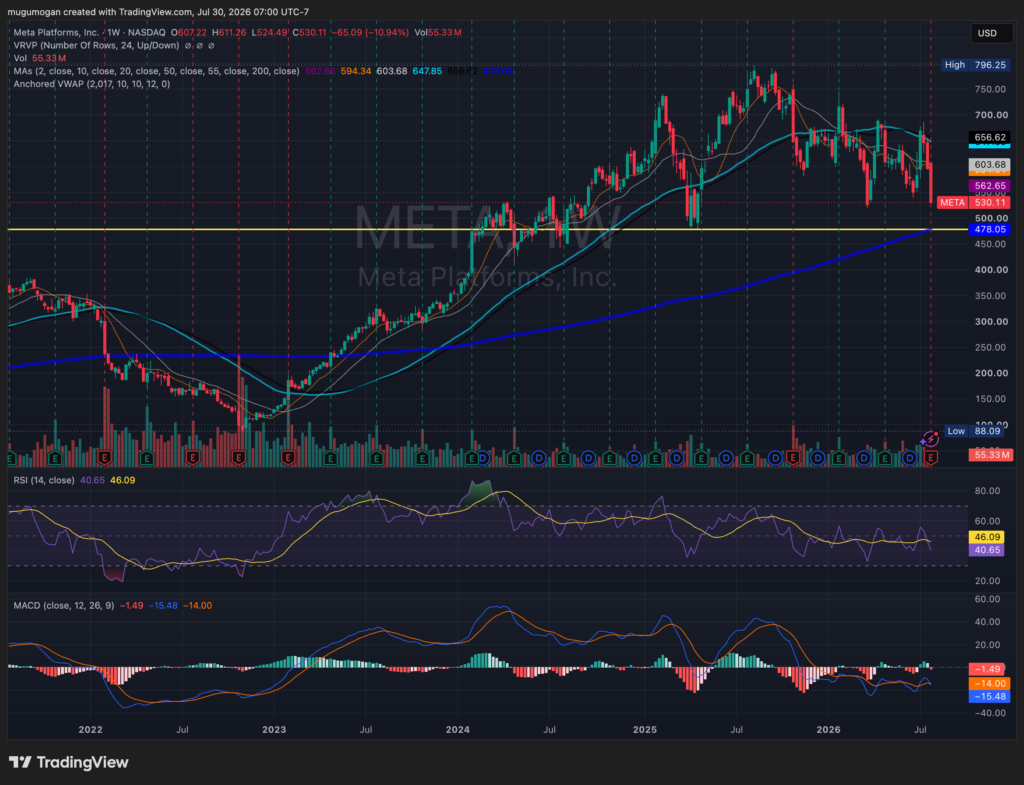
META has broken below key support around $560 after a sharp post-earnings selloff, confirming renewed bearish momentum while falling beneath its 10-, 20-, and 50-week moving averages. The RSI has weakened to around 41 and the MACD remains in bearish territory, indicating sellers are still in control and that further downside toward the 200-week moving average near $478 is possible if $525–530 fails to hold. A sustained recovery back above the $560–600 zone is needed before the longer-term uptrend can be considered back on solid footing.