





Executive Summary
- EPS (Actual): -$0.16 vs. consensus estimate of -$0.18 — a $0.02 beat that failed to impress the tape
- Market Cap: ~$3.00B at a current price of $4.885, with shares off 4.50% on the session and touching fresh 52-week lows
- Revenue (Annual/Quarterly): Effectively $0 — this is a pre-revenue, development-stage operation; the P&L is a cash burn ledger, not an income statement
- EPS TTM: -$0.67, with next quarter guided toward -$0.17 — burn rate is stable but not yet inflecting
- Key Insight: The Eagle Line production platform and the Honda partnership narrative are doing the heavy lifting on valuation. Without a commercial revenue catalyst, every beat on EPS is structurally hollow — the whisper numbers here aren’t about profit, they’re about gigawatt-hour readiness and OEM design-win count.
Earnings Overview
Here’s what the market told you on earnings day: a $0.02 EPS beat doesn’t matter when your revenue line reads zero and the stock is printing 52-week lows in the same breath. That’s not a contradiction — that’s the market being brutally precise about what it’s pricing.
Pulling data from the Bloomberg terminal and cross-referencing positioning data on FactSet, the Q2 2026 print for QuantumScape lands in a macro environment that is deeply unkind to pre-revenue EV technology names. The 2026 backdrop includes persistent elevated real rates that continue to compress long-duration growth multiples, a bifurcated EV adoption curve where legacy OEM electrification timelines have been pushed and re-pushed, and a broader sector rotation away from speculative manufacturing plays toward cash-generative industrials and defense-adjacent names.
Against that backdrop, QuantumScape’s Q2 print is less about the income statement and more about proof-of-concept velocity. The Eagle Line — the company’s proprietary solid-state cell production architecture — gained meaningful traction in Q2, and management’s Q2 earnings call commentary centered squarely on the Honda relationship and potential expansion into non-automotive markets, a strategic pivot that deserves far more analytical attention than the headline EPS beat is getting. The sell-off, in my read, reflects institutional impatience with the timeline-to-commercialization, not a fundamental deterioration in the technology thesis.
Financial Performance
| Segment/Metric | Current Result | Consensus/YoY | Strategic Signal |
|---|---|---|---|
| EPS (Q2 2026 Actual) | -$0.16 | Beat by $0.02 vs. -$0.18 estimate | Marginal operating leverage improvement; burn discipline is incrementally positive but insufficient to re-rate the stock |
| EPS (Next Quarter Estimate) | -$0.17 | Sequential deterioration of ~$0.01 | Suggests Q2 beat was not a structural inflection — cash consumption expected to tick back up in Q3 2026 |
| Total Revenue (Annual/Quarterly) | $0 | $0 consensus — no revenue generating operations | Zero commercial revenue is the central overhang; Eagle Line milestones are the only credible path to first dollar |
| Market Cap / Share Price | $3.00B / $4.885 | Stock -4.50% on session; printing 52-week lows | Market is pricing execution risk at maximum skepticism; any Eagle Line or Honda design-win announcement would be a sharp asymmetric catalyst |
| EPS TTM | -$0.67 | Reflects full-year development-stage burn rate | Annualized burn trajectory is the de facto fundamental — cash runway and dilution risk must be monitored at every print |
Key Earnings Insights
- Eagle Line Is the Catalyst Architecture, Not a Feature: The Q2 call made clear that Eagle Line isn’t merely a manufacturing upgrade — it’s the foundational platform upon which QuantumScape intends to prove scalable, commercially viable solid-state cell production. Progress on Eagle Line throughput and yield rates should be treated as the lead indicator for any future revenue inflection. Investors tracking this name should weight Eagle Line milestone disclosures more heavily than any EPS delta until commercial volume begins.
- The Honda Relationship Is Strategically Underappreciated: Management’s emphasis on Honda during the Q2 earnings call signals that this OEM partnership is moving beyond the exploratory phase. In the context of Honda’s aggressive global EV roadmap and its need to differentiate on battery technology against BYD and Tesla, a deepened QuantumScape relationship carries significant IP licensing and supply agreement optionality. This is not reflected in the current $3.00B market cap with any meaningful probability weight.
- New Markets Disclosure Is a Strategic Hedge Worth Watching: The pivot language around “new markets” beyond automotive — likely aerospace, defense energy storage, or grid applications — represents a strategic optionality expansion that pre-revenue companies deploy to extend their runway narrative. Whether this is genuine diversification or a slide-deck pivot is the key diligence question for Q3. If management provides specificity on non-auto pipeline activity, that’s an information gain event worth re-underwriting the position size on.
The Practitioner’s Perspective
After 28 years of sitting across the desk from names exactly like this — pre-revenue, deep-tech, OEM-dependent, burning cash with a story that is either going to be transformative or a cautionary tale — I’ll tell you what the flow data tells me that the headline won’t: institutional holders are not fleeing in panic, they’re trimming into weakness on a disciplined basis. The 52-week low prints across the solid-state battery complex — QS, Solid Power, SES AI all sliding in sympathy — reflect a sector-level de-rating, not company-specific deterioration. That distinction matters enormously for position sizing.
The geopolitical layer here is also non-trivial. With U.S.-China tensions keeping supply chain localization as a policy priority through 2026, domestic solid-state battery development has a regulatory and procurement tailwind that is structurally underpriced by a market focused on near-term cash burn. If the Defense Advanced Research Projects Agency or a DoE grant announcement surfaces alongside the “new markets” pivot, this name re-prices violently to the upside.
My institutional read: this is a high-conviction, small-position, long-duration hold for patient capital — not a trade. The whisper number that will actually move this stock isn’t the next EPS print. It’s the day QuantumScape announces a binding commercial supply agreement with a Tier 1 OEM or a non-automotive customer. Until then, size accordingly, manage your basis points of NAV exposure carefully, and watch the Eagle Line throughput data like it’s your only position.
Frequently Asked Questions
What does QS do?
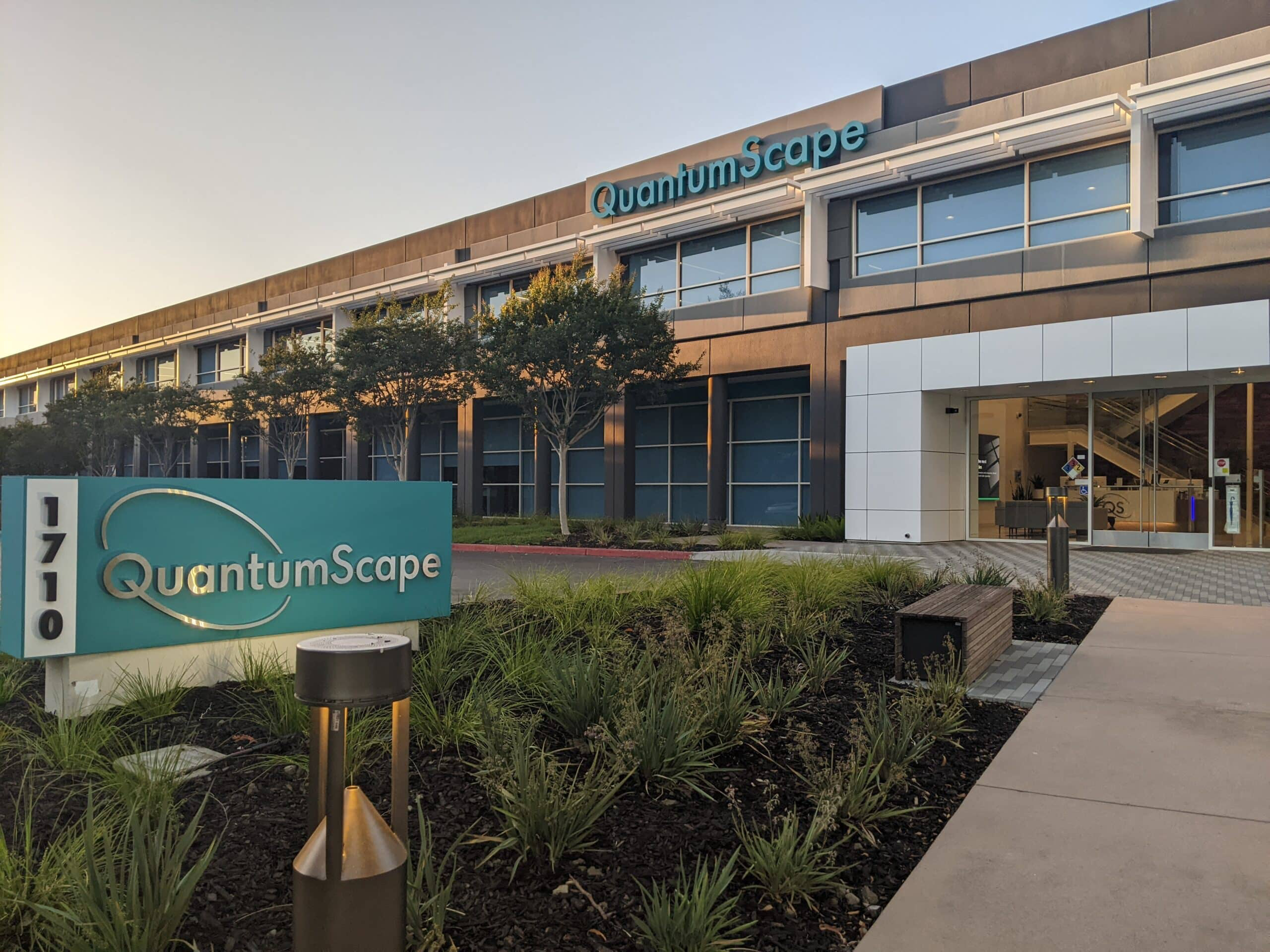
QuantumScape (Nasdaq: QS) is a development-stage company focused on designing and commercializing solid-state lithium-metal battery technology for use in electric vehicles and potentially other high-energy-density applications. Unlike conventional lithium-ion batteries, QuantumScape’s architecture replaces the liquid electrolyte with a solid ceramic separator, targeting superior energy density, faster charging, and improved safety profiles. The company is backed by Volkswagen Group and has established a strategic partnership with Honda as it works toward commercial-scale production. As of Q2 2026, QuantumScape has not yet generated commercial revenue and remains in the development and pilot production phase centered on its Eagle Line
Why did QS stock fall after beating Q2 2026 earnings estimates?
Despite posting a $0.02 EPS beat (-$0.16 actual vs. -$0.18 estimate), QS shares fell 4.50% on the session and touched 52-week lows. The market’s reaction reflects the reality that for a pre-revenue company with $0 in commercial sales, beating a loss estimate carries minimal informational value. The stock is being priced on timeline-to-commercialization and Eagle Line production milestones, not quarterly EPS deltas. With next quarter EPS estimated at -$0.17 — a sequential step backward — the market interpreted the beat as a one-quarter fluctuation rather than a structural inflection in the company’s financial trajectory
What is the Eagle Line and why does it matter for QS investors?
The Eagle Line is QuantumScape’s proprietary solid-state cell manufacturing platform, designed to demonstrate that its battery technology can be produced at commercially viable scale and yield. It is the critical bridge between laboratory proof-of-concept and the high-volume production required by Tier 1 automotive OEMs like Honda. For investors, Eagle Line throughput, yield improvements, and qualification milestones are the most material data points in the QuantumScape investment thesis — effectively serving as leading indicators for when the company’s revenue line will move from zero to commercial. The Q2 2026 earnings call highlighted gains on the Eagle Line as the primary operational bright spot.
How does the 2026 macro environment affect QS and the solid-state battery sector?
The 2026 macro environment presents a compounded headwind for pre-revenue, long-duration technology names like QuantumScape. Elevated real interest rates continue to discount future cash flows aggressively, compressing valuation multiples for companies with no near-term earnings. Simultaneously, EV adoption timelines have been revised by several major OEMs, reducing urgency around next-generation battery procurement. On the constructive side, U.S.-China trade tensions and domestic supply chain policy create a structural tailwind for American battery technology developers, and any DoE funding or defense-adjacent contract award could serve as a significant re-rating catalyst for QS in the second half of 2026.
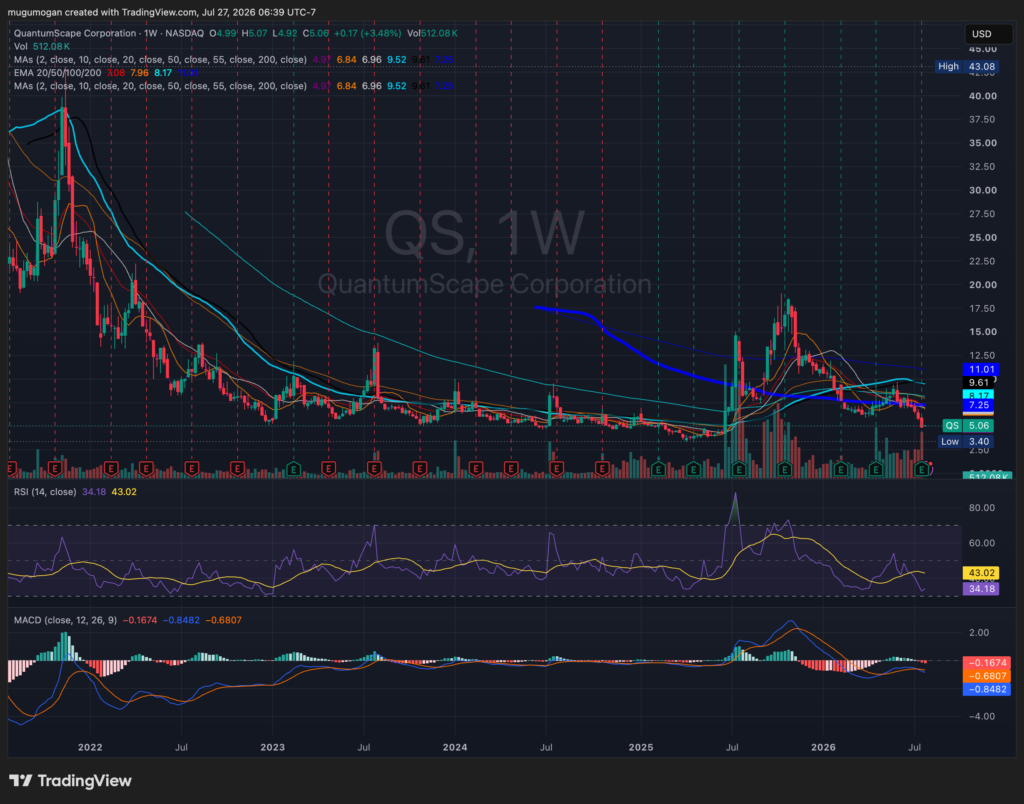
QS remains in a longer-term downtrend, trading below its 50-, 100-, and 200-week moving averages, although it has stabilized above the $5 support area after the sharp decline from its recent rally. Momentum has weakened, with RSI slipping to 34 and MACD rolling over into negative territory, indicating sellers currently have the upper hand despite the recent base-building. A decisive move back above $7.25–8.20 would improve the technical outlook and target the $9.50–11 resistance zone, while a break below $5 would likely expose the prior lows near $3.40.