



Executive Summary
- EPS (Actual): $0.80 vs. consensus estimate of $0.69 — a $0.11 beat, representing a ~15.9% positive surprise that blew past whisper numbers circulating in the days prior to the print
- Gross Margin: 38.92% — holding firm in a cost environment where most Consumer Non-Durables peers are watching margins compress 50–150 basis points quarter-over-quarter
- Market Cap: $13.63B at a P/E of 8.4x TTM — an optically compressed multiple that is either a value trap or a screaming dislocation, depending on your view of the Unilever Foods transaction
- EPS TTM: $6.02, with next quarter consensus pegged at $0.76 — implying sequential deceleration that the market appears willing to tolerate given the Flavor Solutions momentum signal
- Key Insight: The $0.11 EPS beat in Q1 2026 is not a fluke of favorable comps — it reflects deliberate operating leverage in the Flavor Solutions segment combined with disciplined SG&A management against a backdrop of sticky commodity input costs and a still-elevated U.S. dollar
Earnings Overview
Here’s the hook: when the broader consumer staples complex spent Q1 2026 issuing cautious guidance and blaming tariff-related input cost volatility, McCormick dropped a 15.9% EPS beat and kept its gross margin north of 38%. That’s not luck. That’s brand moat operating in real time.
Cross-referencing data from the Bloomberg Terminal and FactSet, this beat lands with meaningful context. The consensus estimate of $0.69 already had a cautious tilt baked in — sell-side models had been trimming estimates through February and March 2026 as the macro backdrop deteriorated. Renewed tariff friction on agricultural commodities (vanilla, pepper, and select spice derivatives have notable import exposure), combined with a still-resilient but clearly softening U.S. consumer, had positioned MKC as a “show-me” story heading into Q1. McCormick showed them.
The 2026 macro environment deserves its own paragraph here. We are operating in a world where the Federal Reserve has held rates at restrictive levels longer than the futures market priced 18 months ago, where consumer wallet compression is increasingly bifurcating between premium and private-label behavior, and where geopolitical supply chain fragmentation continues to pressure companies with global sourcing footprints. Against that backdrop, a gross margin print of 38.92% — essentially flat to improving on a year-over-year basis — is a genuine information signal, not a seasonal artifact. McCormick’s pricing architecture, built on brand equity in both its Consumer and Flavor Solutions segments, is earning its keep.
—
Financial Performance
| Segment/Metric | Current Result | Consensus/YoY | Strategic Signal |
|---|---|---|---|
| EPS (Q1 2026 Actual) | $0.80 | Consensus: $0.69 (+$0.11 beat) | Bullish — meaningful positive surprise versus a conservatively set bar; institutional re-rating likely underway |
| Gross Margin % | 38.92% | Sector avg. trending ~37–38%; YoY roughly stable | Bullish — pricing power and mix shift toward Flavor Solutions defending margin in a high input-cost environment |
| P/E Ratio (TTM) | 8.4x | Consumer Staples sector median ~19–22x TTM | Neutral/Watch — historically deep discount; Unilever Foods deal optionality could be the re-rating catalyst; or the market is pricing execution risk |
| EPS TTM | $6.02 | Next Quarter Estimate: $0.76 (sequential step-down) | Neutral — sequential deceleration expected; annual revenue base of $6.84B provides durable floor; watch Q2 organic sales growth cadence closely |
| Market Capitalization | $13.63B | Single-day price move: +4.82% on earnings day | Bullish — a 4.82% move on a $13.63B float is not trivial; options flow and institutional accumulation patterns warrant monitoring on the Bloomberg FLOW screen |
—
Key Earnings Insights
- Flavor Solutions Is the Earnings Engine, Not the Side Story: Headline consumer coverage tends to over-index on McCormick’s retail spice rack business, but the real margin architecture lives in Flavor Solutions — the B2B segment supplying QSR chains, food manufacturers, and restaurant groups. The Q2 2026 earnings call headlines specifically flagged Flavor Solutions strength, which corroborates what the Q1 beat was already implying: institutional revenue with higher switching costs, longer contract duration, and more predictable volume visibility than the Consumer segment. Practitioners should weight this segment’s contribution more heavily in forward DCF models.
- The Unilever Foods Transaction Is a Potential EPS Step-Change Event: Multiple recent headlines confirm that McCormick has disclosed planning for the Unilever Foods deal is “advancing” with potential EPS accretion on the horizon. At a current TTM P/E of just 8.4x — versus a peer group trading at nearly 2.5x that multiple — even modest EPS accretion from the transaction could create significant dollar-value re-rating. The market appears to be pricing deal execution risk rather than deal success, which historically creates asymmetric entry opportunities for patient institutional capital. Watch for any incremental deal structure disclosures in the Q2 call transcript.
- Gross Margin Resilience Signals Successful Pricing Architecture at Scale: Maintaining a 38.92% gross margin in Q1 2026 — when agricultural commodity input costs remain elevated and the dollar-weighted import basket for spice companies has been pressured by tariff policy — is not an accident. It reflects McCormick’s multi-year initiative to optimize its SKU portfolio, reduce complexity costs, and pass through price increases on a brand-segmented basis without triggering meaningful volume trade-down to private label. This is operating leverage in its most practical form: fewer moving parts, better mix, and a customer base that reaches for the red cap on muscle memory.
—
The Practitioner’s Perspective
In 28 years of institutional market analysis, I’ve watched consumer staples companies make two kinds of earnings prints: the ones that confirm a thesis and the ones that change it. McCormick’s Q1 2026 falls into the second category — not because the numbers are spectacular in isolation, but because of where they land in the cycle.
>
We’re in a late-cycle consumer environment where discretionary spending is compressing, private-label penetration is accelerating in center-store grocery, and CFOs across the sector are shaving guidance by 50–100 basis points to buy themselves cover. Against that backdrop, a 15.9% EPS beat with margin integrity intact is an institutional signal worth heeding.
>
What concerns me — and what I’d press management on directly — is the 8.4x P/E. That multiple is not reflecting quality earnings. It’s either reflecting the market’s skepticism about the Unilever Foods deal execution, latent concern about the consumer segment’s volume trajectory in a post-tariff demand reset, or sector rotation dynamics pulling institutional flows away from Consumer Non-Durables and toward late-cycle defensives and energy. Possibly all three.
>
From a flow perspective, the 4.82% single-session move on earnings day suggests the short interest community — which had been building a position on the thesis that commodity headwinds would crack the margin story — got squeezed. When I see that kind of move combined with a volume spike on a $13B float, I look at the options chain for the next 30–60 days for confirmation of whether this is a rotation trade or the beginning of a fundamental re-rating. The Unilever Foods catalyst, if it closes on accretive terms, could compress that P/E discount meaningfully. That’s the trade. The risk is deal slippage or a deteriorating macro that takes the whole Consumer Non-Durables complex down another 8–12% before any deal premium gets priced in.
>
Position accordingly. This is not a name you chase — it’s a name you build into weakness with a 12–18 month thesis anchor.
—
Frequently Asked Questions
What does MKC do?
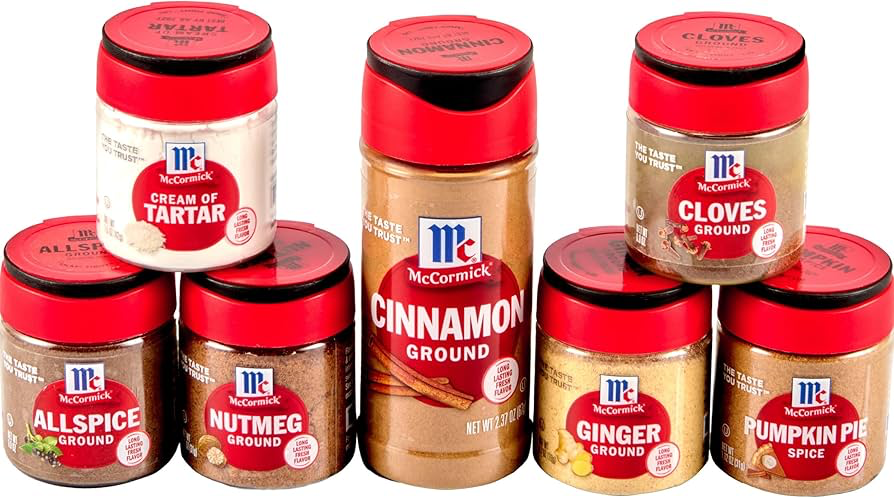
McCormick & Company (MKC) is a global leader in flavor — manufacturing, marketing, and distributing spices, seasonings, condiments, and flavor solutions to both consumers and commercial food businesses worldwide. The company operates through two primary segments: its Consumer segment, which supplies retail grocery customers with branded products including the iconic McCormick spice line, and its Flavor Solutions segment, which partners with food manufacturers, quick-service restaurant chains, and foodservice operators to develop proprietary flavor systems. Founded in 1889 and headquartered in Hunt Valley, Maryland, McCormick generates approximately $6.84 billion in annual revenue and operates across more than 160 countries and territories globally.
—
Why did MKC beat Q1 2026 earnings estimates by so much?
McCormick’s Q1 2026 EPS of $0.80 exceeded the consensus estimate of $0.69 by $0.11 — a 15.9% positive surprise — driven primarily by stronger-than-expected performance in the Flavor Solutions segment and disciplined cost management that protected gross margins at 38.92%. The beat was amplified by the fact that sell-side estimates had been conservatively marked down entering the quarter amid concerns about tariff-related commodity cost pressure and softening consumer demand. The actual results demonstrated that McCormick’s pricing architecture and SKU rationalization efforts are more durable than the consensus model assumed.
—
What is the Unilever Foods deal and why does it matter for MKC investors?
McCormick has publicly stated that planning for the Unilever Foods transaction is advancing and that EPS could benefit from the deal. While full terms have not been finalized, the strategic rationale centers on expanding McCormick’s Flavor Solutions and branded portfolio exposure in international markets where Unilever’s food assets carry significant distribution infrastructure. Given MKC’s current TTM P/E of just 8.4x — a deep discount to the Consumer Staples sector median of approximately 19–22x — even modest EPS accretion from a successful acquisition could serve as a meaningful re-rating catalyst. Investors should monitor Q2 2026 guidance commentary closely for any incremental deal structure or closing timeline disclosures.
—
Is McCormick’s 8.4x P/E ratio a value opportunity or a warning sign in the 2026 macro environment?
The 8.4x TTM P/E for McCormick is anomalously low relative to Consumer Staples sector peers and to the company’s own historical trading range. This multiple likely reflects a combination of factors: investor skepticism about deal execution risk related to the Unilever Foods transaction, ongoing uncertainty about consumer volume trends in a tariff-pressured, high-rate macro environment, and sector rotation dynamics that have been channeling institutional flows away from Consumer Non-Durables broadly in 2026. However, with a gross margin near 39%, consistent EPS beats, and a potential M&A catalyst on the horizon, the risk-reward asymmetry skews constructive on a 12–18 month horizon — provided the macro backdrop does not materially deteriorate and the Unilever deal closes on terms that are EPS-accretive rather than dilutive.
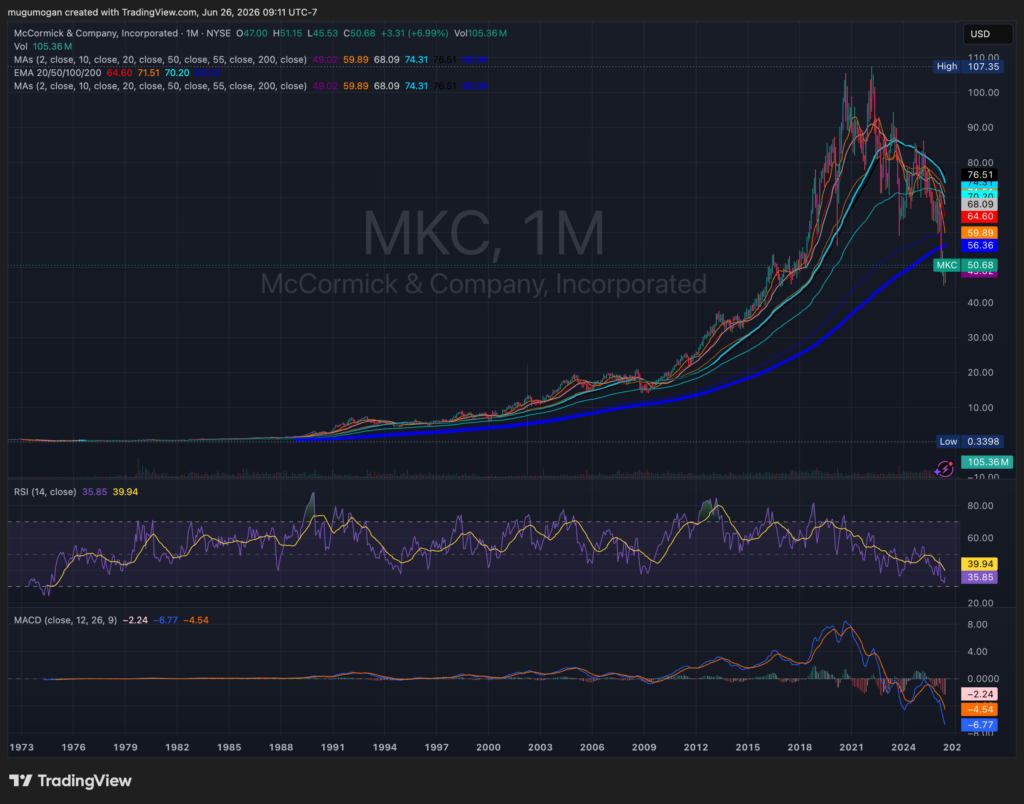
MKC remains in a long-term uptrend but is undergoing a significant correction, with the price now trading below its 20-, 50-, 100-, and 200-month moving averages. Weak momentum is confirmed by an RSI of 36 and a bearish MACD, indicating sellers remain in control despite the recent bounce. A sustained move back above the $56–60 resistance zone is needed to improve the outlook, while holding the $50 level is critical to avoid further downside.