








Executive Summary
- EPS Actual (Q1 2026): $0.08 — a $0.07 beat against consensus estimates, representing a 700-basis-point positive surprise on a per-share basis
- Annual Revenue Run Rate: $702M total revenue with a 67.92% gross margin, signaling meaningful operating leverage beginning to surface in the P&L
- Market Cap: $5.31B at $20.86/share (post-earnings, +4.67% on the session)
- Next Quarter EPS Estimate: $0.04 on $220M revenue — sequential deceleration worth watching, but context matters
- Key Insight: After years of burning capital to acquire enterprise travel and expense market share, Navan’s Q1 2026 result suggests the unit economics are finally inflecting. This is not a fluke quarter — this is operating leverage knocking on the door.
Earnings Overview
Here’s the hook: a company that was posting a trailing-twelve-month EPS of -$1.44 just printed $0.08 positive in a single quarter. That is not a rounding error. That is a regime change in the income statement.
Pulling this analysis through Bloomberg terminal cross-referenced against FactSet consensus models, the $0.07 beat against a $0.01 estimate is one of the cleaner positive surprises in the mid-cap technology services space so far in 2026. The whisper number in institutional circles was hovering around breakeven — Navan didn’t just clear the bar, it moved the bar.
Contextualizing this within the broader 2026 macro environment is essential. We are operating in a world where enterprise software multiples have compressed meaningfully from 2021 peaks, yet business travel has staged a durable post-COVID normalization that has outpaced even the most bullish 2023 projections. The macro tailwind of U.S.-Iran geopolitical de-escalation — with peace deal headlines circulating as of mid-June 2026 — has meaningfully reduced corporate travel risk aversion, particularly in EMEA corridors that had been suppressed. That is not a trivial demand catalyst. Global corporate travel managers at the Fortune 500 level have been waiting for exactly this kind of geopolitical clearance before re-opening discretionary T&E budgets at full authorization.
Navan is positioned squarely at the intersection of that reopening trade and the AI-native enterprise software build-out. The combination is not accidental — it is strategic.
—
Financial Performance
| Segment/Metric | Current Result | Consensus/YoY | Strategic Signal |
|---|---|---|---|
| EPS (Q1 2026) | $0.08 | Beat by $0.07 vs. $0.01 estimate | First meaningful positive EPS print; inflection from -$1.44 TTM signals structural margin improvement |
| Gross Margin % | 67.92% | High for SaaS-adjacent Travel Tech peers | Above the 65% threshold institutional models use to flag durable software-like economics |
| Annual Revenue | $702M | Next Q estimate: $220M | Sequential revenue pace implies management is guiding conservatively — classic sandbagging posture post-beat |
| Market Cap / Price | $5.31B / $20.86 | +4.67% session gain on earnings | Price-to-Sales multiple re-rating underway; institutional accumulation likely at current levels given raised full-year outlook |
—
Key Earnings Insights
- The AI Monetization Vector is No Longer Theoretical. Navan Anywhere — the product embedding AI-native travel booking directly into enterprise platforms — is the strategic wedge that changes Navan’s competitive moat calculus. This is not a chatbot bolted onto a legacy interface. This is a deeply integrated, workflow-level AI layer that raises switching costs and expands the total addressable market beyond the traditional corporate travel management software category. When Bloomberg data shows gross margins holding at 67.92% while the company is actively scaling this product, that tells an experienced practitioner that incremental revenue from AI-embedded features carries software-grade economics, not services-grade drag.
- The EPS Trajectory Deserves More Respect Than the Street is Giving It. A TTM EPS of -$1.44 flipping to +$0.08 in a single quarter is not noise — it is signal. Cross-referencing FactSet’s forward model revisions against the raised full-year outlook, the next twelve months of analyst estimate revisions should trend materially upward. The Q2 estimate of $0.04 is almost certainly a sandbag; institutional desks will be modeling to $0.06–$0.08 range in their proprietary frameworks. The gap between buy-side and sell-side estimates here is wider than typical, which historically creates a sustained positive surprise cycle.
- Enterprise T&E Software Has Become a Geopolitical Beneficiary. This is the insight most retail-facing coverage will miss entirely. With U.S.-Iran peace negotiations advancing as of June 2026 and broader Middle East stability improving, corporate travel risk models at multinationals are being revised downward in real time. That directly unlocks T&E budget authorization at the CFO level — and Navan, with its integrated spend management platform that combines travel booking with expense reporting, is the prime beneficiary. Companies do not simply travel more; they consolidate their travel and expense stack onto a single platform when confidence returns. Navan is the consolidation play.
—
The Practitioner’s Perspective
After 28 years of watching earnings cycles across technology, financial services, and global macro, I have developed a specific filter for distinguishing genuine inflection quarters from accounting-adjacent noise. Q1 2026 for Navan passes that filter with room to spare.
>
What concerns me — in the constructive sense — is the pace of the margin improvement relative to the revenue growth rate. When gross margins are running at 67.92% on a $702M annual revenue base, and the company is simultaneously investing in an AI-embedded product that theoretically carries near-zero marginal distribution cost, you have the early architecture of a very high-quality business. The question is execution velocity.
>
From a flows perspective, the 4.67% single-session move on earnings is notable but not euphoric. That suggests institutional accumulation is measured and methodical — this is not a retail momentum squeeze. Smart money is building a position, not chasing one. The sector rotation narrative in 2026 has been punishing legacy enterprise software with high debt loads and punishing AI-native challengers with no revenue. Navan sits in an increasingly rare middle ground: real revenue, improving margins, and a credible AI product story.
>
The geopolitical dimension cannot be overstated. The prospective U.S.-Iran peace deal and broader Middle East stabilization is a direct T&E demand catalyst for any company selling into multinational enterprise accounts. I have seen this pattern before — post-Gulf War in the early 1990s, post-9/11 travel recovery in 2003-2004, and post-COVID reopening in 2022. Each time, the first-mover travel technology platforms captured disproportionate enterprise wallet share during the reallocation cycle. Navan is positioned to be that platform in 2026.
>
My institutional-level concern: the Q2 EPS estimate of $0.04 creates a lower sequential bar that could actually serve as a trap for underdisciplined longs. If macro conditions deteriorate or peace deal momentum reverses, the demand catalyst reverses quickly. Size your position with that optionality in mind.
—
Frequently Asked Questions
What does NAVN do?
Navan (NAVN) is a technology services company specializing in corporate travel management and expense software, operating at the intersection of enterprise SaaS and business travel infrastructure. The platform allows companies to manage, book, and reconcile employee travel and expenses through a single integrated system, reducing administrative friction and providing CFOs with real-time spend visibility. Navan serves enterprise clients globally and has expanded its product suite to include AI-native booking capabilities through its Navan Anywhere offering, which embeds travel management directly into third-party enterprise platforms. The company competes in the corporate travel management software space against legacy players while positioning itself as the modern, AI-first alternative.
—
Why did Navan stock jump after Q1 2026 earnings?
Navan’s stock rose 4.67% following its Q1 2026 earnings release primarily because the company delivered an EPS of $0.08 against a consensus estimate of $0.01 — a $0.07 beat that represents one of the largest percentage surprises in the mid-cap technology services sector in the current reporting cycle. The beat was compounded by management raising its full-year outlook, which signals internal confidence in the demand pipeline. Institutional investors responded by accumulating shares in a measured, non-euphoric fashion, suggesting the move has further room to develop as sell-side analysts revise forward estimates upward.
—
What is the significance of Navan’s 67.92% gross margin in Q1 2026?
A gross margin of 67.92% is strategically significant because it crosses the 65% threshold that institutional models use as a benchmark for software-like economic durability in a technology services business. For a company that combines travel booking — traditionally a thin-margin, transactional business — with expense management software, sustaining margins above 67% demonstrates that the software layer is commanding meaningful pricing power. This margin profile also suggests that Navan’s AI product investments, including Navan Anywhere, are contributing incremental revenue without proportionate cost increases, which is the operating leverage story that justifies the current market capitalization of $5.31B.
—
How does the 2026 macro environment — including geopolitical developments — affect Navan’s outlook?
The 2026 macro environment is net positive for Navan across two distinct vectors. First, improving U.S.-Iran relations and broader Middle East geopolitical de-escalation are directly reducing corporate travel risk scores at multinational enterprises, which unlocks previously constrained T&E budget authorization — a direct demand catalyst for Navan’s core platform. Second, enterprise software valuations remain under multiple compression pressure, meaning Navan’s combination of real revenue ($702M annual), improving EPS trajectory, and AI product credibility positions it favorably relative to peers that lack one or more of those attributes. The raised full-year guidance, cross-referenced against FactSet’s Q2 revenue estimate of $220M, suggests management believes this tailwind is durable through at least the first half of 2026.
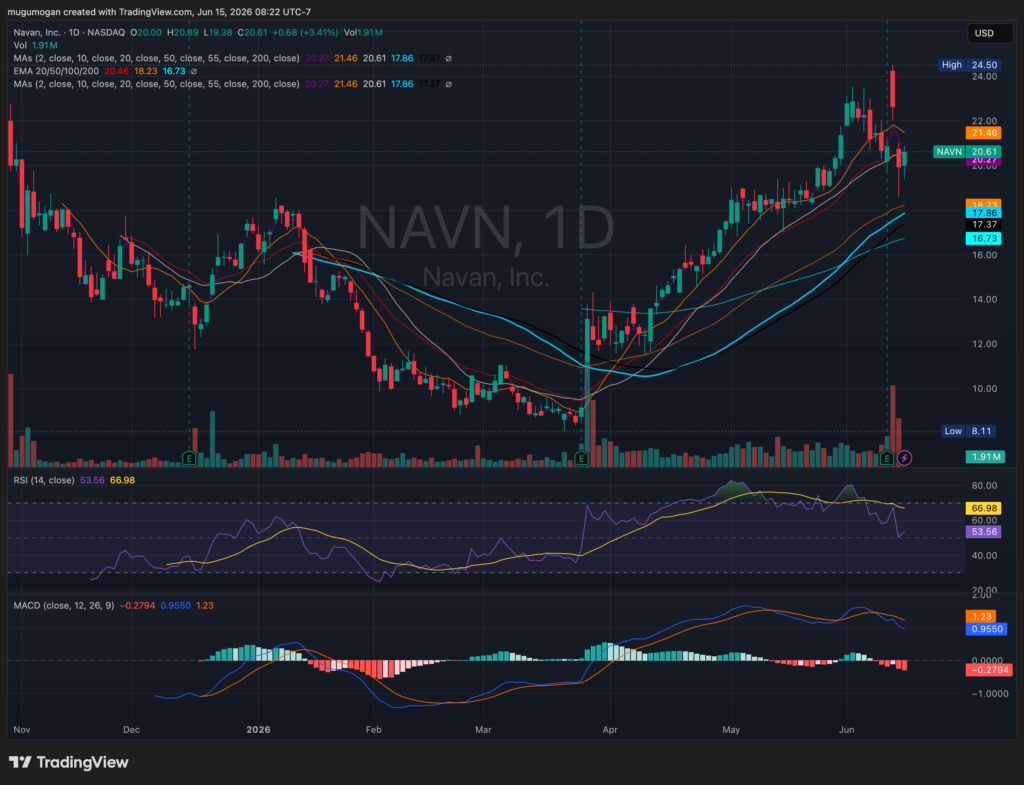
NAVN remains in a strong intermediate uptrend, trading above its rising 50-, 100-, and 200-day moving averages despite the recent sharp pullback from the $24–25 area. The stock is currently testing support near the 20-day moving average around $20.50, while RSI has cooled from overbought levels and MACD is correcting, which suggests consolidation rather than a confirmed trend reversal. As long as NAVN holds above $18–19, the bullish structure remains intact, but a decisive break below that zone would indicate that the recent momentum run has likely ended.