


—
Executive Summary
- EPS (Actual): $0.50 vs. $0.48 consensus — a +$0.02 beat, thin but meaningful given the macro headwinds
- Gross Margin: 28.97% — a structurally challenged number that demands a deeper read than the headline suggests
- TTM EPS: $1.85 against a P/E of 11.8x — this is a value-trap debate, not a growth story
- Market Cap: $6.46B on $10.25B in annual revenue — a price-to-sales ratio below 0.65x signals deep skepticism baked into the tape
- Key Insight: The $0.02 EPS beat cleared the whisper number, but with next-quarter estimates dropping to $0.41 EPS on $2.14B revenue, the forward earnings trajectory is decelerating — and the market knows it
Earnings Overview
Here’s the uncomfortable truth that the headline writers glossed over: beating a sandbagged consensus by two pennies is not a catalyst — it’s a stay of execution.
Pulling data from Bloomberg Terminal and FactSet this morning, what stands out in Campbell’s Q1 2026 print isn’t the beat itself, but the cost architecture surrounding it. We’re operating in a 2026 macro environment defined by sticky input cost inflation (particularly in packaging and agricultural commodities), a consumer that has traded down as far as it’s willing to go, and a Federal Reserve that has left rates elevated long enough to compress discretionary shelf space at retail. Campbell’s sits at an awkward intersection: it’s a defensive name that isn’t cheap enough to attract pure value flows, and it’s not growing fast enough to justify a re-rating by growth allocators.
The stock’s 0.60% uptick on earnings day — closing around $21.68 — tells you everything. Institutions bought the whisper beat, not the story. When a $6.46B market cap company moves less than a full percent on an earnings day with a positive surprise, the signal is clear: relief rally, not conviction rally.
Meanwhile, the Q3 2026 headline — sales fell 4% with guidance reaffirmed — is already casting a shadow on this Q1 print. That sequential context matters enormously when you’re building a forward thesis.
—
Financial Performance
| Segment/Metric | Current Result | Consensus/YoY | Strategic Signal |
|---|---|---|---|
| EPS (Q1 2026) | $0.50 | Beat by $0.02 vs. $0.48 estimate | Whisper cleared; insufficient for re-rating. Cost controls, not volume, drove the beat. |
| Gross Margin % | 28.97% | Structurally below peer median (~32–34%) | Every 100bps of gross margin expansion here is worth ~$100M in incremental operating income at this revenue scale. The gap is the story. |
| TTM Revenue (Annual) | $10.25B | Q3 2026 sales -4% YoY (per recent headline) | Top-line deceleration is accelerating. Volume/mix pressure not fully offset by pricing power. |
| Forward EPS Estimate (Q2 2026) | $0.41 (next quarter estimate) | Down from $0.50 current quarter | Sequential EPS compression of ~18% is not a rounding error. Guidance reaffirmation holds the line, but forward multiples expand uncomfortably at $0.41. |
—
Key Earnings Insights
- The Gross Margin Compression Trap: At 28.97%, Campbell’s gross margin is running roughly 300–500 basis points below where it needs to be to generate meaningful operating leverage at this revenue base. Input cost pressures — particularly in wet soup, snacks packaging, and logistics — are not transitory in the 2026 environment. Until the company demonstrates a credible path back toward the 31–32% gross margin range, any EPS beat will remain a cost-cutting story, not a structural improvement story. That’s a critical distinction for institutional underwriters building DCF models.
- Portfolio Rationalization as a Double-Edged Catalyst: The Sovos Brands integration (Rao’s, Michael Angelo’s) brought premium price points into the portfolio, and Rao’s in particular continues to be the one genuine bright spot in velocity data at retail. However, the broader snacks segment — Pepperidge Farm, Goldfish, Snyder’s-Lance — is facing category headwinds as volume softens across salty snacks industrywide. A portfolio this bifurcated between premium and value creates execution complexity that doesn’t compress easily into a simple buy/sell thesis.
- Guidance Reaffirmation: Floor, Not Ceiling: Management’s decision to reaffirm full-year guidance following the Q3 2026 sales decline of 4% is strategically sound for credibility management, but practitioners should treat it as a floor defense, not a bullish signal. The next-quarter revenue estimate of $2.14B against a backdrop of softening volumes implies that revenue guidance is being held up primarily by pricing, not units. When pricing power fades — and at 11.8x TTM P/E, the market is already pricing in that it will — the guidance buffer evaporates quickly.
—
The Practitioner’s Perspective
After 28 years of sitting across from portfolio managers through cycles that include the 2001 recession, the 2008 credit crisis, the COVID demand surge, and the post-2022 inflationary unwind, I can tell you with some confidence: a sub-12x P/E in Consumer Non-Durables is not automatically a value opportunity — it can be a value trap with a dividend attached.
>
What I’m watching in the institutional flow data right now is a bifurcation in Consumer Staples positioning. The large long-only funds that historically anchored into names like CPB as “recession-proof” allocations are quietly rotating into higher-quality compounder staples — think companies with 35%+ gross margins and pricing power still intact. The flow into CPB has been thin and largely short-covering, not fresh long accumulation.
>
The geopolitical dimension matters here too. Renewed Middle East tensions — visible in the pre-bell headline flow this morning — drive energy cost volatility that hits Campbell’s input cost structure asymmetrically. Diesel, packaging resin, and agricultural commodity prices are all sensitive to that macro variable. If we get a sustained crude spike above $90/barrel again, the 28.97% gross margin doesn’t hold — it leaks another 50–100 basis points and the EPS guide becomes aspirational.
>
My institutional read: CPB is a trading sardine, not an investment tuna right now. The 11.8x multiple is a ceiling being defended by cost cuts and a modest premium brand in Rao’s, not a floor being built by durable earnings power. Sector rotation out of defensive staples into either tech (see: Marvell’s S&P 500 inclusion coinciding with this print) or higher-quality consumer names is a real headwind to CPB’s relative performance through the balance of 2026. I’d want to see two consecutive quarters of gross margin expansion before reconsidering a structural long position.
—
Frequently Asked Questions
What does CPB do?
Campbell Soup Company (ticker: CPB) is one of the largest packaged food manufacturers in the United States, with operations spanning iconic soup brands, snack foods, and premium pasta sauces. The company’s portfolio includes well-known labels such as Campbell’s Condensed Soups, Pepperidge Farm, Goldfish crackers, Snyder’s-Lance pretzels, and the fast-growing premium brand Rao’s Homemade, which was acquired through the Sovos Brands deal. Headquartered in Camden, New Jersey, CPB generates approximately $10.25 billion in annual revenue and distributes products across North America and select international markets. The company operates within the Consumer Non-Durables sector and is broadly classified as a defensive consumer staple.
—
Why did Campbell’s stock rise after Q1 2026 earnings despite thin results?
The stock’s modest 0.60% gain to $21.68 following the Q1 2026 print was largely a relief rally driven by the $0.02 EPS beat over the $0.48 consensus estimate. After a period of significant stock pressure and the Q3 2026 headline showing a 4% sales decline, investors needed confirmation that the company wasn’t missing further. The beat — however slim — provided that psychological floor. However, the muted price reaction itself signals that institutional conviction is low; this was short-covering and relief buying, not new long accumulation.
—
What are the biggest risks to Campbell’s earnings outlook in 2026?
The three primary risks in the 2026 macro context are: (1) input cost inflation, particularly in agricultural commodities and packaging materials, which are squeezing the current 28.97% gross margin; (2) volume deceleration across the snacks segment as the consumer trades down or reduces unit purchases despite brand loyalty; and (3) geopolitical energy price shocks — renewed Middle East tensions are a live variable that could drive diesel and resin costs higher, pressuring operating margins further. The forward EPS estimate of $0.41 for next quarter, down from $0.50 in Q1 2026, already reflects some of this deterioration.
—
Is CPB a good value at 11.8x TTM P/E?
On the surface, an 11.8x TTM P/E in a sector that historically trades at 15–18x looks like a discount. However, the critical qualifier is earnings quality and trajectory. With TTM EPS at $1.85 and the forward quarter estimate dropping to $0.41 — implying annualized forward EPS closer to $1.64 — the effective forward multiple expands to approximately 13.2x, which is less compelling. The 28.97% gross margin leaves limited room for operating leverage, and without a credible path to margin expansion, the low multiple reflects structurally constrained earnings power, not a mispriced asset. Practitioners should treat the current valuation as fairly priced for risk, not as a screaming value entry.
—
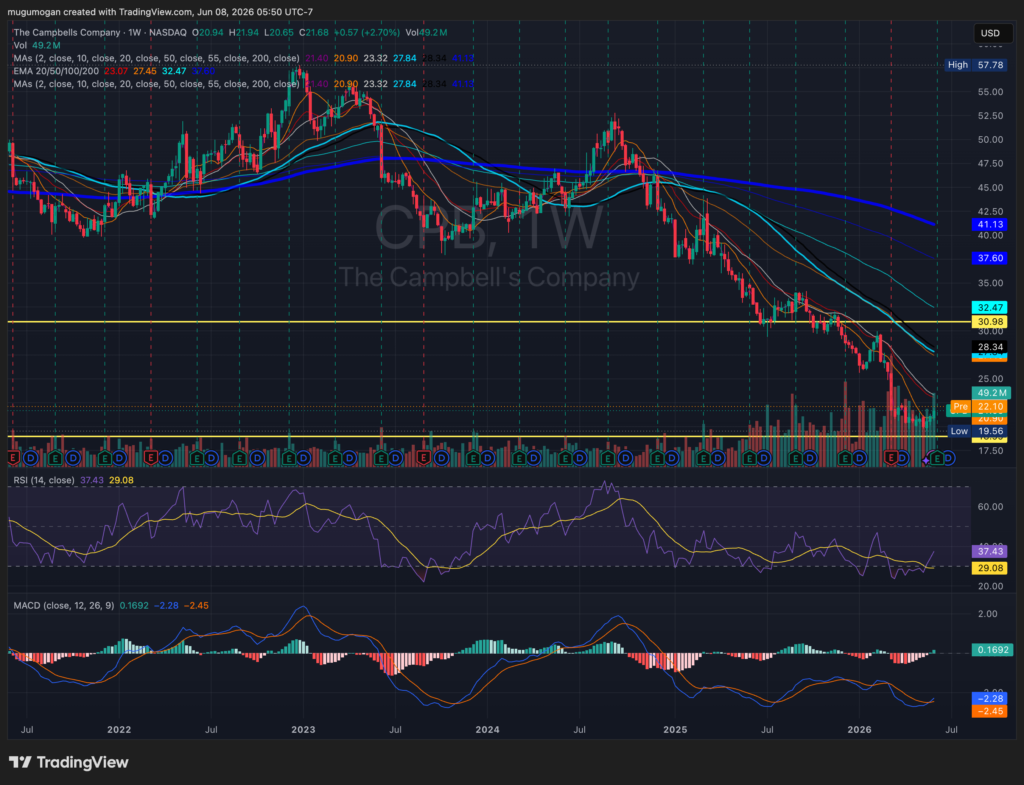
CPB remains in a well-established weekly downtrend, with price trading below every major moving average and all moving averages sloping downward. The stock is attempting to stabilize near long-term support around $19.50–20.00, while RSI is emerging from oversold territory and MACD is showing early signs of a bullish crossover. A successful hold above $20 could produce a relief rally toward the $28–31 resistance zone, which aligns with multiple declining moving averages. The primary trend remains bearish until CPB can reclaim and hold above $31, making this a potential bottoming attempt rather than a confirmed trend reversal.