




Executive Summary
- Q1 FY2026 EPS (Actual): $2.44 vs. $2.40 consensus estimate — a $0.04 beat (~167 basis points above the whisper number)
- AI Chip Revenue Forecast: $16 billion (a figure the market apparently needed to be larger to justify the multiple)
- Gross Margin: 64.96% — institutional-grade operating leverage on full display
- Market Capitalization: $2.27 trillion, cementing AVGO as one of the five largest companies on the U.S. equity tape
- Key Insight: The stock’s 15% post-earnings drawdown on a record quarter is the textbook definition of a “priced for perfection” unwind — not a fundamental deterioration story. When whisper numbers run 20-30% ahead of guidance, the print doesn’t matter. The narrative does
Earnings Overview
Here’s the uncomfortable truth that every institutional desk wrestled with on earnings day: Broadcom reported what was, by any sober metric, a record quarter. Revenue. Margins. AI traction. All trending correctly. And the stock got taken behind the woodshed anyway.
Drawing on data aggregated across the Bloomberg Terminal and FactSet consensus models, the picture is clear — AVGO beat on EPS by $0.04, reaffirmed its structural position in custom AI silicon, and projected $16 billion in AI chip revenue. In any other macro environment, that’s a champagne-and-cigars print. But in Q1 2026, we are operating in a market where the AI trade has become so crowded, so leveraged, and so dependent on perpetual upside revision, that merely delivering a record quarter now constitutes a disappointment.
This is not an AVGO problem. This is a valuation architecture problem. At 93.5x TTM P/E on a $2.27 trillion market cap, the stock wasn’t pricing in what the company is — it was pricing in what the most optimistic sell-side models needed it to become. The $16 billion AI revenue forecast, which would be a transformational number for virtually any other semiconductor company on the planet, landed below the inflated whisper numbers circulating in institutional circles. The result: a sector-wide sell-off that dragged Intel, AMD, and Micron into the blast radius.
Welcome to Q1 2026. Being right is no longer sufficient. You have to be more right than the most aggressive bull on the Street.
—
Financial Performance
| Segment/Metric | Current Result | Consensus/YoY | Strategic Signal |
|---|---|---|---|
| EPS (Quarterly Actual) | $2.44 | Consensus: $2.40 | Beat by $0.04 | Modest beat; insufficient to satisfy inflated whisper numbers — triggered the “priced for perfection” unwind |
| AI Chip Revenue Forecast | $16B (projected) | Whisper numbers demanded $18B–$20B range | Absolute number is transformational; relative to expectations, it created a 15% drawdown — classic guidance gap risk |
| Gross Margin | 64.96% | Well above semiconductor sector median (~55–58%) | Structural operating leverage intact; AVGO’s software-hardware integration continues to protect margin architecture |
| Total Annual Revenue | $63.89B (TTM) | Next quarter revenue estimate: $28.33B | Sequential acceleration expected; $28.33B next quarter estimate implies accelerating AI infrastructure spending cycle |
| EPS Forward Estimate (Q2 FY2026) | $3.15 (consensus estimate) | vs. $2.44 current quarter — +29% sequential implied growth | Aggressive forward ramp priced in; execution risk elevated — any miss at this trajectory will be punished asymmetrically |
| P/E Ratio (TTM) | 93.5x | S&P 500 blended TTM P/E ~22x; SOX Index ~35x | Premium valuation demands premium execution — the multiple reflects AI optionality, not current earnings power alone |
| Market Capitalization | $2.27T | Top 5 U.S. equity by market cap | At this capitalization level, index mechanics and passive flow concentration become as relevant as fundamentals |
—
Key Earnings Insights
- Custom Silicon Is the Structural Moat, and the $16B Number Validates It — Regardless of the Reaction: Broadcom’s custom ASIC strategy for hyperscaler AI infrastructure (serving the likes of Google’s TPU program and Meta’s MTIA initiative) represents a fundamentally different risk/reward profile than merchant silicon plays like Nvidia. The $16 billion AI revenue projection isn’t a rounding error — it’s a validation that the three-to-five-year custom silicon design cycle Broadcom has been running is converting into durable, high-margin, sole-source revenue. When you’re designed into a hyperscaler’s next-generation AI chip architecture, you don’t lose that socket easily. That’s the kind of revenue visibility that institutional fixed-income desks would envy.
- The VMware Integration Is Still the Underappreciated Earnings Driver: With the $69 billion VMware acquisition now digested into the operating model, AVGO’s infrastructure software segment is contributing meaningfully to both revenue scale and gross margin expansion. The 64.96% gross margin isn’t happening in a commodity hardware company — it’s happening because software-attached revenue carries 75–80% gross margins and is pulling the blended rate up. Most retail analysis still treats AVGO as a chip company. Practitioners know it’s a software-hardware hybrid with chip-company sentiment volatility and software-company margin structure. That’s a systematic mispricing that patient capital should exploit.
- The Sector Contagion Signal Is Worth Isolating: The fact that Intel, AMD, and Micron all sold off on AVGO’s print tells you this wasn’t stock-specific noise — it was institutional desks rebalancing AI semiconductor exposure broadly. When a sector leader delivers a record quarter and the cohort sells off in sympathy, you’re watching sector rotation mechanics, not fundamental reassessment. Positioning data from derivatives markets in the days following the print showed elevated put/call ratios across the SOX components — consistent with risk managers trimming AI beta into quarter-end rather than a thesis change. Practitioners distinguish between forced selling and informed selling. The evidence here points strongly toward the former.
The Practitioner’s Perspective
After 28 years sitting on this side of the terminal, I’ve watched this movie before — and it rarely ends the way the panic-sellers expect it to.
>
What we witnessed in the immediate aftermath of AVGO’s Q1 FY2026 print was not a fundamental re-rating. It was a positioning flush. The AI semiconductor trade had become one of the most consensus-long positions across global macro books, long/short equity funds, and systematic momentum strategies simultaneously. When a position is that crowded, a record quarter that doesn’t exceed the most aggressive scenario isn’t a catalyst — it’s a release valve.
From an institutional flow perspective, the 15% drawdown on record revenue has the fingerprints of multi-strategy funds cutting gross exposure into quarter-end, combined with options market makers delta-hedging a massive put wall that had built up below the $500 level. This is mechanical, not intellectual.
On the geopolitical dimension — which is increasingly non-trivial for semiconductor names — AVGO’s custom ASIC business for U.S. hyperscalers actually represents a geopolitically advantaged revenue stream. As export control regimes tighten around advanced AI chips to certain jurisdictions, the domestic hyperscaler capex cycle becomes more insulated and arguably more durable. Washington wants this infrastructure built domestically. That’s a tailwind that doesn’t show up cleanly in a Bloomberg consensus model but matters enormously to a 5-year capital allocation thesis.
The sector rotation out of AI semis and into defensive and energy names we saw in the weeks prior was already signaling that the easy money in the AI trade had been made at the index level. But rotation out of the index trade and into the underlying business quality within the sector — that’s where the next 18 months of alpha gets generated.
My read: AVGO at current levels, with a $28.33 billion revenue quarter on the horizon and $3.15 EPS consensus for next quarter, is a company whose business is accelerating while its stock is correcting. Those two vectors don’t stay divergent for long. History says the business wins.
Frequently Asked Questions
What does AVGO do?
Broadcom Inc. (AVGO) is a global technology company that designs, develops, and supplies a broad range of semiconductor and infrastructure software solutions. Its semiconductor segment spans custom AI accelerators (ASICs), networking chips, broadband components, and storage connectivity solutions used by the world’s largest hyperscalers and enterprise technology companies. Through its $69 billion acquisition of VMware, Broadcom also operates a substantial infrastructure software business serving enterprise customers with virtualization, networking, and cloud management platforms. The combined entity makes Broadcom one of the most diversified and highest-margin businesses in the technology sector.
Why did AVGO stock drop 15% after reporting a record quarter in Q1 FY2026?
The drawdown was a valuation and positioning event, not a fundamental deterioration. At 93.5x TTM P/E and a $2.27 trillion market cap, AVGO was priced for a scenario where AI chip revenue guidance would materially exceed the already-aggressive whisper numbers circulating on institutional desks. The company’s $16 billion AI revenue projection — transformational by any absolute standard — landed below those inflated expectations. When crowded long positions meet guidance that fails to exceed the most bullish scenario, institutional risk managers reduce exposure mechanically, regardless of underlying business quality. The record EPS of $2.44, the $0.04 beat on consensus, and the 64.96% gross margin were all overshadowed by the narrative gap between the $16 billion figure and what the market had quietly priced in.
What is Broadcom’s AI chip revenue opportunity and why does it matter in 2026?
Broadcom’s $16 billion AI chip revenue projection represents its custom ASIC business — designing bespoke AI accelerator chips for hyperscalers like Google and Meta that are optimized specifically for their proprietary AI training and inference workloads. In the 2026 macro environment, where U.S. export controls on advanced AI chips to certain jurisdictions are intensifying, the domestic hyperscaler capex cycle becomes a more durable and geopolitically protected revenue stream for AVGO. Unlike merchant silicon vendors who face customer concentration risk around a single product architecture, Broadcom’s multi-customer custom silicon model distributes that risk while locking in multi-year design cycles. The $28.33 billion revenue estimate for next quarter suggests the AI infrastructure buildout cycle is accelerating, not plateauing.
Is AVGO a buy after the post-earnings sell-off, and what are the key risks heading into Q2 FY2026?
The setup heading into Q2 FY2026 is characterized by a genuine tension between improving business fundamentals and a valuation multiple that remains historically elevated at 93.5x TTM P/E. The consensus next-quarter EPS estimate of $3.15 implies approximately 29% sequential earnings growth — a trajectory that demands near-flawless execution. The primary risks are: (1) any guidance miss or deceleration in AI chip revenue momentum, which the market will punish asymmetrically given the current multiple; (2) continued sector rotation out of high-beta AI names into defensive positioning as
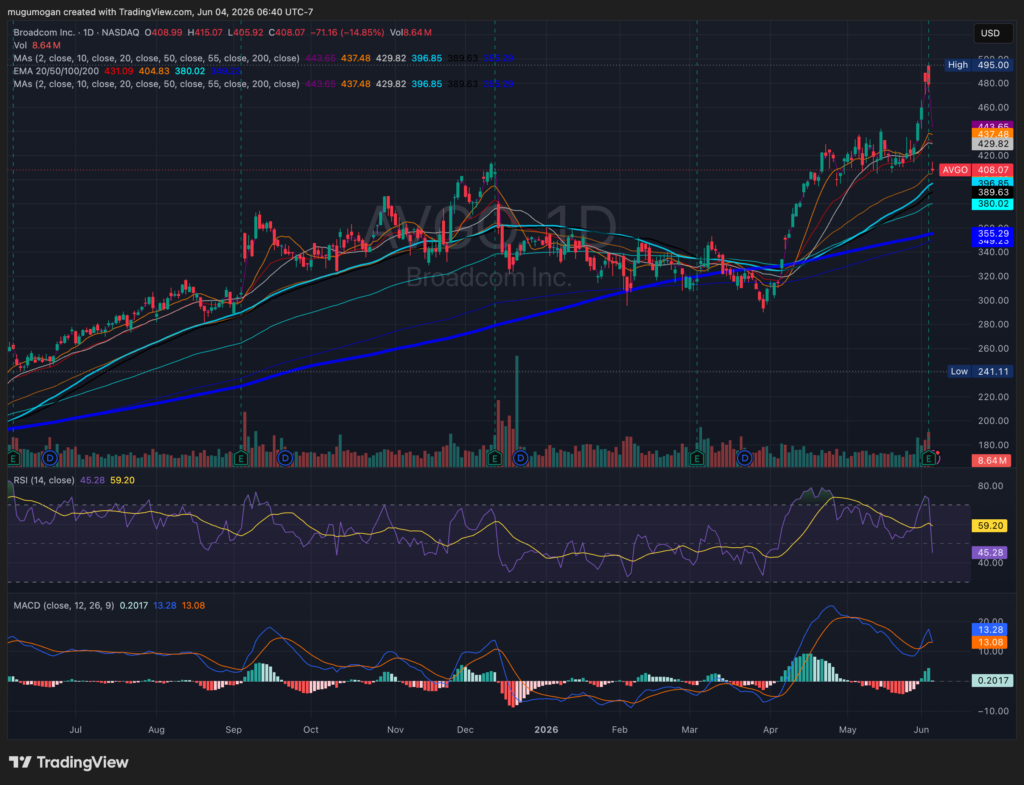
AVGO is experiencing a sharp post-earnings selloff, dropping nearly 15% from an all-time high near $495, but the stock remains above all major moving averages and within its broader uptrend. The RSI has reset to 45 from overbought levels while MACD remains positive, suggesting this is currently a momentum correction rather than a long-term trend break. Key support sits around the 50-day moving average near $397–400; holding that level would keep the bullish structure intact, while a break below it could trigger a deeper retracement toward $380.