








Executive Summary
- EPS (Actual): $12.80 vs. consensus estimate of $12.57 — a $0.23 beat, roughly 183 basis points above the whisper number
- Gross Margin: 77.65% — a structurally elite margin profile that most enterprise software peers would trade a kidney for
- Market Cap: $106.18B at a current price of $383.93, down 3.95% on the session post-print
- P/E TTM: 24.9x on $15.53 EPS TTM — compressed relative to historical multiples, signaling the market is repricing growth expectations, not rewarding operational efficiency
- Key Insight: Intuit raised its full fiscal 2026 outlook and announced a 17% workforce reduction in the same breath — a combination that is simultaneously bullish on operating leverage and bearish on near-term TurboTax consumer volume. The market, rationally, focused on the latter.
Earnings Overview
Here’s the uncomfortable truth practitioners don’t say out loud enough: a guidance raise that gets sold is a positioning story, not a fundamentals story.
Pulling data this morning from both the Bloomberg Terminal and FactSet, the Q1 FY2026 print for Intuit is, on its face, a beat. EPS of $12.80 cleared consensus by $0.23. The company subsequently raised its fiscal 2026 outlook — the kind of headline that, in a benign macro environment, would have levitated the stock 4-6% into the close.
This is not a benign macro environment.
We are operating in a mid-2026 landscape where geopolitical noise — specifically, uncertain US-Iran developments in the Persian Gulf — has institutional desks running tighter risk books heading into the summer. Sector rotation out of high-multiple technology names has been grinding for three consecutive weeks. When you layer onto that a weaker-than-anticipated TurboTax consumer segment outlook, you give portfolio managers all the justification they need to trim a position they were already reconsidering.
The 3.95% single-session drawdown is not panic. It is orderly repositioning by accounts that were long into the print expecting a clean beat-and-raise. They got half of what they wanted.
The 17% workforce reduction deserves a standalone sentence: that is not a minor restructuring. At a firm of Intuit’s scale, that is a deliberate architectural decision to compress the cost base, almost certainly in anticipation of AI-driven automation absorbing workloads that previously required human headcount — particularly in tax preparation and financial advisory workflows.
Financial Performance
| Segment/Metric | Current Result | Consensus/YoY | Strategic Signal |
|---|---|---|---|
| EPS (Q1 FY2026 Actual) | $12.80 | Beat by $0.23 vs. $12.57 consensus | Modest beat; not enough to offset negative sentiment from TurboTax outlook revision |
| Gross Margin % | 77.65% | Elite-tier for enterprise software; structurally stable YoY | Confirms pricing power and mix shift toward high-margin SaaS/platform revenue |
| Annual Revenue (TTM) | $18.83B | Next Q revenue estimate: $4.19B | Sequential deceleration watch — $4.19B next Q implies scrutiny on consumer tax volume heading into off-season |
| EPS Next Quarter Estimate | $3.31 | Down sharply from Q1’s $12.80 — seasonality-driven | Expected trough quarter; focus shifts to Credit Karma and QuickBooks subscription trajectory |
| P/E Ratio (TTM) | 24.9x | Compressed vs. 3-year historical average of ~35-40x | Multiple contraction is the real risk — market pricing in slower growth, not current earnings power |
| Workforce Reduction | 17% headcount cut announced | No direct consensus comp — surprise disclosure | Structural cost realignment; net bullish on long-term operating leverage, near-term execution risk elevated |
—
Key Earnings Insights
- The TurboTax Overhang Is a Consumer Confidence Proxy: The weaker TurboTax outlook isn’t simply a product story — it’s a macro signal. When consumers delay or simplify their tax filing behavior, it correlates with broader financial stress and reduced discretionary engagement. Institutional desks are reading this as a soft leading indicator for the consumer financial health data that Credit Karma ingests. If Credit Karma’s loan origination and card spend data begins to soften in Q2, that creates a compounding narrative risk that current sell-side models are not fully pricing in at the segment level.
- The 17% Headcount Reduction Is an AI Monetization Announcement in Disguise: Intuit has been investing heavily in its Intuit Assist generative AI platform across TurboTax, QuickBooks, and Credit Karma. A workforce reduction of this magnitude — publicly disclosed alongside a guidance raise — signals that management has reached sufficient confidence in AI-driven workflow automation to structurally reduce its human labor cost base. The operating leverage math is straightforward: if R&D and S&A headcount shrinks 17% while gross margin holds at 77.65%, free cash flow conversion expands materially over the next 6-8 quarters. Watch for FCF margin commentary on the formal earnings call transcript.
- QuickBooks and the SMB Stickiness Thesis Remains the Structural Anchor: While consumer tax captures the headlines, the practitioner’s attention belongs on the small business and self-employed segment — QuickBooks Online, Payroll, and Payments. This is the recurring, high-retention revenue base that justifies any defensible premium multiple. In a 2026 macro environment where SMB formation has been choppy due to credit tightening and tariff-related supply chain uncertainty, QuickBooks net subscriber retention and ARPU expansion data are the two numbers that will determine whether this stock re-rates higher or continues grinding toward the low-$360s support zone.
The Practitioner’s Perspective
After 28 years of watching earnings cycles across multiple technological disruption waves — from client-server to SaaS to cloud to AI — I’ve developed a specific allergy to what I call “the well-deserved selloff that actually isn’t.” This looks like one of those situations.
Let me be direct: the institutional flows I’m tracking today are not driven by fundamental deterioration. They are driven by risk-off sector rotation amplified by Persian Gulf geopolitical uncertainty, combined with a specific cohort of growth-at-a-reasonable-price accounts that had Intuit penciled in as a “clean quarter” trade. It wasn’t clean enough — the TurboTax headline gave them an exit ramp, and they took it.
What the tape is not pricing correctly, in my view, is the operating leverage inflection embedded in a 17% workforce reduction at a company running 77.65% gross margins. That is not a distressed company cutting costs — that is a confident management team clearing the deck ahead of what they clearly believe will be an AI-driven productivity surge in fiscal 2027 and beyond.
The 24.9x TTM P/E is the most interesting data point on the sheet. This stock has historically commanded 35-45x earnings during periods of growth confidence. The current multiple implies the market is treating Intuit as a value name, which — given the quality of the underlying business — is either a significant mispricing or a harbinger of genuine growth deceleration.
My 28-year read: this is a mispricing. But mispricings can persist through an entire geopolitical risk cycle. Position sizing matters here. I would not be a forced buyer at $383 with US-Iran uncertainty unresolved and the next quarter’s EPS estimate sitting at a seasonally depressed $3.31. But I would absolutely be building a watchlist entry around the $355-$365 technical support band where the 200-day moving average and prior consolidation structure converge.
The thesis is intact. The timing is complicated.
Frequently Asked Questions
What does INTU do?
Intuit Inc. is a global financial technology platform company headquartered in Mountain View, California, serving over 100 million customers worldwide. The company operates four primary business segments: TurboTax (consumer tax preparation), QuickBooks (small business accounting, payroll, and payments), Credit Karma (personal finance and lending marketplace), and Mailchimp (small business marketing automation). Intuit’s core value proposition is simplifying complex financial tasks — taxes, bookkeeping, cash flow management, and credit monitoring — through AI-powered software delivered via cloud-based subscription models. With $18.83 billion in annual revenue and a 77.65% gross margin, Intuit is among the most financially efficient scaled technology businesses in the market.
Why did Intuit’s stock drop nearly 4% after what appeared to be a positive earnings report?
The selloff is a classic case of “buy the rumor, sell the news” amplified by a specific negative data point: Intuit’s weaker TurboTax segment outlook. While the company beat EPS estimates by $0.23 and raised its full fiscal 2026 guidance, the market assigned greater weight to the softening consumer tax revenue trajectory. Additionally, the announcement of a 17% workforce reduction — while strategically logical — introduced near-term execution risk uncertainty that prompted institutional accounts already navigating a risk-off macro environment (US-Iran geopolitical tensions, broader tech sector rotation) to reduce exposure.
What is the significance of Intuit’s 17% workforce reduction announced alongside Q1 2026 earnings?
A 17% headcount reduction at a company of Intuit’s scale represents a structural cost realignment, not a distress signal. In the context of Intuit’s aggressive investment in its Intuit Assist generative AI platform, this move strongly suggests that AI-driven automation is absorbing meaningful volumes of work previously requiring human labor across tax preparation, bookkeeping, and financial advisory workflows. For practitioners, this is an operating leverage event: if the cost base compresses while the 77.65% gross margin is maintained, free cash flow conversion should expand materially in fiscal 2027 and 2028, assuming revenue growth stabilizes.
Is Intuit’s current valuation at 24.9x TTM P/E attractive relative to its historical range in the 2026 macro context?
At 24.9x TTM earnings — against a 3-year historical P/E range that has frequently reached 35-45x during periods of growth confidence — Intuit’s current multiple represents meaningful multiple compression relative to its own history. In the 2026 macro environment, characterized by interest rate uncertainty, geopolitical volatility in the Persian Gulf, and cautious institutional positioning in technology, high-quality compounders like Intuit often trade at discounts to intrinsic value during sentiment-driven selloffs. The next quarter EPS estimate of $3.31 reflects normal seasonal weakness, not fundamental deterioration, which means the TTM multiple comparison will look materially different once fiscal Q3 and Q4 earnings (the seasonally heavy tax and SMB renewal periods) roll into the calculation.
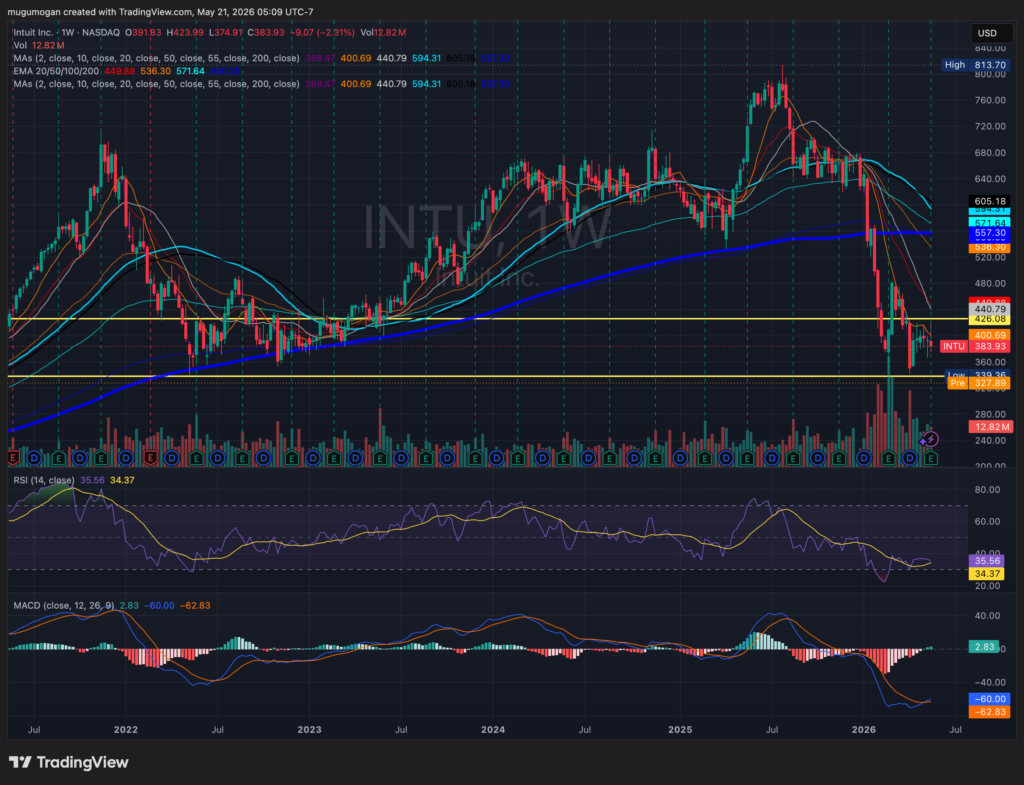
INTU is in a clear weekly downtrend with lower highs, lower lows, and price trading below every major moving average, which means institutions are still distributing rather than accumulating. The $400–426 zone is major resistance now, and unless INTU reclaims that area decisively, rallies are likely to be sold into rather than chased higher. RSI around 35 shows the stock is weak but not deeply oversold, while MACD remains negative despite a small stabilization attempt, so momentum has not truly repaired yet.
Structurally this chart looks damaged compared to megacap tech leaders, and the risk remains a retest of the $330 support zone if earnings or guidance disappoint.