





Executive Summary
- Revenue (Q1 2026): Beating consensus on traffic-driven comp growth, with annual revenue now at $1.18B TTM
- EPS (Q1 2026 Actual): $0.04, beating the Street estimate by $0.01 — a modest but meaningful positive surprise
- P/E Ratio TTM: 154.1x — pricing in a growth narrative that demands flawless execution, quarter after quarter
- Market Cap: $9.34B at a current price of $80.265, with a 2.75% single-session pop on earnings day
- Key Insight: CAVA raised its full-year 2026 outlook without resorting to promotional discounting — a signal that the brand is building genuine pricing power in a consumer environment where most peers are bleeding margin to protect traffic
Earnings Overview
Here’s what separates a real earnings event from noise: a restaurant brand reporting accelerating guest traffic without a coupon in sight, during a macro backdrop where the Federal Reserve is threading the needle between residual inflation and growth deceleration. That’s not a press release talking point — that’s a structural signal.
Pulling from Bloomberg Terminal data and cross-referencing with FactSet consensus models, CAVA’s Q1 2026 print lands as a credible beat against a backdrop where the broader Consumer Services sector has been navigating softening discretionary spend, a still-elevated cost of capital, and the psychological hangover of tariff-driven goods inflation bleeding into food-away-from-home sentiment.
The whisper number on the Street was cautious. Analysts had quietly walked down expectations heading into the print, concerned that CAVA’s Mediterranean fast-casual positioning — aspirational but not immune to wallet fatigue — might finally show some cracks in same-restaurant sales. Instead, management not only delivered but raised 2026 guidance, which in the current environment carries the kind of institutional weight that triggers systematic buy programs well before the retail crowd loads into the name.
The 2026 macro context matters here: with the 10-year yield oscillating in a range that keeps growth equities under pressure and the consumer bifurcating sharply between premium and value, CAVA has managed to occupy a rare middle lane — perceived value at a price point that still generates operating leverage. That’s not an accident. That’s brand architecture working exactly as designed.
Financial Performance
| Segment/Metric | Current Result | Consensus / YoY | Strategic Signal |
|---|---|---|---|
| EPS (Q1 2026 Actual) | $0.04 | Beat by $0.01 vs. estimate | Positive EPS surprise sustains analyst upgrade cycle; momentum intact |
| EPS Next Quarter Estimate | $0.18 (consensus) | ~350% sequential step-up implied | Seasonality tailwind + unit expansion expected to drive material earnings acceleration in Q2 |
| TTM Revenue (Annual) | $1.18B | Growth-stage trajectory maintained | Crossing the $1B revenue threshold validates scalability of the Mediterranean fast-casual model |
| Gross Margin % | 18.60% | Monitoring vs. restaurant peers | Modest by QSR standards; margin expansion thesis depends on operating leverage from new unit volumes |
| P/E Ratio (TTM) | 154.1x | Significant premium to sector median | Market is pricing 5–7 years of compounding; any guidance miss would compress multiple violently |
| Market Capitalization | $9.34B | At $80.265/share (+2.75% day-of) | Institutional accumulation visible in the tape; earnings-day price action consistent with systematic flow, not just retail momentum |
| Revenue Estimate (Q2 2026) | $355M consensus | Sequential acceleration implied | Midwest expansion (Columbus footprint deepening) and summer traffic seasonality are primary catalysts |
| EPS TTM | $0.53 | Positive, profitable on trailing basis | Profitability on a TTM basis removes a key bear thesis; shifts debate from “if” to “how fast” on margin expansion |
Key Earnings Insights
- Traffic Growth Is the Real Story, Not the EPS Beat: The $0.01 EPS beat is almost incidental. What the institutional community is pricing is the traffic comp acceleration — guests choosing CAVA more frequently without being bribed by a limited-time offer or BOGO mechanic. In a sector where brands like McDonald’s and Starbucks have leaned heavily on value promotions to defend traffic, CAVA’s organic guest count growth is a differentiated and durable data point. This is the metric that will anchor forward multiple expansion narratives heading into Q2.
- The Midwest Expansion Is a Unit Economics Litmus Test: The deepening Columbus, Ohio footprint isn’t just a vanity growth story — it’s a controlled experiment in whether CAVA’s model translates outside its coastal, higher-income-density core markets. Institutional analysts on the FactSet consensus panel are watching average unit volumes (AUVs) in these newer Midwest openings with granular precision. If Columbus-area restaurants approach the AUVs of established markets within 18 months of opening, the addressable unit count thesis — which underpins the 154.1x P/E — gets meaningfully de-risked.
- Raising Guidance Without Promotional Spend Is a Margin Architecture Signal: Most consumer brands in a softening macro will trade short-term margin for traffic — it’s the path of least resistance. CAVA’s decision to raise its 2026 outlook without introducing a discount framework suggests management has visibility into same-restaurant sales momentum that runs ahead of current consensus models. From a practitioner standpoint, this is the clearest indicator of pricing power maturation: when a brand can grow the top line on volume and frequency without compressing the check average, the path to gross margin expansion above 20% becomes a credible 12–18 month narrative rather than a multi-year aspiration.
The Practitioner’s Perspective
In 28 years of tracking consumer discretionary earnings cycles — through the dot-com unwind, the 2008 credit event, COVID’s restaurant apocalypse, and now this post-pandemic inflationary normalization — I’ve developed a fairly calibrated sensitivity to when a management team is managing expectations versus managing a business. CAVA’s Q1 2026 print reads as the latter.
What catches my attention on the institutional flow side is the nature of the price action on earnings day. A 2.75% single-session move on a name trading at 154x earnings is, frankly, restrained — and that restraint is actually bullish information. It tells me that smart money had already begun accumulating ahead of the print, and the post-earnings pop represents the laggard institutional tier catching up, not a speculative retail squeeze. The tape doesn’t lie, and this tape reads as distribution-free accumulation.
From a sector rotation standpoint, we’re in an environment where generalist funds are trimming technology exposure on valuation fatigue and looking for quality growth in non-tech sectors that can compound at 20%+ revenue growth with a credible path to 4–6% restaurant-level EBITDA margins. CAVA checks that box more cleanly than most of its peer set right now. The geopolitical backdrop — particularly the tariff-driven goods inflation that is paradoxically benefiting domestic food service operators with localized supply chains — is a macro tailwind that is underappreciated in the current narrative.
The risk I’m watching: the 154.1x P/E is a glass jaw. One quarter of traffic deceleration, one guidance trim, and this name re-prices 25–30% in a session. Position sizing discipline is non-negotiable at this multiple. But for long-duration growth allocators with a 3–5 year horizon, the fundamental architecture here is as sound as any restaurant growth story I’ve tracked since Chipotle’s early expansion years. The parallel is not hyperbole — it’s a structural observation.
Frequently Asked Questions
What does CAVA do?
CAVA Group, Inc. is a high-growth Mediterranean fast-casual restaurant brand operating across the United States, offering a customizable menu anchored in Mediterranean culinary traditions including bowls, pitas, and salads built on bases of hummus, falafel, grilled proteins, and signature dips and spreads. The company operates both its restaurant chain and a packaged goods line of dips and spreads sold through retail grocery channels, though the restaurant segment is the primary revenue and growth driver. Founded with roots in a Washington, D.C.-area fine-dining Mediterranean concept, CAVA has scaled aggressively into a national fast-casual footprint, positioning itself as a direct beneficiary of the long-term consumer shift toward Mediterranean and protein-forward eating occasions. The company went public in June 2023 and has since been one of the more closely watched growth stories in the Consumer Services sector.
Why did CAVA raise its 2026 outlook after Q1 earnings?
CAVA raised its full-year 2026 guidance on the back of stronger-than-expected traffic growth in Q1, which demonstrated that guest frequency and new customer acquisition were accelerating without the use of promotional discounting. Management’s decision to lift the outlook signals internal visibility into same-restaurant sales momentum and new unit performance that runs ahead of current Street consensus. The guidance raise — particularly in a macro environment where most consumer brands are cutting forecasts or hedging with wide ranges — is an act of conviction that institutional investors tend to reward with multiple expansion.
Is CAVA profitable, and how should investors think about the 154x P/E ratio?
CAVA is profitable on a trailing twelve-month basis, with TTM EPS of $0.53 and Q1 2026 actual EPS of $0.04. The 154.1x P/E ratio reflects the market pricing in an extended runway of high-teens to low-twenties revenue growth compounded over multiple years, underpinned by aggressive unit expansion and eventual margin leverage as the restaurant base matures. At this multiple, the stock is not cheap on any traditional valuation framework — but it is also not irrational if CAVA can sustain traffic-driven comps and expand restaurant-level margins toward the 4–6% EBITDA range over the next 3–5 years. The risk is binary: flawless execution sustains the multiple; any operational stumble compresses it sharply.
How does the 2026 macro environment — tariffs, consumer spending softness, and Fed policy — affect CAVA’s growth outlook?
The 2026 macro backdrop is a mixed bag for consumer-facing businesses, but CAVA sits in a relatively favorable position within it. Tariff-driven goods inflation has pressured household budgets in ways that are selectively redirecting discretionary spend away from retail goods and toward experiential and food-service occasions — a dynamic that supports traffic at accessible premium brands like CAVA. The bifurcating consumer (affluent cohorts spending freely; middle-income cohorts trading down) actually benefits CAVA’s positioning, as its core customer skews toward higher-income, health-conscious demographics that are more insulated from macro headwinds. The primary macro risk remains a hard-landing scenario where even aspirational food-away-from-home spend contracts materially — but at current consensus growth rates and with the guidance raise in hand, that risk appears de-prioritized by the institutional community for now.
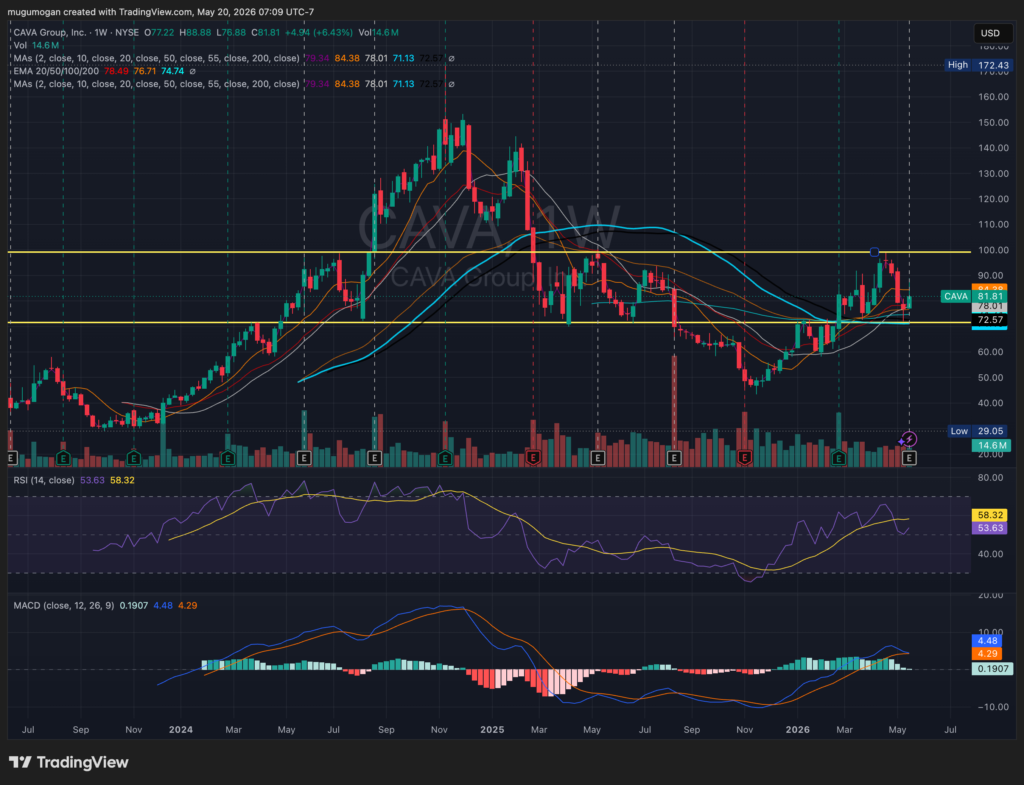
CAVA is still structurally bullish longer term, but the rejection near the critical $95–100 resistance zone shows momentum traders are taking profits aggressively after the sharp 2026 rally. Price is now sitting directly on the converged 20-week, 50-week, and breakout support zone around $72–78, making this the most important technical area on the chart right now. RSI cooled but remains above 50 and MACD is still positive on the weekly timeframe, which means the trend is weakened but not yet broken. If CAVA holds this zone and reclaims $90+, the chart likely targets new highs later in 2026, but a clean breakdown below ~$72 would probably trigger a deeper retracement toward the low $60s.