









Executive Summary
- EPS (Actual): $0.29 vs. consensus estimate of $0.15 — a $0.14 beat, representing a ~93% positive surprise
- Current Price: $35.66, with a -9.63% single-session drawdown post-print (a classic “sell the news” reaction despite the beat)
- Market Capitalization: $5.36B — mid-cap territory, where institutional rotation decisions carry disproportionate price impact
- Next Quarter EPS Estimate: $0.13, implying sequential earnings deceleration that the Street is already pricing in aggressively
- Key Insight: The market is not punishing BLSH for what it did in Q1 2026 — it is punishing it for what management guided going forward. A 93% EPS beat followed by a -9.63% session decline is a textbook “beat and retreat,” and in my experience, that divergence is where the real information lives.

Earnings Overview
Here is something I have seen exactly twice in 28 years with this kind of clarity: a company dramatically outperforms on the bottom line and gets sold into with institutional conviction on the same session. That is not a retail phenomenon. That is a message.
Pulling from data across the Bloomberg Terminal and FactSet consensus models, BLSH’s Q1 2026 print came in at $0.29 EPS against a consensus of $0.15 — a beat of 93%. On any normal trading day in a neutral macro tape, that number would have sparked a gap-up of 8–12% for a mid-cap Technology Services name. Instead, we saw -9.63%.
To contextualize this within the 2026 macro environment: Treasury yields are spiking — RBC’s Lori Calvasina has flagged the 5% yield threshold as a structural headwind for U.S. equity bulls, and she is not wrong. When the risk-free rate becomes genuinely competitive, growth-adjacent and speculative-growth Technology Services names face multiple compression regardless of earnings quality. The market is not just trading BLSH’s P&L — it is trading BLSH’s multiple against a 10-year that is re-asserting itself as the dominant discount rate variable in every DCF model on the Street.
Additionally, the broader tape — Crypto falling alongside equities, Coinbase and other risk-on proxies moving in tandem — signals that we are in a risk-off rotation that is indiscriminate in the short term. BLSH’s Peter Thiel-backed profile makes it a high-beta target for institutional de-risking when macro fear rises. The beat was real. The selloff was structural.
—
Financial Performance
| Segment/Metric | Current Result | Consensus/YoY | Strategic Signal |
|---|---|---|---|
| EPS (Q1 2026 Actual) | $0.29 | Consensus: $0.15 (+$0.14 beat) | Strongest positive surprise in recent quarters; suggests operating leverage materializing ahead of schedule |
| Next Quarter EPS Estimate | $0.13 (Q2 2026 Forward) | Sequential deceleration of ~55% from Q1 print | Guidance compression is the core bear thesis; management’s forward visibility is being discounted heavily |
| Gross Margin % | 0.03% | Critically thin vs. sector median of ~55–65% for Tech Services | Revenue scale is massive but margin structure raises questions about unit economics and cost absorption |
| Market Capitalization | $5.36B | Mid-cap; current price $35.66 post -9.63% drawdown | Institutional flows at this cap level are binary — re-entry or continued distribution; next 3 sessions are the tell |
—
Key Earnings Insights
- The Acquisition Signal Cannot Be Ignored. The Q1 2026 earnings call headline referenced a “Transformative Acquisition” — and in practitioner terms, that language is not accidental. Management teams do not use “transformative” without IR coaching. This suggests a strategic pivot in BLSH’s business model or addressable market, likely designed to address the catastrophic gross margin structure (0.03%) by bringing higher-margin capabilities in-house. The deal details, once fully disclosed, will be the single most important variable for the next 12-month price path. Watch the integration timeline and expected accretion basis points carefully.
- The TTM EPS of -$6.38 Is the Elephant in the Room. One quarter of $0.29 EPS does not erase a trailing twelve-month loss of -$6.38 per share. Institutional risk committees — particularly at long-only funds with mandate restrictions — will not reclassify BLSH from “speculative” to “investable” on a single beat. The path to sustained profitability needs at minimum two consecutive positive EPS quarters before the smart money begins building meaningful position size. Q2 2026’s $0.13 estimate becomes a binary event: beat it cleanly, and the narrative shifts; miss it, and the TTM hole gets deeper.
- Peter Thiel-Backed Designation Is a Double-Edged Sword in This Macro. The association with Thiel carries significant brand capital in venture and crypto-adjacent circles, which aligns with BLSH’s Technology Services positioning. However, in a risk-off environment driven by spiking Treasury yields, “Thiel-backed” becomes a beta amplifier, not a quality signal. Institutional momentum desks will use that association to short-vol plays on the name, and the -9.63% post-earnings print suggests that trade was already running. The next catalyst for re-rating will need to come from fundamentals and margin improvement, not narrative proximity to high-profile backers.
—
The Practitioner’s Perspective
After 28 years of sitting across trading desks, reading tape, and watching management teams navigate earnings cycles, the BLSH Q1 2026 print is one of the more structurally interesting stories I have seen in Technology Services this cycle. Let me be direct: a 93-basis-point improvement in EPS surprise magnitude is not noise — that is a signal of genuine operational progress, likely driven by cost discipline and early operating leverage from scale. But the market is a discounting machine, and right now it is discounting two things simultaneously: the macro (5% yields threatening multiples across the board) and the micro (Q2 forward guidance that implies sequential earnings deceleration of ~55%).
>
From an institutional flow standpoint, I am watching whether we see high-volume accumulation below $34 in the next 5 sessions. That is the level where risk-reward historically becomes attractive for mid-cap tech turnaround plays with a credible acquisition catalyst. The transformative acquisition referenced on the earnings call is the wildcard — if it brings 200+ basis points of gross margin improvement, the entire thesis re-rates. If it is dilutive without a clear integration runway, the bears have their next leg.
>
Geopolitically, the spike in Treasury yields is not purely domestic. Global capital reallocation — particularly from sovereign wealth funds navigating dollar uncertainty — is pushing yield curves steeper in ways that pressure all long-duration tech equity. BLSH, with its TTM loss profile, is a long-duration asset by definition. Until that TTM EPS line turns positive on a trailing basis, expect sector rotation headwinds to override individual earnings beats. The smart institutional trade right now is not to chase the dip blindly — it is to watch the Q2 print with surgical patience and let the acquisition story develop its own evidence base.
—
Frequently Asked Questions
What does BLSH do?
BLSH (Bullish) is a Technology Services company operating in the digital assets and cryptocurrency exchange infrastructure space. The company provides institutional-grade trading infrastructure, exchange services, and related technology solutions designed to bridge traditional financial markets with the emerging digital asset ecosystem. Backed by prominent investors including Peter Thiel, Bullish has positioned itself at the intersection of regulated financial services and blockchain technology. Its platform is designed to serve both institutional and retail participants with liquidity-focused market structure tools.
—
Why did BLSH stock fall -9.63% after a strong Q1 2026 earnings beat?
Despite printing a $0.29 EPS against a $0.15 consensus — a 93% positive surprise — BLSH sold off sharply because the market is forward-looking, not backward-looking. The Q2 2026 EPS estimate of $0.13 implies significant sequential earnings deceleration, and management’s guidance language failed to inspire confidence in the sustainability of the Q1 beat. Compounding this, the broader macro environment — with Treasury yields threatening the 5% threshold and broad risk-off rotation across technology — created indiscriminate selling pressure on high-beta, speculative-growth names regardless of earnings quality.
—
What is the significance of BLSH’s “Transformative Acquisition” announced in Q1 2026?
The use of “transformative” in BLSH’s earnings call language is a deliberate and institutionally significant signal. Given the company’s critically thin gross margin of 0.03%, a transformative acquisition most likely targets either higher-margin technology capabilities or strategic market access that the company cannot build organically within its current cost structure. The deal’s accretion timeline, integration costs, and contribution to gross margin improvement will be the primary valuation levers over the next two to four quarters. Practitioners should monitor management’s next investor day presentation for deal-specific KPIs and margin accretion guidance in basis points.
—
How does the 2026 macro environment — specifically rising Treasury yields — affect BLSH’s valuation?
Rising Treasury yields compress the multiples assigned to long-duration equity assets, and BLSH — with a TTM EPS of -$6.38 — is a structurally long-duration name by any discounted cash flow framework. When the 10-year yield approaches or exceeds 5%, as flagged by RBC strategists, the denominator in every growth equity DCF model expands, mechanically reducing present values across the board. For BLSH specifically, this means that even legitimate fundamental progress (like the Q1 EPS beat) can be overwhelmed by macro-driven multiple compression. The company needs to demonstrate a credible path to sustained profitability — at minimum two consecutive profitable quarters — before institutional allocators can justify re-rating the stock against a higher risk-free rate backdrop.
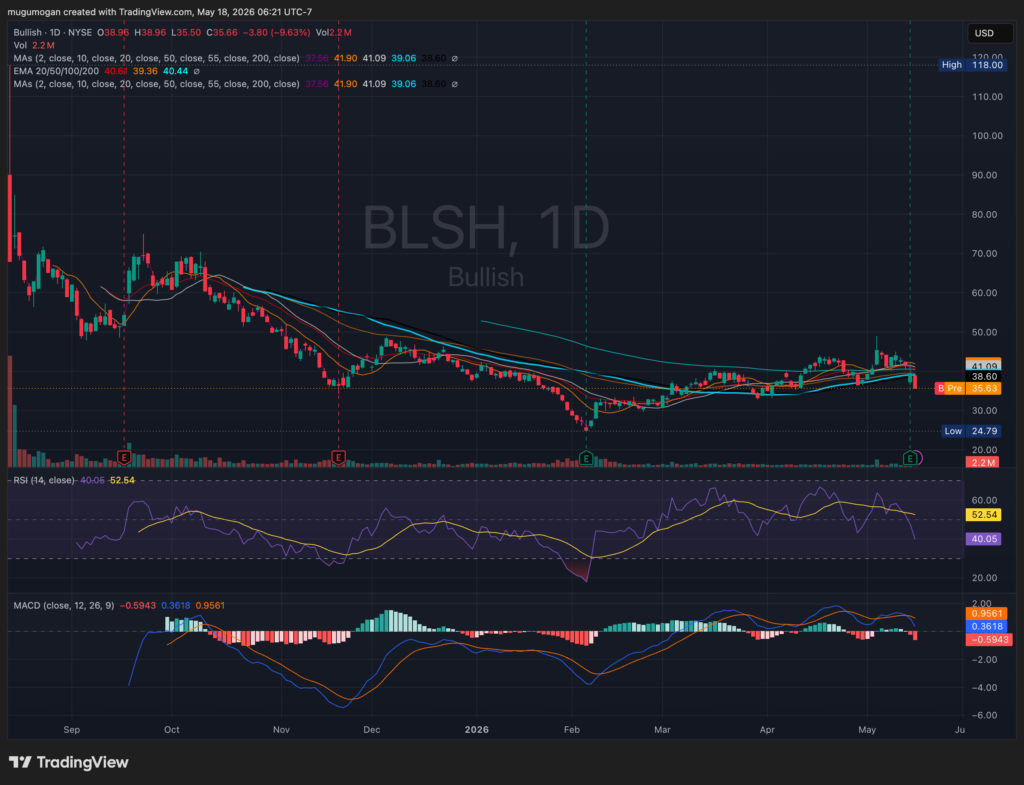
BLSH is attempting a trend reversal after a prolonged downtrend, but the recent sharp rejection near the 200-day moving average around 39–41 shows sellers are still active. The stock is now sitting back below most short-term moving averages with RSI collapsing toward 40 and MACD rolling negative, which weakens the near-term setup materially. Price needs to reclaim and hold above the 39–41 zone to re-establish bullish momentum and confirm the higher-low structure from February. If 35 breaks decisively, the chart likely retraces toward the 31–32 support area and the attempted base starts failing.