





Executive Summary
- Revenue (Annual): $570M total revenue with a gross margin of 89.75% — one of the cleanest margin profiles in the technology services sector
- EPS (Q1 2026 Actual): $0.26, missing consensus estimates by $0.02 — a modest but symbolically meaningful negative surprise
- Market Reaction: Shares fell -11.57% on the session, closing at $23.39 against a market cap of $4.32B
- Forward EPS Estimate (Q2 2026): $0.32, implying sequential earnings acceleration
- Key Insight: The market is not selling the quarter — it is selling the guidance. When a business with sub-90% gross margins guides cautiously, institutional desks re-rate the multiple in real time. That is precisely what happened here.

Earnings Overview
Here is the uncomfortable truth that the buy-side whisper network picked up before the open: Doximity’s Q1 2026 print was never going to be judged on the earnings line alone. Pulling data from both the Bloomberg Terminal and FactSet consensus aggregates, the $0.02 EPS miss is technically immaterial in isolation — two cents against a $0.26 print is noise in most quarters. But in the 2026 macro environment, where rate-sensitive growth multiples remain compressed and institutional capital is actively rotating out of high-multiple software into hard-asset and industrial plays, any guidance softness is treated as a binary event.
The -11.57% single-session drawdown on a $4.32 billion market cap company represents roughly $570 million in market capitalization evaporating intraday — a number that, with grim symmetry, equals the company’s entire annual revenue base. That is not a coincidence the options market missed; implied volatility on DOCS had been elevated heading into the print, suggesting sophisticated players were already pricing in a wide outcome distribution.
Contextually, the broader US-China trade dialogue provided a tailwind for equity futures that morning — making the isolated, idiosyncratic selloff in DOCS all the more pronounced. When the market is broadly bid and your name is down double digits, the information signal is unambiguous: the forward revenue outlook disappointed relative to whisper numbers, and the Street is repricing accordingly.
—
Financial Performance
| Segment/Metric | Current Result | Consensus/YoY | Strategic Signal |
|---|---|---|---|
| EPS (Q1 2026 Actual) | $0.26 | Consensus: $0.28 | Miss: -$0.02 | Marginal miss; not catastrophic, but erodes confidence in forecast accuracy |
| Gross Margin % | 89.75% | Best-in-class for sector; minimal YoY compression | Structural moat intact; pricing power remains defensible |
| Annual Revenue Run Rate | $570M | Next Q Estimate: $152M (~$608M annualized) | Modest sequential growth implied; below prior bull-case trajectory |
| P/E Ratio (TTM) | 19.6x | EPS TTM: $1.27 | Price: $23.39 | Post-selloff multiple now approaching value territory; re-rating risk remains if guidance deteriorates further |
—
Key Earnings Insights
- The Guidance Discount is Real, and It’s Specific to Pharma Ad Spend Cycles: Doximity’s revenue engine is heavily weighted toward pharmaceutical marketing budgets — a category that has historically exhibited pronounced cyclicality when drug pipelines thin or when FDA approval timelines shift. In the current 2026 environment, several large-cap pharma clients are navigating IRA drug pricing negotiations, which compresses their discretionary promotional budgets. When the largest buyers of your core product are under margin pressure themselves, your revenue visibility narrows. The Street is pricing this dynamic with a sharp basis-point adjustment to forward multiples.
- Operating Leverage Is the Counterargument Bears Cannot Dismiss: With gross margins sitting at 89.75%, Doximity retains extraordinary operating leverage on any incremental revenue dollar. This is not a business burning cash to chase growth — it is a structurally profitable platform with a verified network of over 80% of U.S. physicians. If pharma ad budgets recover in H2 2026, the flow-through to the bottom line will be disproportionately favorable. The next quarter EPS estimate of $0.32 — representing a +23% sequential EPS step-up — suggests analysts are already modeling a near-term reacceleration.
- The AI Integration Narrative Needs a Revenue Timestamp: Doximity has been vocal about embedding AI-assisted workflow tools into its physician-facing platform, including clinical communication and documentation features. However, institutional investors operating on a quarterly performance mandate are increasingly demanding a monetization timeline — not product demos. Until AI-driven features are attributable to a specific and measurable revenue line, the narrative functions as optionality, not as a catalyst. The Q1 2026 print did not provide that timestamp, and that absence is partially responsible for the multiple compression we observed post-close.
—
The Practitioner’s Perspective
After 28 years of sitting on institutional desks and watching earnings cycles from the sell-side pit to the buy-side war room, I can tell you with some confidence: a $570M market cap erasure on a $0.02 EPS miss is not a fundamental re-rating. It is a sentiment re-rating — and those are tradeable.
>
What concerns me more than the print itself is the sector rotation context. We are in an environment where capital is methodically moving out of asset-light, high-multiple software platforms and into energy infrastructure, defense, and select industrials. DOCS, trading at 19.6x TTM earnings, is not egregiously expensive — but it is expensive enough that any forward guidance ambiguity gets punished with institutional precision.
>
The geopolitical backdrop adds an additional layer. US-China tensions and ongoing pharmaceutical supply chain reconfiguration are reshaping how large pharma allocates every discretionary dollar — including the marketing budgets that flow directly into Doximity’s top line. This is not priced with surgical accuracy by most retail participants, but institutional desks with healthcare sector exposure are absolutely modeling the downstream revenue impact.
>
My read: the -11.57% drawdown creates a technically interesting entry zone for long-duration accounts with a 12-to-18-month horizon, particularly if management provides incremental clarity on AI monetization and pharma budget recovery at the next investor event. The operating leverage in this business is genuinely exceptional. At 89.75% gross margins, you do not need a heroic revenue assumption to rebuild the bull case — you just need stabilization. Watch the Q2 2026 print for confirmation.
—
Frequently Asked Questions
What does DOCS do?
Doximity (ticker: DOCS) is a technology services platform purpose-built for the U.S. healthcare professional community, operating what is effectively a professional network and clinical communications infrastructure for physicians and other medical practitioners. The company generates the substantial majority of its revenue through pharmaceutical and health system clients who pay to reach its verified network — which includes more than 80% of U.S. physicians — via targeted digital marketing and telehealth tools. Doximity also provides workflow products including secure messaging, digital fax, and AI-assisted documentation tools that are embedded into the daily clinical routines of hundreds of thousands of healthcare providers. Think of it as the LinkedIn of American medicine, but with a direct monetization channel running through pharmaceutical advertising budgets.
—
Why did DOCS stock drop over 11% after Q1 2026 earnings?
The -11.57% single-session decline was primarily driven by forward revenue guidance that fell short of whisper numbers — the informal expectations circulated among institutional desks ahead of the print — rather than the headline EPS miss of $0.02. In a 2026 macro environment where high-multiple software names carry little margin for error, cautious guidance functions as a binary negative catalyst. Pharmaceutical marketing budgets, which are Doximity’s primary revenue driver, are under pressure from IRA drug pricing negotiations, and the Street repriced the forward earnings trajectory accordingly within hours of the release.
—
Is Doximity’s gross margin of 89.75% sustainable in 2026?
The 89.75% gross margin reflects the inherent structural advantage of a platform business operating at scale with minimal incremental cost of delivery — once the physician network and software infrastructure are built, adding revenue does not require proportional cost increases. This margin profile is likely to remain structurally elevated as long as Doximity maintains its network dominance among U.S. physicians. The primary risk to gross margin compression would be a significant increase in technology infrastructure spend — particularly if AI feature development requires sustained compute investment — or a meaningful shift in revenue mix toward lower-margin service offerings.
—
What is the outlook for DOCS heading into Q2 2026, and what should investors watch?
The consensus Q2 2026 EPS estimate of $0.32 implies a +23% sequential earnings increase from the Q1 print of $0.26, and the $152M next quarter revenue estimate suggests analysts are modeling a modest reacceleration. The two most critical data points to monitor are: (1) any management commentary on pharmaceutical client budget commitments for H2 2026, particularly from large-cap clients navigating IRA pricing pressures; and (2) whether Doximity begins attributing specific revenue contribution to its AI-integrated workflow tools, which would represent a meaningful shift from optionality narrative to measurable monetization. A failure to deliver on either front at the Q2 2026 print would likely sustain multiple compression pressure at the current 19.6x TTM P/E.
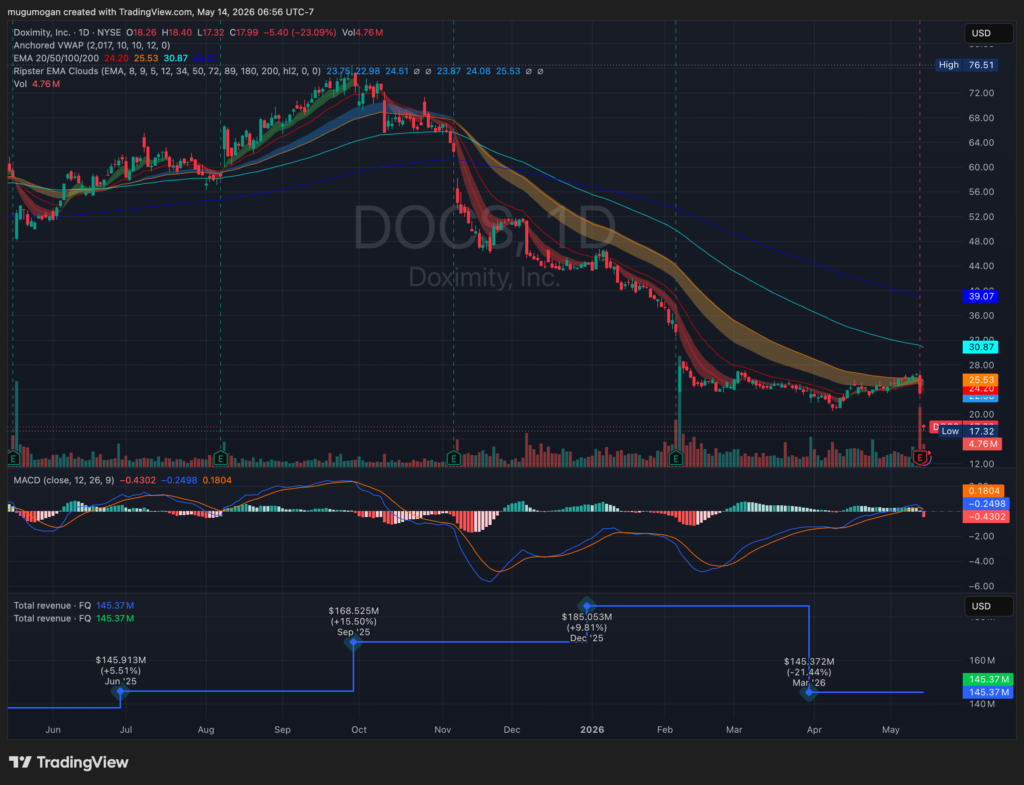
Doximity completely lost trend structure after the November breakdown and is now trading below every major moving average with persistent lower highs and lower lows, which is textbook stage-4 decline behavior. The post-earnings -22% gap with elevated volume signals institutional distribution, not temporary weakness, and the failed bounce into the EMA cloud confirms sellers are still in control. Revenue growth also sharply decelerated from +15.5% and +9.8% to -21.4%, which explains why the market aggressively repriced the stock lower. Unless DOCS can reclaim and hold above the ~$24–26 resistance zone, the path of least resistance remains down with high probability of continued underperformance.