






Nike is the world’s largest athletic footwear and apparel company, founded in 1964 and headquartered in Beaverton, Oregon. The company designs, markets, and sells athletic shoes, apparel, and equipment under the Nike, Jordan, and Converse brands. In fiscal 2024, Nike generated approximately $51 billion in revenue, growing low single digits year-over-year as demand softened in key regions. Its primary competitors include Adidas, Puma, and Lululemon, with competition intensifying across both performance and lifestyle segments. Nike’s scale, brand equity, and direct-to-consumer push have historically driven strong margins, but recent quarters show signs of strategic recalibration.

Latest Earnings — Mixed Execution with Weak Guidance
Nike reported its latest earnings this week (late March 2026), delivering revenue of approximately $12.4 billion and EPS of around $0.77. Revenue declined roughly 2–3% year-over-year, coming in slightly below analyst expectations, while EPS modestly beat due to cost controls and inventory normalization. North America showed flat growth, China rebounded modestly, but Europe remained weak. Gross margins improved sequentially due to discounting reductions, but overall demand softness persisted. Guidance for the next quarter was cautious, with management expecting low-single-digit revenue declines and continued pressure on wholesale channels, signaling a slower recovery than the market expected.
Founding and Evolution — From Running Shoes to Global Brand
Nike was founded by Phil Knight and Bill Bowerman as Blue Ribbon Sports before rebranding to Nike in 1971. The company initially focused on distributing Japanese running shoes before designing its own products, eventually pioneering performance footwear innovation. The introduction of Air cushioning technology and athlete endorsements, particularly with Michael Jordan, transformed Nike into a global cultural brand. Over decades, Nike expanded into apparel and equipment while building a dominant presence across sports categories. Its brand positioning evolved from performance-driven to a blend of sport, fashion, and lifestyle.
Product Portfolio and Business Model — Direct Shift Under Pressure
Nike’s business spans footwear (roughly 65% of revenue), apparel (30%), and equipment (5%). The company has aggressively shifted toward direct-to-consumer (DTC), including its website, SNKRS app, and owned retail stores. This strategy aimed to improve margins and customer data ownership while reducing reliance on wholesale partners. However, the pullback from wholesale has recently created distribution gaps, forcing Nike to re-engage partners like Foot Locker and others. Innovation cycles, particularly in running and basketball, have slowed relative to competitors, impacting product freshness.
Geographic Footprint and Expansion — China Still Critical
Nike operates globally, with North America contributing around 40% of revenue, followed by EMEA and Greater China. China remains a key growth driver long-term, despite volatility tied to macro conditions and local competition. Emerging markets provide incremental growth but are not yet material enough to offset weakness in developed regions. Currency fluctuations have also impacted reported growth, adding another layer of complexity.
Competitive Landscape — Crowded and Fragmenting
The athletic apparel market has become significantly more competitive over the past decade. Adidas remains a strong global competitor, particularly in lifestyle and soccer, while Lululemon has captured premium athleisure demand. On Running and Hoka (Deckers) are gaining share in performance running, one of Nike’s historical strongholds. Meanwhile, newer brands are winning with product innovation and community-driven marketing rather than traditional celebrity endorsements. This fragmentation is eroding Nike’s dominance in key categories.
Market Opportunity — Still Large but Slowing Growth
The global athletic apparel and footwear market is expected to exceed $600 billion by 2030, growing at a CAGR of roughly 6–8%. Growth is driven by health awareness, casualization of apparel, and emerging market expansion. However, the premium segment—where Nike plays heavily—is becoming saturated, with slower growth relative to newer performance niches. Digital commerce continues to expand, but customer acquisition costs are rising. Nike’s challenge is maintaining share in a growing but increasingly competitive market.
Industry Trends — Shift Toward Performance + Niche Brands
Consumer preferences are shifting toward specialized performance products, sustainability, and brand authenticity. Running, outdoor, and fitness-specific brands are gaining traction over generalized athletic brands. Social media and influencer-driven discovery are reshaping brand building, reducing Nike’s traditional marketing advantage. Additionally, supply chain diversification and nearshoring are becoming critical to managing costs and responsiveness.
Differentiation — Brand + Scale, But Losing Edge
Nike’s core differentiation lies in its unmatched brand equity, global distribution, and athlete endorsement ecosystem. Its ability to scale innovation globally remains a key advantage. However, the differentiation gap is narrowing as competitors innovate faster in specific categories. Nike’s storytelling and marketing still lead the industry, but product innovation cycles have not kept pace. The company is now attempting to rebalance between brand power and product relevance.
Management Team — Leadership Reset Phase
Nike is led by CEO John Donahoe, who took over in 2020 after leading ServiceNow and eBay. His focus has been on digital transformation and DTC expansion, though execution has faced criticism recently. CFO Matthew Friend has emphasized cost discipline and inventory management during the current slowdown. The leadership team is now pivoting toward restoring wholesale relationships and accelerating product innovation, signaling a strategic adjustment phase.
Financial Performance — Revenue Growth Slowing
Over the past five years, Nike’s revenue has grown from approximately $39 billion to $51 billion, representing a CAGR of around 5–6%. Growth peaked post-pandemic due to strong consumer demand but has since decelerated significantly. Recent quarters show flat to declining revenues, particularly in North America and EMEA. The DTC shift initially boosted growth but is now stabilizing.
Profitability Trends — Margins Under Pressure
Nike’s operating margins historically ranged between 12–15%, but have recently compressed due to discounting, inventory corrections, and higher logistics costs. Gross margins declined during the inventory glut phase but are now recovering modestly. Earnings growth has been inconsistent, with recent declines offset partially by cost-cutting measures. The company is prioritizing margin stabilization over aggressive growth in the near term.
Balance Sheet and Capital Allocation — Still Strong
Nike maintains a strong balance sheet with manageable debt levels and significant cash flow generation. The company continues to return capital through dividends and share buybacks, though at a more measured pace. Inventory levels have normalized after prior overstock issues, improving working capital efficiency. Financial flexibility remains a key strength, allowing Nike to invest in innovation and marketing.
Bull Case — Why It Could Work
Nike’s brand remains one of the most powerful globally, enabling long-term pricing power and customer loyalty. The reset in inventory and wholesale strategy could lead to cleaner growth and margin recovery over the next 12–24 months. A successful product innovation cycle, particularly in running and basketball, could reignite demand and market share gains.
Bear Case — What Could Go Wrong
Nike is losing share in key categories like running to faster-moving competitors with better product innovation. The DTC strategy missteps have created distribution challenges that may take multiple quarters to fix. Continued weak demand in North America and Europe could pressure revenue and margins longer than expected.
Analyst Reactions — Cautious Tone Emerging
Following the earnings release, analysts were mixed but leaning cautious. Several firms maintained neutral ratings, citing uncertainty around demand recovery and execution risk in the wholesale reset. Some price targets were trimmed due to weaker near-term guidance, while a few long-term bulls reiterated confidence in Nike’s brand strength and turnaround potential. Overall sentiment suggests patience is required, with limited near-term catalysts.
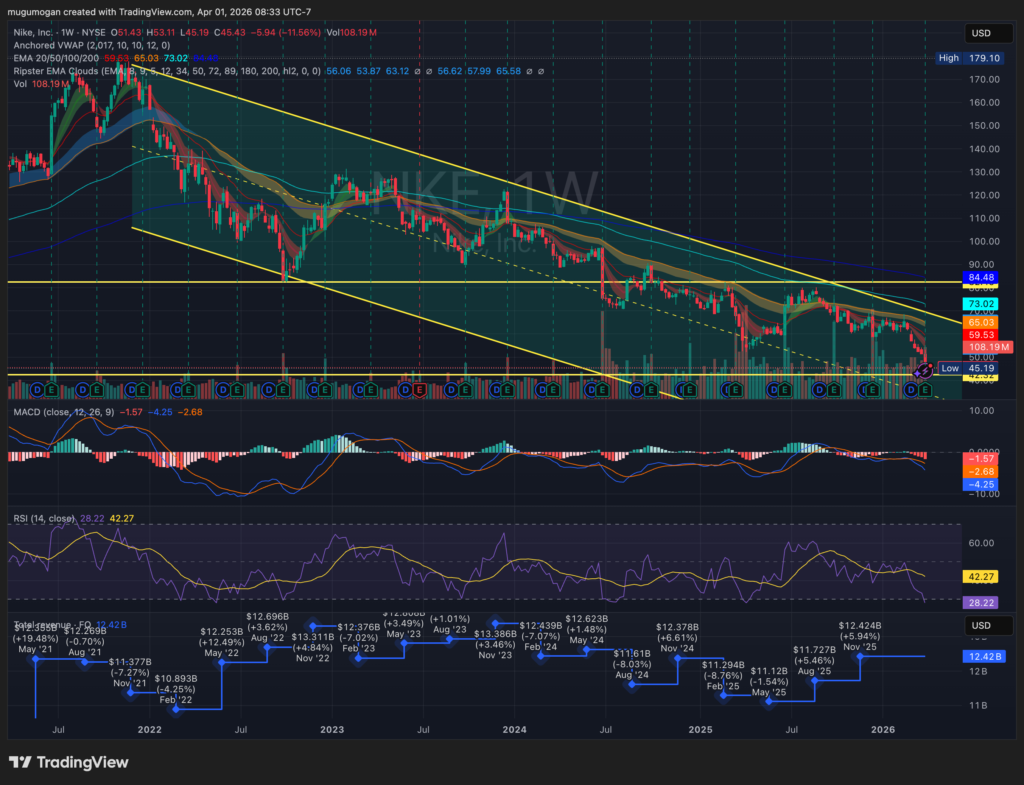
Nike is in a well-defined long-term downtrend channel, consistently making lower highs and lower lows, and it just broke down to fresh cycle lows around ~$45 with heavy volume—this is not what strength looks like. The price is trading below all major moving averages, and the anchored VWAP levels above (mid-$60s to $70s) now act as strong resistance zones. RSI is deeply oversold (~28), which may trigger a short-term bounce, but the MACD remains negative, indicating momentum is still bearish. Bottom line: any rally here is likely a dead-cat bounce unless it can reclaim and hold above the $60–$65 zone.