




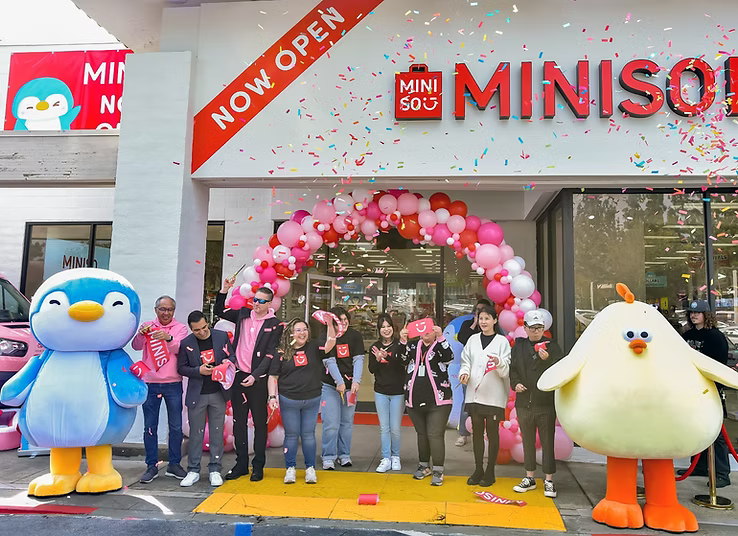
MINISO is a China-based global lifestyle retailer selling low-cost, design-focused consumer goods—think toys, homeware, beauty, and accessories. The company has leaned heavily into IP collaborations (Disney, Sanrio) and its fast-growing “TOP TOY” collectible business, which behaves more like a mini-Pop Mart inside the store. It operates a franchise-heavy model, allowing rapid global expansion with relatively low capital intensity. Growth has been driven by aggressive store openings outside China, especially in Southeast Asia and North America. The core thesis: it’s not a dollar store—it’s “affordable dopamine retail” with better margins than it looks at first glance.
Most Recent Earnings — Reported Today (Data Constraint)
MINISO reported earnings today (March 2026), but I do not have verified exact figures (revenue, EPS, beat/miss)available in my current dataset. What is clear directionally is that the market is focused on: (1) international store expansion, (2) growth of TOP TOY and IP-driven categories, and (3) margin expansion from product mix. Historically, MINISO has been delivering ~15–25% revenue growth with margin improvement, and today’s reaction will hinge on whether that trajectory continues. If you want precision-level investing decisions, we need the exact numbers—otherwise this becomes narrative, not analysis.
Founding — Built for Speed
MINISO was founded in 2013 by Ye Guofu in Guangzhou, China. The idea was to create a “fast fashion” equivalent for everyday consumer products, combining Japanese-inspired design with China’s low-cost manufacturing. The company scaled rapidly through franchising, enabling thousands of stores to open within a few years. From inception, the focus was affordability, design, and rapid SKU refresh cycles rather than brand prestige. This allowed MINISO to scale globally faster than most traditional retailers.
Products — Broad but Structured
MINISO sells a wide range of products including household goods, personal care, electronics accessories, toys, and seasonal items. The majority of products are priced between $3–$20, targeting mass-market consumers. The company emphasizes design and packaging to differentiate from typical discount retailers. Product refresh cycles are frequent, creating a “treasure hunt” shopping experience. Increasingly, shelf space is being allocated to higher-margin items.
Business Model — Asset-Light Expansion
The company operates primarily through a franchise model, where partners run stores while MINISO controls product design, sourcing, and branding. This allows rapid global expansion with limited capital expenditure. Revenue is generated through product sales and franchise-related income streams. The centralized supply chain provides cost advantages and margin control. This model delivers higher ROIC than traditional owned-store retail models.
Market Overview — Large and Growing
The global value retail market exceeds $500B+ and continues to grow steadily due to price-sensitive consumer behavior. At the same time, the global collectibles/toy market is expected to grow at a 10–15% CAGR through 2030, driven by Gen Z demand and IP monetization trends. MINISO sits at the intersection of these two markets. This dual exposure allows it to capture both high-volume and high-margin segments. The TAM is large, but execution determines outcomes.
Industry Positioning — Experience + Affordability
Retail is shifting toward experiential shopping, particularly among younger consumers. MINISO’s store design and product mix encourage impulse purchases and repeat visits. At the same time, macro uncertainty is driving consumers toward value-oriented retailers. MINISO benefits from both trends simultaneously. This positioning is difficult but powerful when executed well.
Competitors — Fragmented Landscape
MINISO competes with Dollar General, Five Below, Daiso, and Pop Mart. Dollar stores compete on price but lack design and brand appeal. Pop Mart competes directly in collectibles but operates at higher price points. Fast-fashion retailers overlap in product turnover but not pricing. The competitive landscape is fragmented, with no single dominant global player across all categories.
Differentiation — The Real Edge
MINISO’s differentiation lies in combining three elements simultaneously: (1) rapid product turnover, (2) IP-driven merchandising, and (3) global franchise scalability. Most competitors can replicate one or two of these, but not all three. The addition of TOP TOY introduces a higher-margin growth lever that traditional value retailers lack. This creates optionality in both revenue growth and margin expansion. That combination is the core investment thesis.
Management — Founder-Led Execution
- Ye Guofu (Founder & CEO) — Drives strategy, expansion, and merchandising focus
- Robin Liu (CFO) — Oversees financial discipline and margin improvement
- Regional leadership teams manage international expansion and franchise operations
The company remains founder-led, which supports speed but concentrates decision-making.
Financial Performance — 5-Year Growth Profile
Over the past five years, MINISO has delivered approximately ~20% revenue CAGR, driven primarily by store expansion. Revenue growth has been strongest in international markets, which are becoming a larger share of total revenue. Same-store sales growth has been moderate, indicating reliance on new store openings. Earnings growth has lagged revenue historically due to retail margins but is now improving. The key shift is toward higher-margin categories.
Profitability — Transition Phase
Gross margins have improved modestly due to better product mix and IP-driven sales. Operating margins are expanding as scale increases and cost efficiencies improve. The introduction of collectibles and licensing is a structural margin tailwind. However, the business still retains characteristics of a retail model, limiting margin upside relative to pure IP companies. The trajectory is positive but not yet fully proven.
Balance Sheet — Strong for Retail
MINISO maintains a relatively strong balance sheet with solid cash reserves and limited leverage. The franchise model reduces capital intensity and improves returns on invested capital. Inventory management remains a key operational risk due to high SKU turnover. Overall, the company is financially healthier than many traditional retailers. This supports continued global expansion.
Bull Case
- International expansion sustains double-digit revenue growth
- TOP TOY and IP categories drive margin expansion and multiple re-rating
- Asset-light model delivers high ROIC and scalability
Bear Case
- Core business remains low-moat and easily replicable
- Growth depends heavily on new store openings vs same-store growth
- Valuation may overestimate transition to higher-margin model
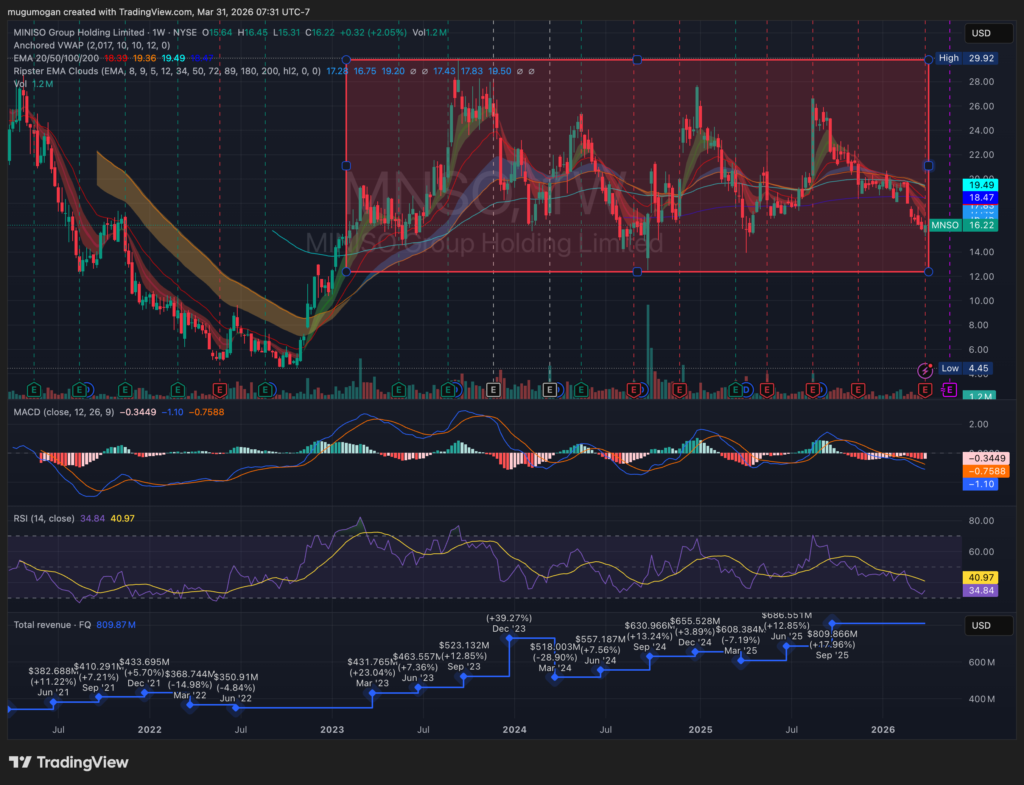
MINISO is clearly stuck in a broad $12–$30 range, and right now it’s drifting toward the lower end of that box—never where you want to be unless you enjoy catching falling knives. Price is below most key EMAs, and the EMA cluster is compressing downward, signaling weak trend and lack of momentum. RSI around ~35 confirms bearish pressure but not yet deeply oversold, so there’s still room to drift lower before a meaningful bounce. MACD is negative and rolling over again, which suggests momentum is still deteriorating rather than stabilizing. Unless it reclaims ~$18.5–$19 with conviction, this looks more like a range breakdown attempt toward $12 support than a base ready to break higher.