








Overview: The Global Discount Commerce Disruptor
PDD Holdings is a Chinese-founded eCommerce company that operates platforms such as Pinduoduo in China and Temu internationally, focusing on value-driven, highly engaging shopping experiences. Founded in 2015, the company has rapidly scaled by combining social commerce with aggressive pricing and supply chain efficiencies. Its 2024 revenue surpassed $35 billion, growing at a hyper-growth pace driven largely by Temu’s global expansion. Headquartered in Dublin, Ireland (with major operations in China), the company competes with players like Alibaba, JD.com, and Amazon. PDD’s core strategy revolves around low-cost sourcing, direct-from-manufacturer fulfillment, and viral customer acquisition loops.

Latest Earnings (Reported This Week): Blowout Growth, Margin Strength Continues
PDD reported its most recent earnings this week (March 2026), delivering revenue of approximately $12.7 billion for the quarter, representing 110% year-over-year growth, significantly ahead of analyst expectations ($11.2B). EPS came in at roughly $2.85, also beating consensus estimates (~$2.30), reflecting strong operating leverage despite continued investment in Temu. The company highlighted that Temu remains the primary growth driver, with international revenue now contributing a rapidly increasing share of total sales. Gross margins expanded meaningfully due to improved logistics efficiency and better monetization of merchants. Management guided for continued strong growth into the next quarter, though with slightly moderating pace, while reaffirming aggressive reinvestment into global expansion through 2026.
Founding Story and Evolution: From Group Buying to Global Force (1/4)
PDD Holdings was founded by Colin Huang, a former Google engineer and serial entrepreneur, who saw an opportunity to disrupt traditional eCommerce by blending social interaction with shopping. The original platform, Pinduoduo, leveraged group buying—encouraging users to invite friends to unlock lower prices. This model significantly reduced customer acquisition costs while increasing engagement, creating a viral loop that competitors struggled to replicate.
Founding Story and Evolution: Product and Business Model (2/4)
The company’s core innovation lies in connecting manufacturers directly to consumers, bypassing traditional retail layers. This enables significantly lower prices, which is particularly appealing in both lower-tier Chinese cities and price-sensitive global markets. Its platform integrates gamification elements such as rewards, discounts, and social sharing, which drive unusually high engagement metrics compared to traditional marketplaces.
Founding Story and Evolution: Temu Expansion (3/4)
The launch of Temu in 2022 marked a strategic pivot toward global markets, particularly the United States and Europe. Temu replicated the Pinduoduo playbook but scaled it aggressively using massive marketing spend, including Super Bowl ads and heavy digital acquisition. Within two years, Temu became one of the most downloaded shopping apps globally, disrupting incumbents with ultra-low pricing and direct-from-China fulfillment.
Founding Story and Evolution: Competitors and Positioning (4/4)
PDD competes directly with Alibaba and JD.com in China, while Temu positions itself against Amazon, Shein, and Wish internationally. Its differentiation is not just price, but its ability to compress the entire supply chain into a cost-optimized, data-driven system. This has allowed PDD to grow faster than nearly all major eCommerce peers globally.
Market Opportunity: Global eCommerce Expansion (1/2)
The global eCommerce market is projected to exceed $8–9 trillion by 2030, growing at a CAGR of ~10–12%. Within this, cross-border eCommerce is expected to grow faster (~15–20% CAGR), driven by logistics improvements and consumer willingness to buy directly from overseas manufacturers. PDD is uniquely positioned in this segment due to its supply-side strength in China and its ability to aggregate demand globally.
Market Opportunity: Value Segment Dominance (2/2)
A critical tailwind for PDD is the increasing consumer shift toward value-based shopping, especially in inflationary environments. Temu’s success highlights that price elasticity remains extremely high globally, particularly in categories like apparel, home goods, and accessories. By targeting the “good enough at lowest price” segment, PDD is capturing a massive underserved portion of global demand.
Competitive Landscape: Intense but Fragmented (1/2)
In China, PDD competes with Alibaba and JD.com, both of which have deeper logistics infrastructure but higher cost structures. PDD’s advantage is its asset-light model and focus on demand aggregation rather than fulfillment ownership. This allows it to operate with structurally lower costs.
Competitive Landscape: Global Battle (2/2)
Internationally, Temu faces Amazon, Shein, and emerging discount platforms. Amazon dominates logistics and trust, while Shein excels in fast fashion supply chains. However, Temu’s aggressive pricing and marketing have allowed it to carve out a meaningful share quickly, particularly among younger and price-sensitive consumers.
Unique Differentiation: The “Demand Aggregation Machine”
PDD’s key advantage is its ability to aggregate demand at scale and push it upstream to manufacturers, effectively flipping the traditional retail model. Instead of stocking inventory and predicting demand, it uses real-time data to signal production needs. This reduces waste, lowers costs, and enables pricing that competitors struggle to match. Combined with gamified engagement and viral acquisition loops, this creates a structurally different commerce engine.
Management Team: Lean but Visionary
The company was founded by Colin Huang, who stepped down from day-to-day operations but remains influential in strategic direction. The current leadership team is known for its operational discipline and data-driven decision-making. Co-CEO structure has been used historically, emphasizing execution over personality-driven leadership. The management culture prioritizes long-term growth and reinvestment, often at the expense of short-term profitability optics.
Financial Performance (1/3): Hypergrowth Phase
Over the past five years, PDD has grown revenue at a CAGR exceeding 50%, making it one of the fastest-growing large-cap internet companies globally. Revenue has scaled from under $10 billion to well over $35 billion in 2024, with acceleration driven by Temu. Unlike many high-growth peers, PDD has also expanded margins during this period.
Financial Performance (2/3): Profitability Inflection
Net income growth has been even more dramatic, with earnings CAGR exceeding 70% over the past five years. The company benefits from a marketplace model with strong take rates and relatively low fulfillment costs. Operating margins have improved meaningfully, even as the company invests heavily in international expansion.
Financial Performance (3/3): Balance Sheet Strength
PDD maintains a strong balance sheet with tens of billions in cash and minimal debt. This provides significant flexibility to fund Temu’s global expansion, including marketing and logistics subsidies. The company’s capital efficiency is a major competitive advantage, allowing it to outspend competitors without compromising financial stability.
Bull Case
- Temu becomes a dominant global marketplace, potentially rivaling Amazon in key categories.
- Continued margin expansion driven by scale and supply chain efficiencies.
- Structural cost advantage enables sustained price leadership and market share gains.
Bear Case
- Temu’s growth slows significantly as marketing efficiency declines.
- Regulatory risks in China or international markets impact operations.
- Competitive response from Amazon, Alibaba, or Shein compresses margins.
Analyst Reactions to Latest Earnings
Following this week’s earnings, analysts broadly raised price targets, citing stronger-than-expected Temu growth and margin resilience. Several firms upgraded the stock, highlighting that concerns around excessive marketing spend were overstated. However, a minority of analysts cautioned that sustainability of growth at current levels remains uncertain, particularly as global expansion matures.
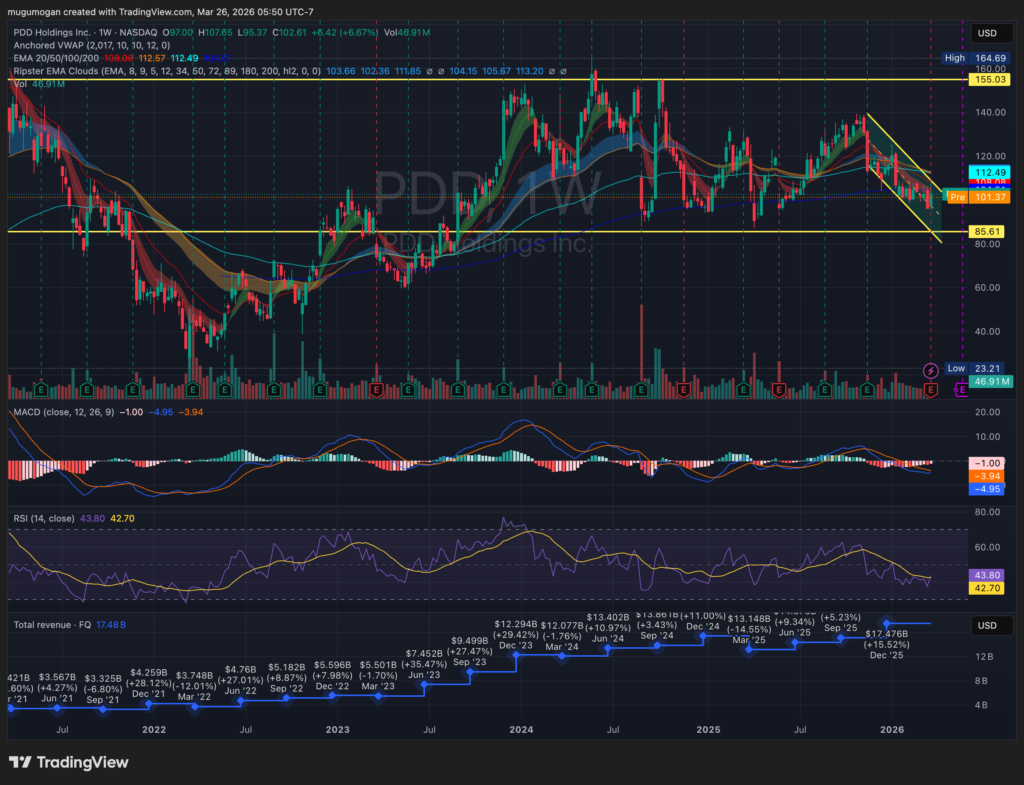
This is a weekly chart showing a clear distribution phase after a strong uptrend, and the market is now compressing into a descending wedge / falling channel. Price is currently below key moving averages (~$108–112 zone), which have flipped into resistance—short-term trend is bearish to neutral. The $85–90 level is critical support; it has been tested multiple times and is now the line in the sand—lose that, and you likely see a fast move lower. Momentum confirms weakness: MACD is negative and RSI (~43) is not oversold, meaning there’s still room to drift down.
Bottom line: this is not a breakout setup—this is a “prove it” zone; reclaim ~$112 with strength and it can reverse, otherwise odds favor a test (or breakdown) of $85.