






FedEx Corporation is one of the world’s largest transportation and logistics providers, best known for its overnight shipping and integrated supply chain solutions. Founded in 1971, the company operates through segments like Express, Ground, Freight, and Services, handling millions of packages daily across more than 220 countries and territories. FedEx generated approximately $90+ billion in annual revenue in fiscal 2024, with modest low-single-digit growth driven by e-commerce and international shipping demand. Headquartered in Memphis, Tennessee, the company competes primarily with United Parcel Service, DHL, and Amazon. Its core value proposition is time-definite delivery, global scale, and an integrated logistics network.
Recent Earnings Snapshot: Margin Story Still Playing Out
FedEx most recently reported earnings for the quarter ending December 2025 (Fiscal Q2 2026). The company delivered adjusted EPS of approximately $4.05, beating analyst expectations by roughly 5–7%, while revenue came in around $22.2 billion, slightly below consensus due to softer volume trends. Year-over-year revenue declined marginally (~1–2%), but operating income improved significantly due to aggressive cost-cutting under its DRIVE transformation program. Management reiterated full-year EPS guidance in the $17–$18 range and emphasized continued margin expansion rather than top-line growth. The next quarter guidance pointed to stable demand with incremental margin improvement, signaling a “profit over volume” strategy.
Origins and Evolution: The Overnight Delivery Pioneer
FedEx was founded by Frederick W. Smith, who famously conceptualized the hub-and-spoke delivery model while at Yale. The company launched operations in 1973 with 14 aircraft and quickly scaled by guaranteeing overnight delivery—a radical innovation at the time. Memphis was chosen strategically as a central logistics hub, enabling efficient nationwide distribution.
Over the decades, FedEx expanded through acquisitions and internal buildouts, including the launch of FedEx Ground (for cost-efficient parcel delivery) and FedEx Freight (LTL shipping). The company also invested heavily in global infrastructure, building a network that rivals national postal systems in scale and reliability.
Today, FedEx operates one of the largest cargo airline fleets globally and has deeply embedded logistics capabilities across air, ground, and digital systems. Its key competitors include UPS for premium logistics, DHL for international dominance, and Amazon, which is vertically integrating its own logistics network.
Market Landscape: A $10T+ Logistics Opportunity
FedEx operates within the global logistics and transportation market, which is estimated to exceed $10 trillion in total economic activity. The parcel delivery segment alone is projected to grow at a CAGR of 6–8% through 2030, driven primarily by e-commerce penetration, cross-border trade, and supply chain digitization.
Within this, express shipping (FedEx’s historical strength) is growing slower than ground delivery due to cost sensitivity among consumers and businesses. Ground and deferred shipping are expected to outpace express, forcing FedEx to rebalance its mix.
The long-term tailwind is clear: more packages, more frequently, across more geographies. But the industry is becoming margin-compressed due to pricing competition, fuel volatility, and rising labor costs.
Competitive Dynamics: Brutal and Capital Intensive
FedEx’s most direct competitor is UPS, which has consistently outperformed FedEx on margins (UPS operating margin ~12–13% vs FedEx ~7–9%). DHL dominates international markets, particularly in Europe and Asia, while Amazon is the wildcard—building a logistics network that increasingly bypasses traditional carriers.
Amazon’s internal shipping capability now handles over 70% of its own volume in the U.S., directly eroding FedEx’s potential growth in e-commerce fulfillment. Meanwhile, regional carriers and last-mile specialists are chipping away at profitability in dense urban areas.
Differentiation: Network Scale + Time-Definite Reliability
FedEx’s primary differentiation lies in its integrated air-ground network and time-definite delivery capabilities. Unlike many competitors, FedEx owns and operates a massive global air fleet, enabling precise delivery windows and international reach.
The company is also undergoing a structural transformation—merging Express and Ground networks to reduce redundancy and improve efficiency. If executed well, this could close the margin gap with UPS and unlock billions in cost savings.
Leadership: Founder DNA Still Present
The company is led by Raj Subramaniam, who took over as CEO in 2022 after decades within the organization. His focus has been on operational efficiency and network integration.
Frederick W. Smith transitioned to Executive Chairman, maintaining strategic influence while stepping back from day-to-day operations.
John Dietrich oversees financial strategy, particularly around cost discipline and capital allocation.
Financial Performance: Growth Stalled, Margins Improving
Over the past five years, FedEx has grown revenue from roughly $69 billion (FY2019) to over $90 billion (FY2024), representing a CAGR of ~5–6%. Growth peaked during the COVID-driven e-commerce boom but has since normalized.
Earnings growth has been more volatile. Operating income has fluctuated due to cost pressures, inefficiencies, and demand variability. However, recent restructuring efforts have driven a rebound in profitability, with operating margins improving from ~6% to closer to 9%.
The balance sheet remains solid, with manageable debt levels and strong cash flow generation. FedEx generates billions annually in free cash flow, enabling share buybacks and dividends while funding capital expenditures.
A key trend: FedEx is transitioning from a volume-driven business to a yield-driven one—prioritizing higher-margin shipments and shedding unprofitable volume.
Bull Case: Why This Could Work
FedEx successfully executes its DRIVE cost-cutting program, unlocking $4B+ in structural savings and closing the margin gap with UPS.
E-commerce and global trade rebound, driving higher shipment volumes without proportional cost increases.
Network integration (Express + Ground) materially improves efficiency, creating operating leverage at scale.
Bear Case: What Can Go Wrong
Amazon continues to internalize logistics, permanently capping FedEx’s growth in e-commerce.
Labor and fuel costs remain elevated, compressing margins despite cost-cutting efforts.
Execution risk: integrating complex global networks could lead to service disruptions or missed savings targets.
Analyst Reactions: Cautious Optimism
Following the latest earnings, analysts were generally constructive but not euphoric. Several firms raised price targets modestly (5–10%) citing margin improvement, while maintaining neutral-to-buy ratings.
There were no major downgrades, but skepticism remains around top-line growth. Analysts are effectively saying: “We believe the cost story—but show us sustained volume growth.”
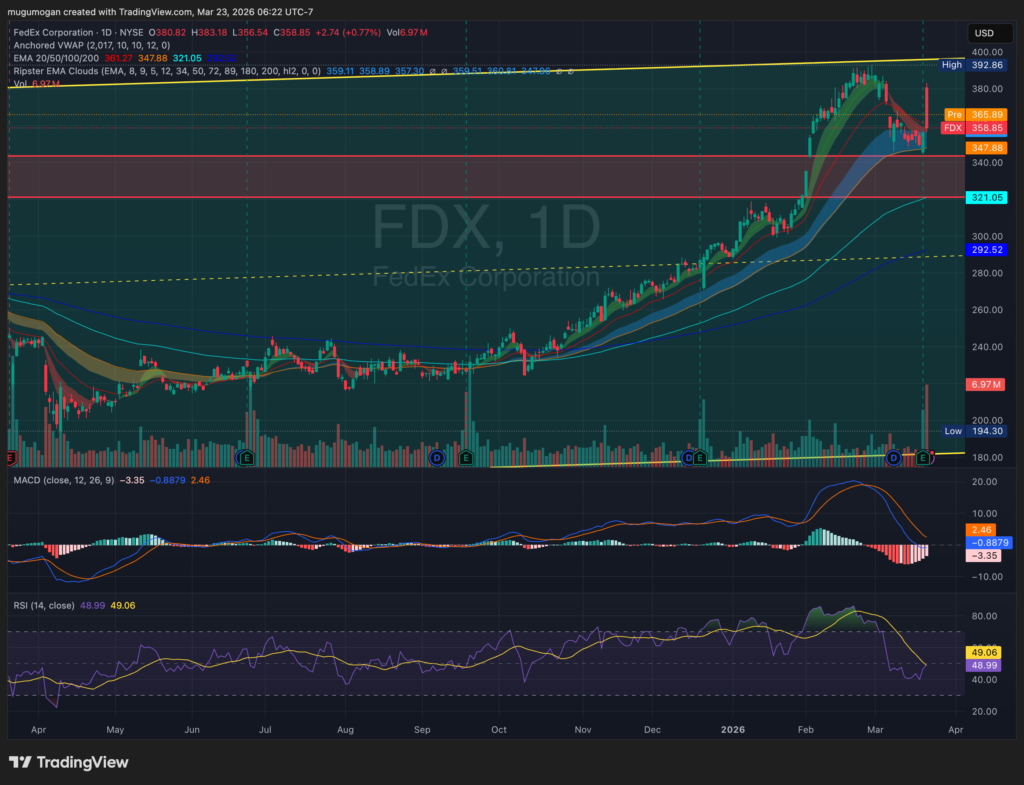
Long-term, FedEx Corporation remains in a clear uptrend within a rising channel, so the primary trend is still bullish. Short-term, however, the daily chart shows a loss of momentum after rejection near $390, with price now consolidating and sitting just above key support around $347. Indicators like RSI (~49) and a negative MACD suggest the stock is in a cooling phase rather than ready to run. If $350 holds, you could see a move back toward $370–$380, but a breakdown likely sends it to the $320 zone. Net: strong long-term story, but near-term patience will likely get you a better entry.