








Overview — Small Cap, Big Narrative Shift
Red Cat Holdings is a U.S.-based drone technology company focused on military, government, and commercial unmanned aerial systems (UAS). The company has aggressively pivoted from a fragmented drone roll-up into a defense-first platform centered around its subsidiary Teal Drones. Its core product, the Teal 2, is designed for short-range reconnaissance (SRR) missions, targeting U.S. military and allied defense contracts. Red Cat generated roughly ~$17–20M in annual revenue recently, but its valuation is driven far more by future defense pipeline expectations than current financials. Headquartered in San Juan, Puerto Rico, it competes with Skydio, AeroVironment, and Parrot in the rapidly evolving drone defense ecosystem.
Latest Earnings — Still Early, Still Volatile
Red Cat’s most recent earnings (late 2025) showed revenue in the low single-digit millions for the quarter, missing expectations due to timing of defense contract rollouts. EPS remained negative, with losses reflecting continued R&D investment and scaling costs tied to Teal 2 production. Management reiterated that revenue is highly “lumpy” due to government procurement cycles rather than demand weakness. Guidance emphasized a meaningful ramp in 2026 tied to U.S. Army SRR program participation and international defense orders. In short: fundamentals look weak on paper, but the company is pre-scale in a contract-driven market.
Origins — From Roll-Up to Focused Defense Bet
Red Cat was founded in 2016 as a drone services and analytics roll-up, acquiring smaller drone-related businesses to build a diversified platform. The original strategy lacked focus and struggled to generate meaningful scale or differentiation. The real inflection point came with the acquisition of Teal Drones, a U.S.-based manufacturer focused on secure, NDAA-compliant drones.
This pivot aligned Red Cat with a major geopolitical tailwind: the U.S. government’s push to reduce reliance on Chinese drone manufacturers like DJI. That shift effectively created a protected market for domestic drone providers, dramatically improving Red Cat’s strategic positioning.
The company divested non-core assets and consolidated around Teal, making defense its primary growth engine. This “focus after chaos” transition is critical—Red Cat today is not the same company it was pre-2022.
Products — Teal 2 Is the Entire Story
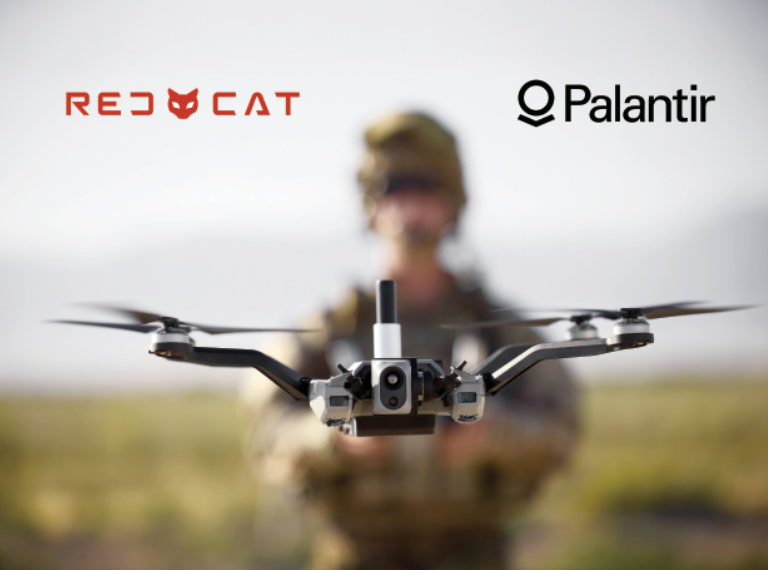
The Teal 2 drone is built specifically for military reconnaissance, featuring night vision, AI-based object detection, and secure communications. It is designed to meet the U.S. Army’s Short Range Reconnaissance (SRR) requirements—a key procurement program.
Unlike consumer drones, Teal 2 emphasizes ruggedization, cybersecurity compliance, and real-time battlefield intelligence. This is not a hobby drone—it’s a soldier’s tool.
Market — Defense Drones Are Exploding
The global military drone market is projected to grow from ~$15B today to ~$35–40B by 2030, implying a CAGR of ~12–15%. Within that, small tactical drones (like Teal 2) are one of the fastest-growing segments due to their use in modern warfare (Ukraine being the clearest proof point).
The U.S. Department of Defense alone is expected to spend billions annually on small UAS systems, with programs like SRR acting as major entry points for companies like Red Cat.
Geopolitics is the growth engine here. Every conflict is now a drone war.
Competitive Landscape — Not a Winner-Take-All Game
Red Cat competes primarily with:
- Skydio (U.S., privately held, strong AI autonomy)
- AeroVironment (NASDAQ: AVAV, established defense contractor)
- Parrot (Europe-based, defense pivot)
AeroVironment has scale and proven contracts. Skydio has superior autonomy software. Red Cat’s edge is compliance + focus on SRR niche.
This is not a monopoly market—multiple vendors will win contracts across different branches and allies.
Differentiation — The “Non-Chinese + Military-Specific” Advantage
Red Cat’s biggest advantage is simple but powerful: it is a U.S.-based, NDAA-compliant drone manufacturer at a time when Chinese drones are being systematically excluded from government use.
That alone creates a supply vacuum.
Add to that:
- Purpose-built military design (not retrofitted consumer drones)
- Focus on a specific program (SRR)
- Early positioning in a fragmented domestic market
It’s not the best tech story—it’s the right place, right regulation story.
Management — Founder-Led Transition Phase
Jeff Thompson (CEO) has been leading the company through its transition from a roll-up to a focused defense player. His background is more entrepreneurial than defense-native, which cuts both ways—flexibility vs execution risk.
The leadership team has been increasingly supplemented with defense and government contracting expertise, signaling a shift toward institutional maturity.
Still, execution risk remains high. This is not Lockheed Martin.
Financials — Pre-Scale, High Burn
Over the last 5 years, Red Cat’s revenue growth has been inconsistent, largely due to strategic pivots and divestitures. Revenue CAGR is misleading because the business model itself changed.
Losses have widened as the company invests heavily in:
- Manufacturing scale
- Product development
- Compliance and certifications
Balance sheet is relatively weak, with reliance on equity raises. Cash burn is a real constraint—this company needs contracts to hit before dilution hits again.
This is a classic “story stock before revenue catches up.”
Bull Case — Why This Could Work
- U.S. defense tailwinds + China ban = structural demand
- SRR program win could unlock exponential revenue scaling
- Small-cap leverage: even modest contracts can 3–5x revenue
Bear Case — Why This Could Fail
- Failure to secure or scale defense contracts
- Stronger competitors (Skydio, AVAV) dominate key programs
- Continued dilution due to weak cash flow
Analyst / Market Reaction — Narrative Driven
There is limited traditional analyst coverage given Red Cat’s size, but investor sentiment is heavily driven by:
- Contract announcements
- Department of Defense partnerships
- Geopolitical developments
Stock moves tend to be binary—up sharply on contract news, down sharply on delays.
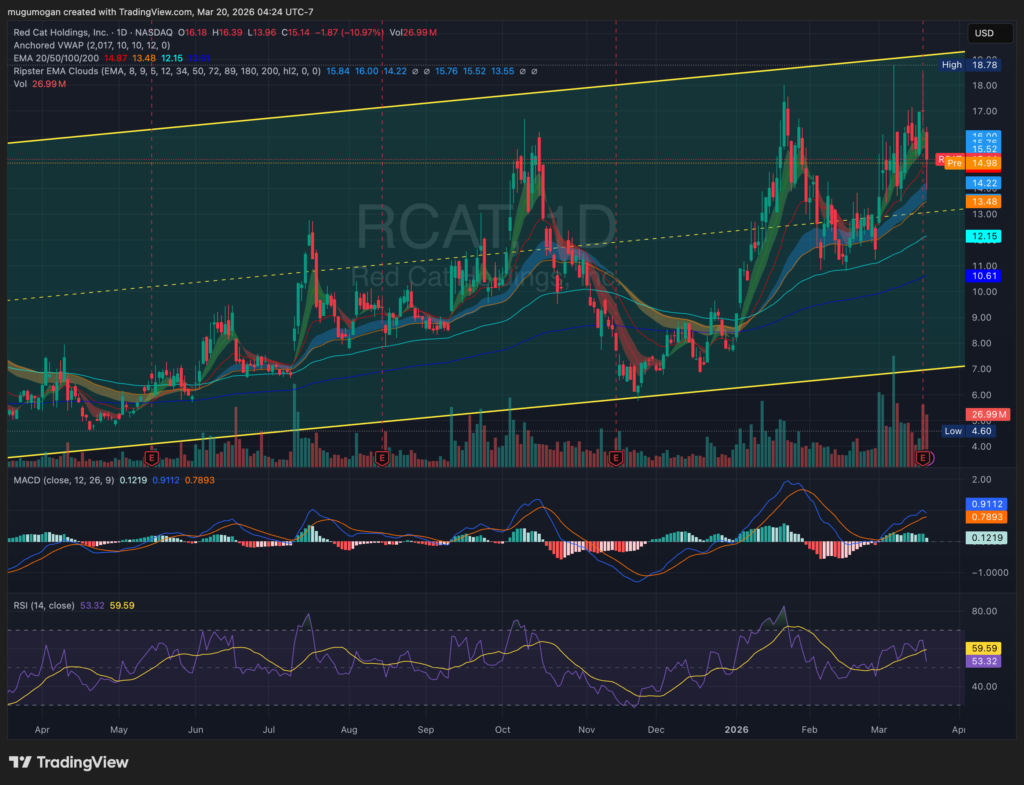
RCAT is in a strong uptrend within a rising channel, but it’s currently testing the upper band, which typically acts as resistance and increases pullback risk. Price is extended above key moving averages, signaling short-term overextension despite the broader bullish structure. MACD remains positive but is flattening, indicating momentum may be slowing after the recent run. RSI in the high-50s suggests there’s still room, but not a lot of immediate upside without consolidation. Net: bullish trend intact, but near-term risk/reward favors a pause or pullback before the next leg higher.