




Overview — Global Manufacturing Backbone of Tech
Jabil is a diversified global manufacturing services company that provides electronics design, production, and supply chain solutions for some of the world’s largest technology, healthcare, automotive, and industrial companies. Founded in 1966, the company operates across two primary segments: Electronics Manufacturing Services (EMS) and Diversified Manufacturing Services (DMS). In fiscal 2024, Jabil generated approximately $34–35 billion in revenue, reflecting modest growth amid cyclical demand pressures. Headquartered in St. Petersburg, Florida, Jabil competes with major contract manufacturers such as Flex, Foxconn, and Celestica. Its value proposition lies in scale, supply chain expertise, and deep integration with customers across product lifecycles.
Recent Earnings — Fiscal Q1 2025 Snapshot (Reported December 2024)
Jabil reported fiscal Q1 2025 revenue of approximately $8.4 billion, down year-over-year as demand softened in mobility and consumer electronics segments. EPS came in around $2.60–$2.70, beating analyst expectations driven by strong margin discipline and cost optimization. While revenue missed consensus slightly, profitability exceeded expectations due to mix improvements and operational efficiency. Management guided for continued softness in certain end markets but highlighted strength in AI infrastructure, automotive, and healthcare. Full-year guidance suggested flat to low-single-digit revenue growth with stable to slightly expanding margins.
Founding and Evolution — From Circuit Boards to Global Supply Chain Giant
Jabil was founded by William E. Morean and James Golden, initially focusing on printed circuit board assembly. The company’s name itself is derived from a combination of early stakeholders’ names—practical, not poetic. Over the decades, Jabil transitioned from a niche electronics assembler into a full-stack manufacturing partner, offering design, prototyping, production, and lifecycle management services. Its growth was fueled by the outsourcing trend among OEMs looking to reduce capital intensity and improve flexibility.
Expansion and Capabilities — Building a Global Footprint
Jabil operates over 100 facilities across 30+ countries, enabling it to serve customers with localized manufacturing and global supply chain coordination. The company has invested heavily in automation, robotics, and digital manufacturing technologies to improve efficiency and reduce costs. Its capabilities now span advanced engineering, additive manufacturing, and precision tooling. This breadth allows Jabil to serve industries with complex regulatory and quality requirements, including healthcare devices and automotive electronics.
Product and Segment Structure — EMS vs DMS
The EMS segment focuses on high-volume production for industries like cloud computing, networking, and mobility. This segment is more cyclical and sensitive to consumer demand trends. The DMS segment, on the other hand, targets higher-margin verticals such as healthcare, automotive, industrial, and packaging. DMS is structurally more resilient due to longer product cycles and higher switching costs. This dual-segment model helps Jabil balance scale with profitability.
Key Competitors — A Ruthless, Low-Margin Industry
Jabil competes with global giants like Flex, Foxconn (Hon Hai Precision), Celestica, and Sanmina. Foxconn dominates in sheer scale, particularly in consumer electronics like iPhones, while Flex and Celestica focus more on diversified industrial and cloud infrastructure markets. The competitive dynamics are brutal—thin margins, high capital intensity, and constant pricing pressure. Differentiation comes down to execution, customer relationships, and supply chain sophistication rather than flashy innovation.
Market Opportunity — Manufacturing Outsourcing Still Has Legs
The global electronics manufacturing services market is expected to grow at a CAGR of ~5–7% through 2030, driven by increasing complexity in electronics, supply chain globalization, and OEMs continuing to outsource production. Additionally, trends like AI infrastructure buildout, EV adoption, and healthcare device innovation are expanding the addressable market. Jabil is particularly well-positioned in AI hardware manufacturing, where demand for data center components is accelerating.
End Market Tailwinds — AI, EVs, and Healthcare
AI infrastructure is emerging as a major growth driver, with hyperscalers investing heavily in servers, networking equipment, and cooling systems—all areas where Jabil participates. Automotive electronics, especially EV components and ADAS systems, are also growing rapidly. Healthcare manufacturing offers stability and higher margins due to regulatory complexity and long-term contracts. These segments are expected to offset weakness in traditional consumer electronics.
Competitive Positioning — Why Customers Stick with Jabil
Jabil’s differentiation lies in its scale, engineering depth, and ability to manage complex global supply chains. Unlike smaller players, Jabil can co-design products with customers, optimize manufacturing processes, and handle logistics end-to-end. Its diversification across industries reduces dependency on any single customer or sector. Additionally, its investments in automation and digital manufacturing give it cost advantages over less sophisticated competitors.
Management Team — Operationally Focused Leadership
The company is led by CEO Kenny Wilson, who has been with Jabil for decades and brings deep operational expertise. CFO Michael Dastoor has played a key role in improving capital allocation and margin discipline. The leadership team emphasizes efficiency, portfolio optimization, and returning capital to shareholders through buybacks. This is not a visionary, founder-led tech story—it’s a disciplined operator’s playbook.
Financial Performance — Revenue and Growth Trends (5-Year View)
Over the past five years, Jabil’s revenue has grown from approximately $25 billion to around $34–35 billion, representing a CAGR of roughly 6–7%. Growth has been uneven due to cyclical demand in consumer electronics but supported by diversification into higher-growth verticals. The company has actively reshaped its portfolio, exiting lower-margin businesses and focusing on more profitable segments.
Earnings and Margins — Quietly Improving the Core Business
Operating margins have gradually improved from ~3% to ~4–5%, driven by mix shift toward DMS and cost optimization initiatives. EPS growth has outpaced revenue growth due to share buybacks and margin expansion, with a 5-year EPS CAGR in the low-to-mid teens. This is a classic “boring but effective” financial story—incremental improvements that compound over time.
Balance Sheet and Capital Allocation — Buybacks Doing Heavy Lifting
Jabil maintains a relatively stable balance sheet with manageable debt levels and strong free cash flow generation. The company has aggressively returned capital to shareholders, primarily through share repurchases, reducing share count meaningfully over time. This has been a key driver of EPS growth. Capex remains elevated due to ongoing investments in manufacturing capacity and automation.
Bull Case — Why the Stock Works
• Exposure to AI infrastructure and data center buildout could drive above-cycle growth
• Margin expansion from mix shift toward higher-value segments like healthcare and automotive
• Strong capital return program enhancing EPS growth even in modest revenue environments
Bear Case — Where Things Break
• Heavy exposure to cyclical end markets like consumer electronics and mobility
• Low-margin industry with constant pricing pressure limits upside
• Customer concentration risk, with large OEMs holding significant bargaining power
Analyst Reactions — Post-Earnings Sentiment
Following the latest earnings, analysts were generally constructive but cautious. Several firms raised price targets modestly due to margin strength and AI-related tailwinds, while others maintained neutral ratings citing revenue softness. The consensus view is that Jabil is executing well operationally but remains tied to broader macro and electronics demand cycles. No major downgrades, but also no euphoric upgrades—classic “show me” story.
Valuation Context — Relative to Peers
Compared to peers like Flex and Celestica, Jabil trades at a mid-range valuation multiple, reflecting its balanced exposure across cyclical and secular growth markets. Its revenue base is larger than Celestica but smaller than Foxconn, with profitability metrics generally in line with industry averages. The market assigns a modest premium for its diversification and improving margins, but not enough to call it expensive.
Final Take — Industrial Compounder, Not a Moonshot
Jabil is not going to 10x your money, but it’s also unlikely to blow up. This is a disciplined, operationally excellent company riding long-term outsourcing and infrastructure trends. If AI infrastructure demand continues to accelerate, Jabil quietly benefits in the background—no headlines, just revenue. The real question is whether it can continue shifting toward higher-margin segments fast enough to escape the gravity of low-margin manufacturing. Right now, it’s doing just enough to keep investors interested—but not excited.
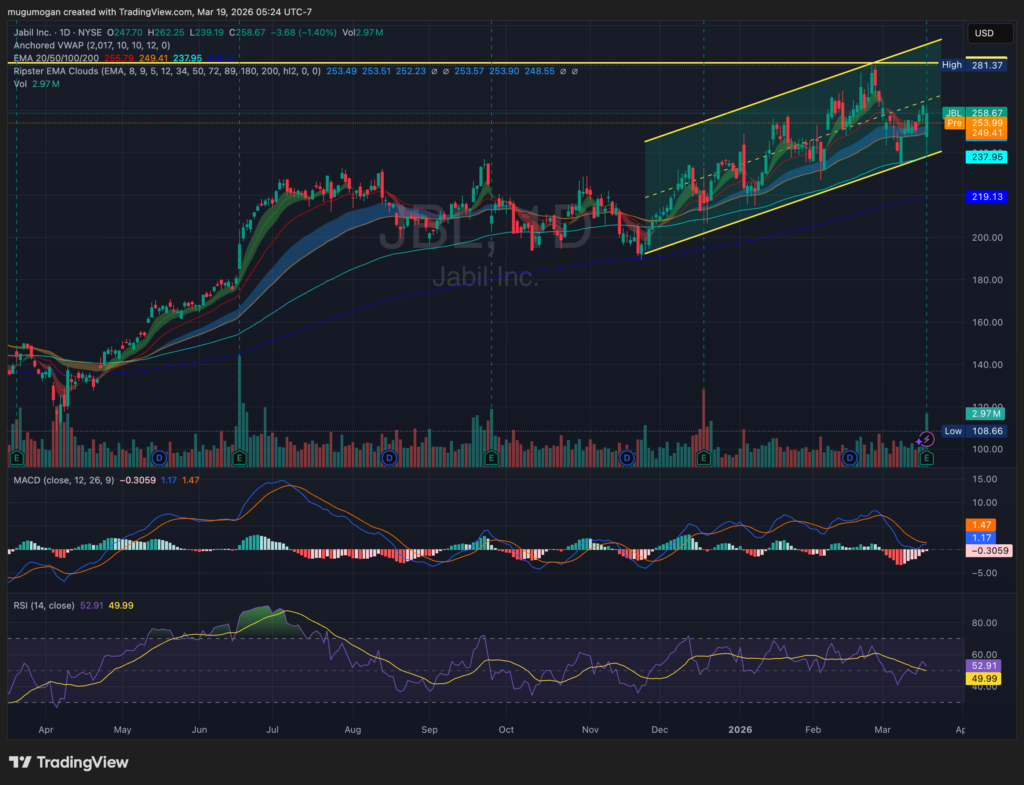
Jabil is trading within a well-defined ascending channel, with higher highs and higher lows intact since late 2025, indicating a sustained uptrend. Price recently pulled back from the upper channel resistance (~$280) and is now consolidating near the mid-channel and short-term moving averages, which are acting as dynamic support around $250–$255.
The 200-day moving average ($219) remains far below, confirming strong longer-term trend strength. Momentum indicators are cooling—MACD is rolling over and RSI is near neutral (~52), suggesting consolidation rather than a reversal. As long as price holds above ~$240, the bullish structure remains intact, with a potential re-test of the upper channel if momentum rebuilds.