




Company Overview: The Trade Desk at a Glance
The Trade Desk is a leading independent demand-side platform (DSP) for programmatic digital advertising. It enables ad buyers to purchase and manage data-driven digital advertising campaigns across various formats including display, video, audio, and connected TV (CTV). Known for its transparent, data-centric approach, the platform empowers advertisers with real-time insights and decisioning tools. The company generates revenue primarily through media buying fees from ad agencies and brands. Founded in 2009, The Trade Desk has become a critical infrastructure provider for modern digital advertising.
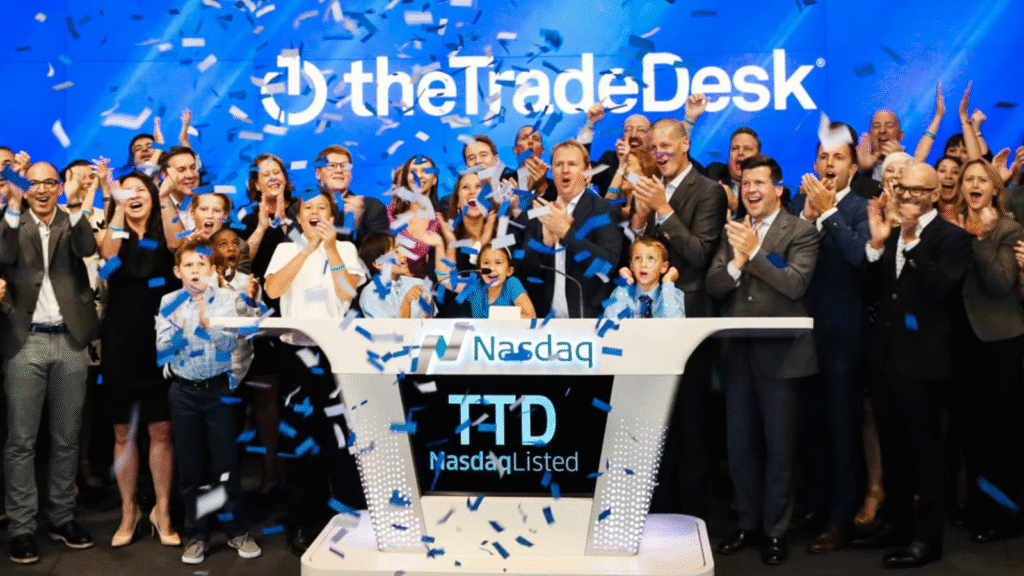
Latest Earnings: Q2 2025 Snapshot
On August 7, 2025, The Trade Desk reported its Q2 2025 earnings. The company posted EPS of $0.37, beating consensus estimates of $0.35, and revenue of $606 million, up 24% year-over-year, exceeding analyst expectations of $590 million. Growth was driven by strong performance in connected TV (CTV), retail media, and political advertising spend ahead of the U.S. elections. The company issued Q3 revenue guidance of $565 million, representing ~22% YoY growth, and maintained full-year 2025 guidance of $2.4 billion in revenue. Management reiterated confidence in long-term operating margin expansion and continued CTV leadership.
Founding, Founders, Products, and Key Competitors
The Trade Desk was founded in 2009 by Jeff Green (CEO) and Dave Pickles (retired CTO) in Ventura, California. Jeff Green previously co-founded AdECN, one of the first ad exchanges, which was acquired by Microsoft. The company raised early funding from Founder Collective and IA Ventures and went public in 2016.
Its flagship product is the demand-side platform (DSP) that enables agencies and advertisers to buy ad inventory in real-time across multiple channels and devices. The platform emphasizes transparency, performance measurement, and identity resolution, and supports integration with major publishers and data providers. A major innovation is Solimar, its updated buying platform introduced in 2021, which enhances AI-driven optimization, privacy-safe targeting, and closed-loop measurement.
The Trade Desk’s key competitors include Google DV360, Amazon DSP, MediaMath, and independent platforms like Adobe Advertising Cloud and Amobee. Unlike vertically integrated platforms owned by walled gardens, TTD positions itself as an independent, neutral alternative.
The company is headquartered in Ventura, California, with additional offices in North America, Europe, and Asia.
Market Landscape and Industry Growth Outlook
The Trade Desk operates within the global digital advertising market, particularly the programmatic advertisingsegment. According to eMarketer and Statista, global programmatic ad spend is projected to exceed $700 billion by 2030, up from ~$550 billion in 2025. This market is growing at a CAGR of 9.5%, driven by shifts to digital channels, automation, and the growth of CTV, retail media, and privacy-safe data targeting.
In particular, Connected TV (CTV) and Retail Media Networks are expected to be the fastest-growing sub-segments. CTV ad spending alone is projected to grow from $30 billion in 2025 to over $70 billion by 2030, as more consumers move from linear TV to streaming platforms. The Trade Desk, with its early bet on CTV, is well positioned to capitalize on this trend.
Additionally, the deprecation of third-party cookies is forcing advertisers to rethink identity, and TTD’s Unified ID 2.0(UID2) initiative could become a core infrastructure layer in a post-cookie advertising world.
Competitive Landscape
The Trade Desk competes with tech giants and platform-owned DSPs like Google’s DV360 and Amazon’s DSP, which bundle ad buying with their owned-and-operated media (YouTube, Twitch, Prime Video, etc.). These players benefit from massive first-party data and vertical integration.
However, advertisers increasingly seek independent DSPs to avoid conflicts of interest, ensure transparency, and unify buys across open internet inventory (outside of walled gardens). This puts The Trade Desk in direct competition with other independent platforms like MediaMath (recently acquired), Xandr (AT&T/Microsoft), and Adobe’s advertising stack.
Despite the competition, TTD is seen as the dominant independent DSP, with deep agency relationships, tech investments, and early innovation in privacy-safe identity solutions.
Unique Differentiation: Why The Trade Desk Wins
The Trade Desk’s biggest differentiation lies in its neutrality and transparency—it doesn’t own any media, which allows it to act in the best interests of advertisers. In contrast, Google, Amazon, and Meta all face conflicts due to media ownership.
Secondly, its advanced AI-powered bidding algorithms and data integrations offer superior campaign optimization. The company also pioneered Unified ID 2.0, an open-source identity framework that aims to replace third-party cookies while preserving user privacy and advertiser effectiveness.
Finally, The Trade Desk has been an early mover in CTV advertising, capturing massive share in one of the fastest-growing ad formats.
Management Team Overview
Jeff Green, Co-founder and CEO, is the visionary behind The Trade Desk. Prior to founding the company, he built AdECN and sold it to Microsoft. Known for his transparency-focused philosophy, Green remains the company’s biggest evangelist for open internet advertising.
Blake Grayson, CFO, joined from Amazon where he was a VP of Finance. He is credited with helping TTD balance growth and profitability, especially as it scales into multi-billion revenue territory.
Michelle Hulst, Chief Data Officer, was previously at Oracle and LiveRamp, and leads TTD’s initiatives around identity resolution, data partnerships, and privacy-safe targeting.
Financial Performance (Last 5 Years)
Over the past five years, The Trade Desk has demonstrated exceptional revenue growth, expanding from $836 million in 2020 to over $2.2 billion in 2024, representing a 5-year CAGR of ~27%. This growth has been fueled by surging demand in CTV, international expansion, and retail media partnerships.
Earnings have grown even faster. Adjusted EBITDA has expanded from $230 million in 2020 to $875 million in 2024, translating to an EBITDA CAGR of 30%+. This strong operating leverage is a result of platform scalability and disciplined investment.
TTD maintains a strong balance sheet, with over $1.3 billion in cash and no debt as of Q2 2025. It has consistently generated positive free cash flow and reinvested in R&D and global expansion without diluting shareholders or taking on leverage.
The company’s gross margins consistently exceed 75%, highlighting the software-like nature of its business. Operating margins are climbing steadily, currently in the high-20s on a non-GAAP basis.
Bull Case for The Trade Desk
- Massive CTV and retail media tailwinds: TTD is positioned at the intersection of two of the fastest-growing ad categories.
- Identity resolution leadership with UID2: Offers a privacy-compliant solution as cookies phase out.
- High operating leverage and FCF generation: Platform scalability translates to long-term margin expansion.
Bear Case for The Trade Desk
- Platform risk from giants like Google or Amazon: Integration restrictions or data access changes could hurt growth.
- Macroeconomic ad spend volatility: Advertising is cyclical, and pullbacks hurt programmatic spend.
- Walled garden dominance: Advertisers may continue shifting budgets to YouTube, Meta, or TikTok, limiting open internet share.
Analyst Reactions to Q2 2025 Earnings
Following Q2 2025 earnings:
- Goldman Sachs reiterated its Buy rating and raised its price target from $105 to $115, citing strong CTV momentum and upside to 2025 guidance.
- Morgan Stanley maintained Equal Weight but raised the PT from $85 to $92 due to better-than-expected political ad spend.
- Barclays upgraded TTD from Hold to Overweight, highlighting its differentiated position in UID2 and long-term international opportunity.
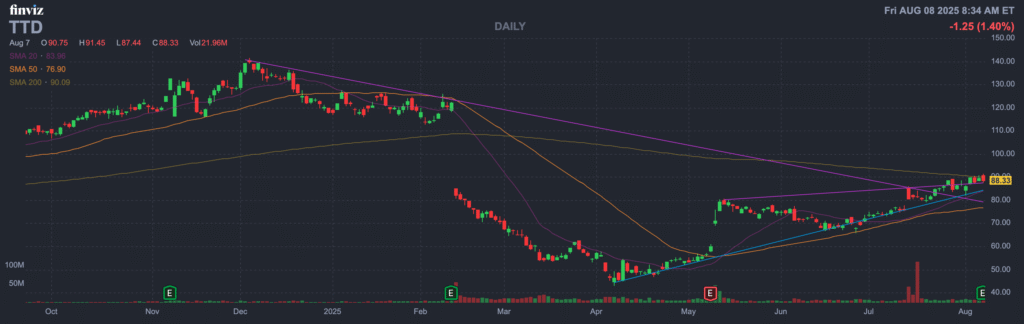
The stock was in a stage 2 markup (bullish) on the monthly and weekly chart, but the earnings has now moved the stock into a stage 4 markdown (bearish) and should find some support in the $52 range.