

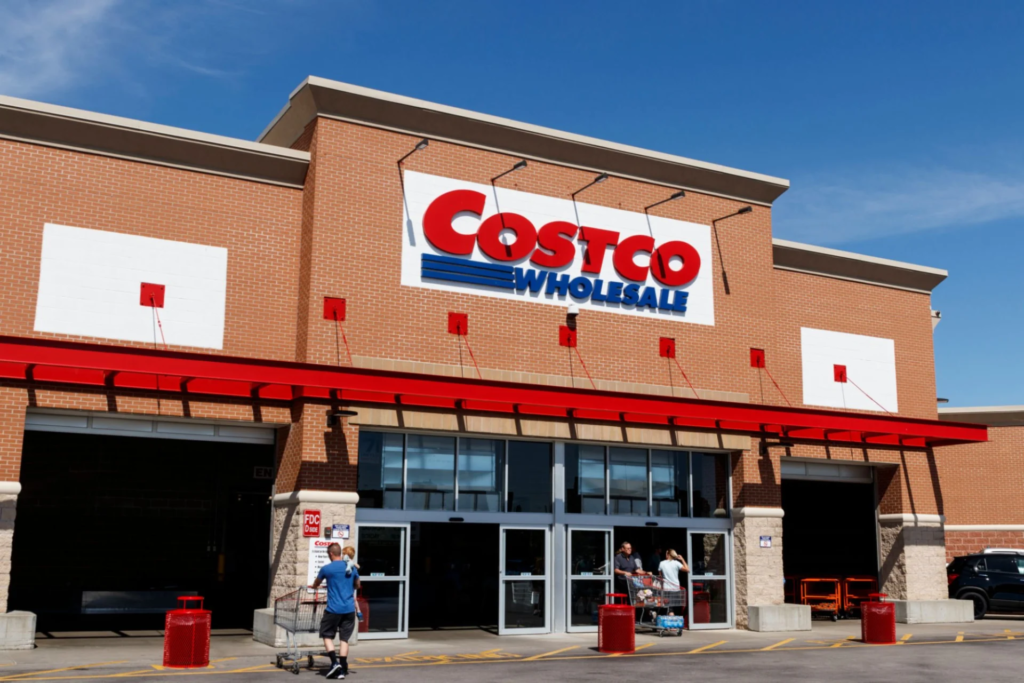
Costco Wholesale Corporation is a global membership-based warehouse retailer founded in 1983 through the Price Club–Costco merger and headquartered in Issaquah, Washington. The company operates a no-frills, high-volume, low-margin model that trades selection breadth for price leadership and operational efficiency. In fiscal 2024, Costco generated roughly $242 billion in revenue, growing in the mid-single digits despite a tougher consumer backdrop. Membership fees—rather than merchandise margin—drive a disproportionate share of operating profit, creating unusually stable cash flows. Core competitors include Walmart (Sam’s Club), BJ’s Wholesale Club, and Amazon.
Most Recent Earnings Snapshot
Costco reported its most recent quarterly results in December 2024 for fiscal Q1 2025, delivering EPS of approximately $4.04 on revenue near $58 billion. Revenue grew about 5% year over year, broadly in line with analyst expectations, while EPS slightly exceeded consensus due to disciplined cost control and steady membership income. Comparable sales growth was modest but positive, with traffic up and average ticket pressured by deflation in key categories. Management guided for continued low-to-mid single-digit revenue growth for the remainder of fiscal 2025, emphasizing margin stability rather than acceleration. Translation: boring, predictable, and Wall Street loves that.
Founding, History, and Evolution
Costco traces its roots to Sol Price, a retail legend who pioneered the warehouse club model with Price Club in San Diego. Jim Sinegal, Costco’s co-founder and long-time CEO, institutionalized a culture of low prices, limited SKUs, and employee-first economics. The 1993 merger of Price Club and Costco created scale advantages that remain difficult to replicate. Over four decades, Costco has resisted Wall Street pressure to raise margins, opting instead to pass savings to members. That stubbornness is now its moat.
Costco’s product strategy centers on approximately 3,700 SKUs per warehouse—dramatically fewer than traditional grocers—allowing bulk purchasing and rapid inventory turns. The Kirkland Signature private label has grown into a multi-tens-of-billions brand, often matching or exceeding national brands on quality while undercutting them on price. Costco also diversified into gasoline, pharmacies, optical centers, and travel services, increasing wallet share per member. International expansion has been deliberate rather than aggressive, prioritizing profitability over store count optics.
Funding has historically come from internal cash generation rather than aggressive leverage or dilution. Costco’s balance sheet philosophy is conservative, with manageable debt and consistent free cash flow. The company’s refusal to chase e-commerce growth at the expense of margins has proven prescient, especially as many retailers now struggle with fulfillment costs. Digital capabilities exist, but they complement—not replace—the warehouse experience. In short, Costco evolves slowly, but almost never backward.
Costco’s headquarters in Issaquah anchors a decentralized operating model where warehouse managers have autonomy within strict cost controls. This operational discipline is embedded culturally, not just financially. Employee retention is among the highest in retail, with wages and benefits well above industry averages. That’s not charity—it reduces shrink, boosts productivity, and keeps execution tight. Cheap prices are easier when your workforce actually shows up.
Market Overview and Size (1/2)
Costco operates within the global warehouse club and mass retail market, a segment valued at well over $1 trillion annually. Growth is driven by value-seeking consumers, private-label expansion, and international penetration, particularly in Asia. By 2030, the global warehouse club segment is expected to grow at a CAGR of roughly 6–7%, outpacing traditional grocery retail. Costco’s share gains tend to come from consistency rather than price wars. Slow and steady wins the inflation-adjusted race.
E-commerce penetration in grocery and essentials remains structurally lower than in discretionary categories, benefiting Costco’s physical footprint. Urban density constraints and zoning laws further limit new warehouse competitors. Membership models create switching costs that blunt competitive pricing attacks. As consumers oscillate between premium and value, Costco uniquely sits in both camps. That’s rare, and valuable.
Competitive Landscape
Costco’s primary competitors include Walmart’s Sam’s Club, BJ’s Wholesale Club, and Amazon in select categories. Sam’s Club leverages Walmart’s logistics scale but runs a more promotion-heavy, margin-flexible model. BJ’s is regionally strong in the U.S. Northeast but lacks Costco’s brand power and international reach. Amazon competes on convenience, not economics, and still struggles to make grocery a high-margin business. Costco competes where others structurally can’t.
Unique Differentiation
Costco’s differentiation lies in its ruthless focus on price integrity, limited assortment, and membership economics. Gross margins are intentionally capped, forcing operational excellence rather than financial engineering. Membership renewal rates—typically around 90%+ in North America—create a recurring revenue base most retailers envy. Kirkland Signature further compresses supplier power while enhancing customer trust. In plain terms: Costco plays a different game, and refuses to change the rules.
Management Team Overview
Ron Vachris serves as CEO, having taken over from Craig Jelinek, and is a 40-year Costco veteran with deep operational roots. Gary Millerchip is the CFO, bringing financial discipline without deviating from Costco’s low-margin philosophy. Hamilton “Tony” James, long associated with governance and strategy, remains influential at the board level. This is a management team optimized for execution, not earnings theatrics.
Financial Performance: Last Five Years
Over the past five fiscal years, Costco has grown revenue from roughly $150 billion to about $242 billion, implying a CAGR near 10%. Growth has been driven by new warehouses, steady comps, and membership fee increases. Earnings have grown faster than revenue due to operating leverage and disciplined SG&A. Costco’s margin profile remains thin by design, but remarkably consistent. Stability is the feature, not the bug.
Operating income and net income have compounded in the high single digits, with EPS growth benefiting from modest share repurchases. Free cash flow generation remains robust, funding capex, dividends, and occasional special dividends. The balance sheet carries manageable debt, with strong interest coverage and ample liquidity. Return on invested capital remains well above retail peers. Efficiency beats flash.
Costco’s balance sheet strength allows it to weather downturns without strategic pivots. Inventory turns are among the fastest in global retail, reducing working capital drag. Capital expenditures are predictable and largely tied to new warehouse openings. Dividend growth has been steady, supplemented by periodic special dividends when cash piles up. Costco doesn’t hoard cash—but it never panics either.
Bull Case for the Stock
Costco continues to compound steadily with minimal execution risk and industry-leading customer loyalty. Membership fee pricing power provides an underappreciated earnings lever. International expansion, particularly in Asia, offers long-term upside without margin dilution.
Bear Case for the Stock
Valuation is rich relative to traditional retail peers, leaving little room for disappointment. Prolonged consumer trading-down could pressure average ticket sizes. Any erosion of price discipline would undermine the core thesis.
Analyst Reactions to Recent Earnings
Post-earnings analyst commentary was broadly constructive, with several firms reiterating Buy or Overweight ratings. Price targets generally moved modestly higher, reflecting confidence in earnings durability rather than growth acceleration. No major downgrades followed the release, though some analysts flagged valuation as a near-term limiter. The consensus view remains that Costco is expensive—but deservedly so.
Valuation Comparison Table
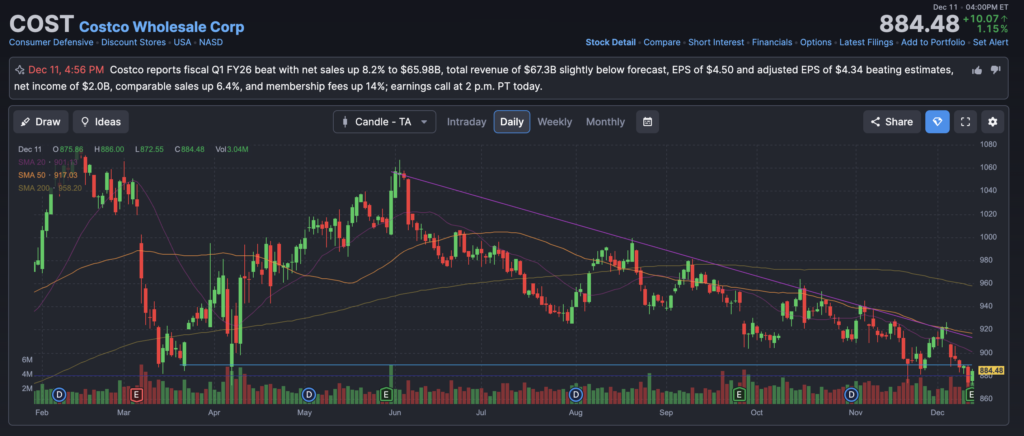
The stock is in a stage 4 markdown (bearish) on the monthly, weekly and daily charts. While the earnings were good, the recent stock price action gives us pause to wait for a reversal, which should happen in the $836 – $871 range.