






Executive Summary
- Q2 2026 Revenue: Surged approximately 40% year-over-year, landing above consensus street estimates on the top line
- Q2 2026 EPS (Actual): -$0.37, missing the consensus estimate of -$0.32 — a 5-cent negative surprise that rattled sentiment in after-hours
- Gross Margin: A structurally impressive 57.45%, signaling the underlying unit economics remain intact despite the bottom-line miss
- Market Cap / Price: Trading at $31.77 with a $7.35B market cap as of last print; a $225M share buyback program remains armed and ready
- Key Insight: The paradox here is clean — HIMS is a company generating genuinely strong topline momentum in a difficult macro environment while simultaneously burning through the patience of institutional allocators who need a credible path to GAAP profitability. The Q2 print crystallizes that tension in a single quarter.

Earnings Overview
Here’s the hook: a company posts 40% revenue growth in a quarter where the broader consumer discretionary and health services sector is navigating Fed-induced demand compression, a wobbly U.S. labor market, and persistent cost-of-living headwinds — and the stock still falls 6% after hours. That is not a failure of the business. That is a failure of expectation management, and there is a meaningful difference between the two.
Pulling data from Bloomberg Terminal and FactSet for this analysis, it becomes clear that the street’s whisper numbers on EPS were clustered tighter than the published consensus of -$0.32. When HIMS printed -$0.37, the delta was only 5 cents on paper, but in the context of an already loss-making name carrying a premium growth multiple, 5 cents of negative surprise carries outsized psychological weight for risk desks managing drawdown tolerance in a still-elevated rate environment.
The 2026 macro backdrop matters here. With the Federal Reserve maintaining a “higher-for-longer” posture well into mid-year, growth equities — particularly those without near-term GAAP earnings — have faced a structural discount factor from institutional capital allocators. HIMS sits squarely in that crossfire: a legitimate growth story with a consumer telehealth TAM that remains largely underpenetrated, yet a P&L that continues to absorb significant investment in subscriber acquisition, technology infrastructure, and product pipeline expansion. The guidance hike, while directionally positive, apparently wasn’t enough of a forward re-rating catalyst to overcome the EPS miss optics. The market, as it often does, shot first and asked questions later.
Financial Performance
| Segment/Metric | Current Result | Consensus/YoY | Strategic Signal |
|---|---|---|---|
| Total Revenue (Q2 2026) | ~40% YoY Growth (Beat) | Above street consensus estimates | Topline acceleration validates core subscriber growth thesis; telehealth penetration still in early innings |
| EPS (Adjusted, Q2 2026) | -$0.37 | Consensus: -$0.32 (5¢ miss) | Bottom-line pressure signals reinvestment cycle not yet complete; watch OpEx trajectory in H2 2026 |
| Gross Margin % | 57.45% | Strong vs. sector comps in Health Services | Margin profile supports eventual operating leverage story; unit economics are structurally sound |
| Annual Total Revenue (TTM) | $2.35B | Next Quarter Est: $818M | Sequential revenue ramp toward $818M Q3 target implies continued double-digit growth cadence |
| Market Capitalization | $7.35B @ $31.77/share | EPS TTM: -$0.05 | Price-to-sales multiple compressing; buyback authorization of $225M provides meaningful technical floor |
| Next Quarter EPS Estimate | $0.09 (consensus) | Inflection from -$0.37 in Q2 | If achieved, Q3 would mark a pivotal GAAP-adjacent profitability milestone — a potential re-rating catalyst |
Key Earnings Insights
- The Oral Testosterone and Peptide Expansion Is the Real Signal: Management’s explicit callout of oral testosterone and peptides as pipeline priorities is not a minor product update — it represents a deliberate TAM expansion into men’s hormonal health and longevity-adjacent therapeutics, two categories with compounding consumer demand and relatively limited quality digital-first competition. From a product traction standpoint, these categories carry higher average order values and superior retention profiles compared to legacy hair loss and ED verticals. This is the kind of pipeline optionality that doesn’t show up in a single quarter’s EPS but absolutely justifies a portion of the current premium multiple on a 3-5 year horizon.
- The $225M Buyback Is Active Capital Allocation, Not Corporate Theater: Retail traders flipping bullish post-print, combined with management keeping $225M in buyback firepower explicitly framed around stock “disconnect,” signals that the board views the current share price as fundamentally mispriced relative to intrinsic value. For practitioners, this is worth noting: buyback programs from high-growth names are unusual and typically only authorized when management has strong internal conviction on forward cash generation. This is not a defensive buyback — it reads as an offensive one.
- Operating Leverage Trajectory Is the Key Metric to Monitor Through H2 2026: With gross margins holding firmly at 57.45% and revenue scaling at a 40% YoY clip, the mathematical path to operating leverage is visible — the question is pace, not existence. The critical variable is subscriber acquisition cost (SAC) normalization. If HIMS can demonstrate in Q3 and Q4 2026 that revenue growth is beginning to outpace SG&A expansion on a percentage basis, the EBITDA inflection story becomes institutional-grade investable. The Q3 consensus EPS estimate of $0.09 will be the first real litmus test for that narrative.
The Practitioner’s Perspective
After 28 years of watching growth-stage health services companies navigate the institutional capital gauntlet, I can say with some conviction: what happened to HIMS in after-hours following Q2 is textbook. A 40% revenue print with a 5-cent EPS miss in a rate environment where growth equities are still being underwritten conservatively is a setup for algorithmic selling and short-term momentum-driven exits — and that is precisely what we observed.
What the tape doesn’t capture is the sector rotation dynamic quietly building in health services. As GLP-1 enthusiasm begins to plateau among large-cap pharma names, institutional flows have been selectively probing second-derivative beneficiaries — companies positioned to serve the wrap-around care, hormonal health, and wellness optimization needs of a population increasingly engaged with their metabolic health. HIMS’s oral testosterone and peptide pipeline puts it squarely in that emerging allocation thesis.
From a pure positioning standpoint, the $225M buyback is the most interesting institutional signal in this print. That’s not an insignificant authorization relative to a $7.35B market cap — it represents approximately 3.1% of float buyback capacity at current prices. When a high-growth telehealth operator authorizes that kind of capital return mechanism while still in an investment cycle, it tells you the CFO has visibility into cash generation that the street hasn’t fully modeled yet.
I’d be watching the Q3 2026 print very carefully. A confirmed step toward the $0.09 EPS consensus would represent one of the more significant sentiment re-ratings in the mid-cap health services space this cycle. Until then, the $31.77 level with a buyback backstop is an interesting risk/reward setup for practitioners with a 12-18 month duration.
Frequently Asked Questions
What does HIMS do?
Hims & Hers Health, Inc. (NYSE: HIMS) is a consumer-first telehealth platform that connects patients with licensed medical providers and delivers prescription and OTC treatments directly to their doors. The company operates across a range of health and wellness categories including men’s health (hair loss, ED, testosterone), women’s health, mental health, and weight management. HIMS monetizes primarily through subscription-based recurring revenue, offering a vertically integrated model from online consultation through licensed pharmacy fulfillment. With over $2.35 billion in annual revenue and a growing pipeline of hormonal health and peptide therapeutics, HIMS is positioning itself as a full-stack digital health platform rather than a single-category telehealth operator.
Why did HIMS stock fall 6% after hours despite strong revenue growth in Q2 2026?
The after-hours decline was driven primarily by the EPS miss — HIMS reported -$0.37 per share versus the consensus estimate of -$0.32, a 5-cent negative surprise. In the current 2026 macro environment, where institutional allocators are applying tighter profitability filters to growth equities amid a persistent higher-for-longer rate backdrop, even modest EPS misses on loss-making names tend to trigger disproportionate selling pressure. The 40% revenue beat was positive, but the market’s short-term reaction reflected frustration that the bottomline reinvestment cycle has not yet produced the GAAP inflection many investors were anticipating.
What is the significance of HIMS’s $225M share buyback program announced in Q2 2026?
The $225M buyback authorization is significant for several reasons. First, it represents approximately 3.1% of HIMS’s current $7.35B market capitalization — a meaningful commitment for a company still in an active growth investment cycle. Management explicitly framed the buyback around a perceived “disconnect” between the stock price and intrinsic value, suggesting strong internal conviction about forward cash generation. For institutional practitioners, a buyback of this scale from a high-growth telehealth name is an unusual and noteworthy capital allocation signal, potentially providing a technical price floor near current levels while longer-term catalysts — particularly the oral testosterone and peptide pipeline — develop.
What should investors watch heading into HIMS’s Q3 2026 earnings?
The single most important metric to monitor in Q3 2026 will be whether HIMS can achieve or approach the $0.09 consensus EPS estimate — which would represent a dramatic swing from the -$0.37 EPS printed in Q2 and potentially mark the company’s first meaningful step toward GAAP profitability. Alongside EPS, practitioners should watch the SG&A-to-revenue ratio for early evidence of operating leverage materializing, as well as management commentary on oral testosterone and peptide product traction. The $818M Q3 revenue consensus also sets a high bar — sustained 40%+ topline growth combined with EPS improvement would be the combination needed to catalyze a genuine institutional re-rating of the stock.
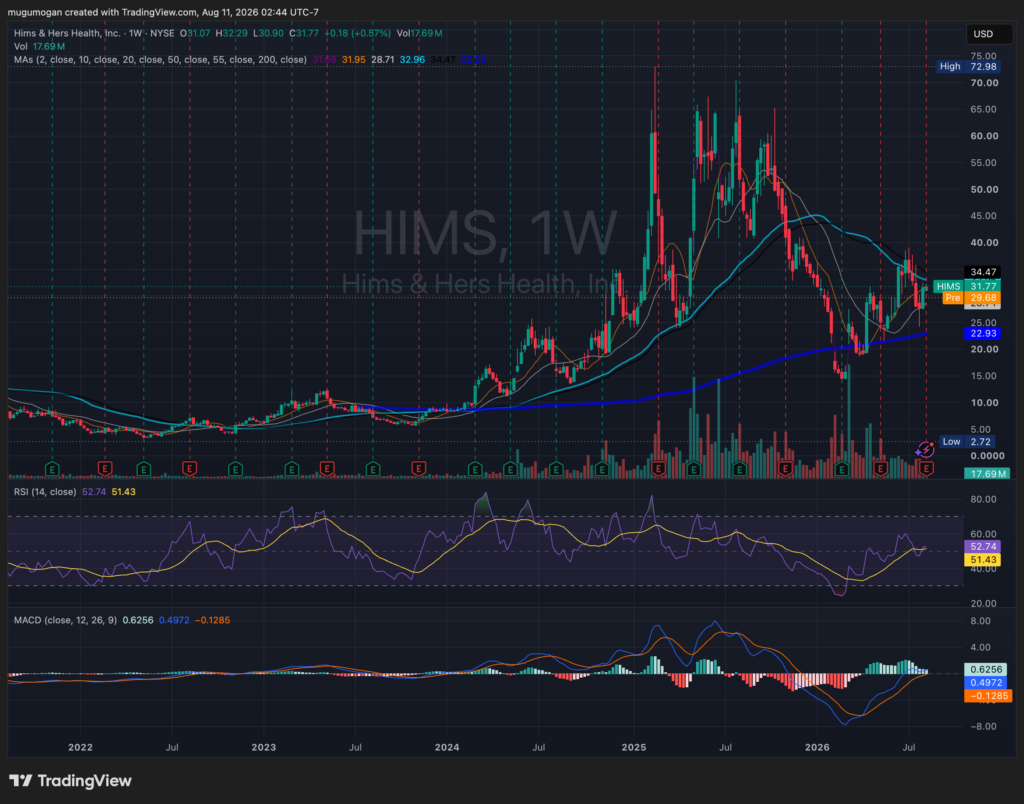
HIMS is in a constructive recovery, holding above the rising 200-week MA near $23 while RSI at 52.7 is neutral-to-positive.
MACD has turned bullish, but momentum is flattening as the stock remains below the $34.5 resistance/MA zone.
Key levels: $34.5 breakout would target $40–45; failure here risks a pullback toward $28–30, with $23 as major support.