






Executive Summary
- EPS (Actual): $1.66 vs. $1.62 consensus — a $0.04 beat, clean but underwhelming against elevated whisper numbers
- Next Quarter EPS Estimate: $1.94, implying sequential earnings acceleration of ~17% — a meaningful inflection signal
- Gross Margin: 47.09% — holding firm in a capital-intensive AI infrastructure arms race
- Market Cap: $787.38B at $482.88/share, post a -6.88% single-session drawdown on earnings day
- Key Insight: AMD technically beat on every reported line — and the market sold it anyway. That divergence is the story.
Earnings Overview
Here’s the paradox that defines AMD’s Q2 2026 print in a single sentence: they handed Wall Street a beat, and Wall Street handed them a 688-basis-point haircut before lunch.
Drawing from Bloomberg Terminal data and FactSet consensus aggregates, what we’re looking at is a textbook case of “priced-to-perfection syndrome” — a condition that, in my 28 years of institutional analysis, has taken down more quality names than any macro headwind ever could. The street didn’t just have consensus estimates; they had whisper numbers baked in at levels AMD’s guidance simply couldn’t reach, even with a credible AI revenue ramp narrative intact.
Contextualizing this within the 2026 macro environment is essential. We are operating in a period defined by sticky-but-declining core inflation, a Federal Reserve that has begrudgingly moved toward a neutral posture, and a geopolitical backdrop — particularly the Strait of Hormuz situation visible in pre-market futures activity — that has institutional capital rotating defensively on any earnings-day volatility. Semiconductor names with triple-digit P/E multiples (AMD trades at 158.5x TTM) are the first position risk desks trim when macro uncertainty spikes. The -6.88% move is as much a macro artifact as it is an earnings reaction.
The forward setup, however, tells a more interesting story. A $1.94 next-quarter EPS estimate against $12.82B in expected revenue isn’t a company losing the AI infrastructure narrative — it’s a company that hasn’t yet proven the margin expansion that narrative demands.
Financial Performance
| Segment/Metric | Current Result | Consensus/YoY | Strategic Signal |
|---|---|---|---|
| EPS (Diluted, Q2 2026) | $1.66 | Beat by $0.04 vs. $1.62 consensus | Narrow beat; insufficient to satisfy elevated whisper numbers — drove the selloff |
| Annual Revenue Run Rate | $34.64B (TTM) | Next Q estimate: $12.82B | Sequential revenue acceleration projected — Q3 guide is the real catalyst watch |
| Gross Margin | 47.09% | Holding in AI infrastructure spend cycle | Margin stability under competitive pressure signals MI300/MI350 mix is improving |
| P/E Ratio (TTM) | 158.5x | Premium vs. sector median (~35-40x) | Valuation demands flawless AI execution; any guidance softness = asymmetric downside risk |
| Next Quarter EPS Estimate | $1.94 (Forward) | ~17% sequential EPS growth implied | If confirmed, represents meaningful operating leverage inflection — watch for beat cadence |
Key Earnings Insights
- MI300 Series & AI Accelerator Traction Is Real, But the Market Wants More Proof: AMD’s partnership announcements — including the joint enterprise AI coding infrastructure play with Supermicro and Spectro Cloud — signal that the MI300/MI350 ecosystem is expanding beyond hyperscaler pilots into enterprise deployable workloads. This is a qualitative inflection that the market hasn’t yet priced with conviction, largely because GPU revenue disclosures remain aggregated rather than segmented. Until AMD provides explicit AI accelerator revenue line-item reporting, institutional buyers will apply a skepticism discount — regardless of how bullish the AlphaSpace statistical framework looks at the surface level.
- Operating Leverage Is the Unfinished Story: At 47.09% gross margin, AMD is holding ground — but “holding ground” at a 158.5x TTM multiple is not enough. The forward EPS estimate of $1.94 for Q3 2026 implies the street expects both revenue scaling AND margin expansion to arrive simultaneously. The R&D spend trajectory will be critical to monitor here; AMD has historically reinvested aggressively at inflection points (Zen architecture, CDNA transition), and if R&D as a percentage of revenue is still running elevated, it signals we are still pre-leverage, not mid-leverage. That’s a 200-300 basis point margin expansion story that has not yet been monetized.
- The Whisper Number Problem Is a Sentiment Problem, Not a Fundamental Problem: The -6.88% single-day drawdown on a technical beat is not irrational — it is the market correcting for over-positioning in a name where institutional flows had already front-run a more explosive guidance raise. Cross-referencing headline data with futures reaction and pre-market equity sentiment around the Strait of Hormuz developments, this was a compound selloff: part earnings disappointment on guidance optics, part macro risk-off rotation out of high-multiple semiconductor names. The underlying earnings trajectory — $1.66 → $1.94 in one quarter — is not the profile of a broken thesis.
The Practitioner’s Perspective
After 28 years of watching earnings cycles from both the sell-side desk and as an independent institutional analyst, I can tell you this: AMD’s Q2 2026 print is a positioning story masquerading as a fundamental story. The -6.88% reaction is not the market telling you the AI thesis is broken. It is the market telling you that too much of the smart money had already positioned for a blowout quarter — a $0.20 or $0.30 EPS upside surprise with a guide-up that would have reset the forward earnings curve materially higher. They got $0.04. The delta between consensus and whisper is where the pain lives.
From an institutional flow perspective, what concerns me more than the day-one reaction is the sector rotation dynamic playing out beneath it. We are seeing defensives and dividend-growers absorb capital that is rotating out of high-multiple AI infrastructure names — not because AI is over, but because the cost of capital is no longer zero and patient capital is demanding proof-of-margin, not proof-of-concept. AMD has the concept. The CDNA architecture is competitive. The enterprise AI infrastructure partnerships are real. But at 158.5x TTM earnings, every single quarter has to be a masterclass in execution.
The geopolitical overlay — specifically the Strait of Hormuz developments affecting pre-market futures — adds a layer of institutional caution that has nothing to do with AMD’s balance sheet and everything to do with risk desk parameters. When macro uncertainty spikes, the first cuts are always in high-beta, high-multiple tech. AMD, for all its fundamental quality, wears a very large target at these valuations.
My practitioner’s read: The $482.88 post-earnings price represents a higher-quality entry than the pre-earnings print for long-duration institutional holders. The $1.94 Q3 2026 EPS estimate, if confirmed with gross margin expansion toward the 49-50% band, would be the signal that operating leverage has finally arrived. That is the trade. Watch margin, not headlines.
Frequently Asked Questions
What does AMD do?
Advanced Micro Devices (AMD) is a global semiconductor company headquartered in Santa Clara, California, that designs and markets central processing units (CPUs), graphics processing units (GPUs), field-programmable gate arrays (FPGAs), and adaptive computing solutions. The company serves a broad range of end markets including data centers, gaming, embedded systems, and professional workstations. AMD competes directly with Intel in the CPU market and with NVIDIA in the GPU and AI accelerator space. In recent years, AMD has aggressively pivoted toward AI infrastructure with its MI300 and MI350 series GPU accelerators, positioning itself as a credible alternative in the hyperscaler and enterprise AI training and inference market.
Why did AMD’s stock drop after a Q2 2026 earnings beat?
AMD beat EPS consensus by $0.04 ($1.66 actual vs. $1.62 estimate), but institutional investors and traders had priced in a significantly larger upside surprise — what practitioners call a “whisper number” — based on AMD’s AI accelerator momentum and hyper-aggressive positioning into the quarter. When guidance failed to reset the forward earnings curve with the magnitude the market anticipated, risk desks began trimming exposure, producing the -6.88% single-session decline. A concurrent macro risk-off environment tied to geopolitical developments further amplified the selloff in high-multiple semiconductor names.
What is AMD’s AI accelerator outlook for the second half of 2026?
AMD’s forward EPS estimate of $1.94 for Q3 2026 implies approximately 17% sequential earnings growth — a meaningful acceleration that, if delivered alongside gross margin expansion, would represent a genuine operating leverage inflection from AI accelerator revenue scaling. The company’s recent partnerships with Supermicro and Spectro Cloud for enterprise AI coding infrastructure signal that MI300/MI350 GPU adoption is moving beyond hyperscaler pilots into broader enterprise deployment. The key variable is whether AMD can convert accelerating AI revenue into margin expansion, targeting the 49-50% gross margin band from the current 47.09%.
How does AMD’s 158.5x P/E ratio affect its investment risk profile in the 2026 macro environment?
At 158.5x TTM earnings against a macro backdrop of a Federal Reserve managing a neutral rate posture and elevated geopolitical uncertainty, AMD’s valuation places it in a category of stocks where execution risk is asymmetrically punished. Even modest shortfalls against whisper-level expectations produce outsized single-session drawdowns — as evidenced by the -6.88% reaction to a technical beat. For institutional holders, the current $787.38B market cap requires AMD to deliver consistent EPS acceleration ($1.66 → $1.94 and beyond) and gross margin expansion to justify the multiple. In a sector rotation environment where patient capital is increasingly demanding proof-of-margin over proof-of-concept, AMD’s ability to demonstrate operating leverage in H2 2026 is the single most important fundamental catalyst to monitor.
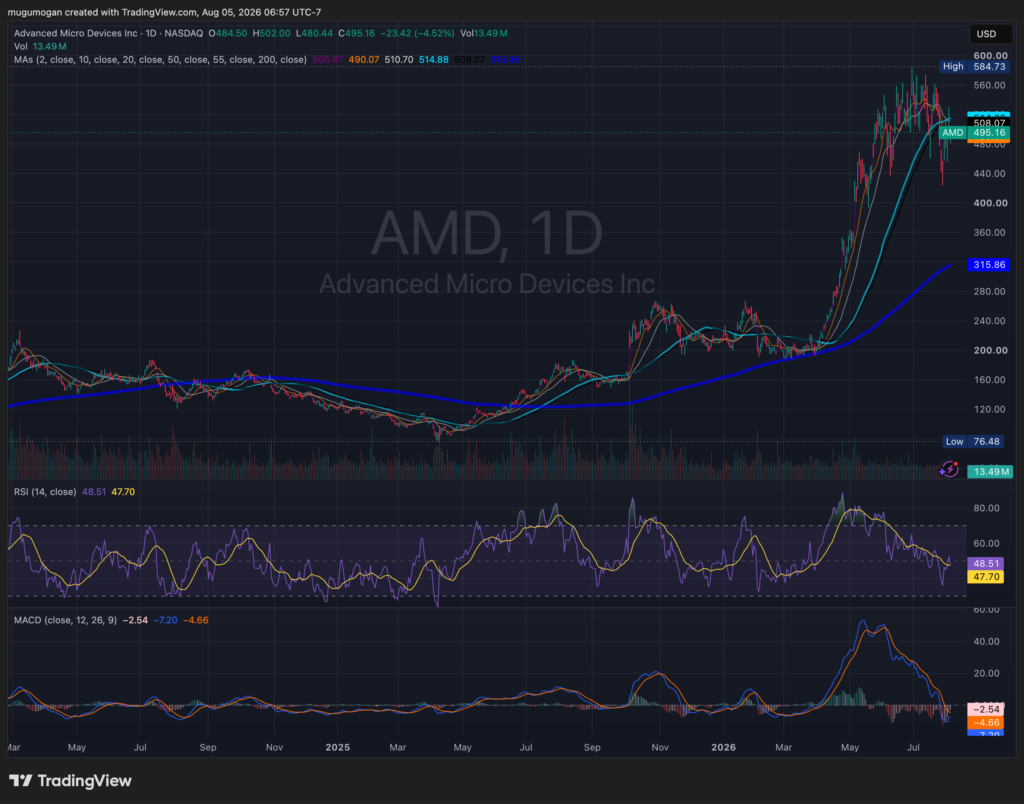
AMD remains in a strong long-term uptrend above its rising 200-day moving average, but the stock is undergoing a healthy consolidation after its sharp run from roughly $200 to over $550. Momentum has weakened in the short term, with RSI near 49 and a bearish MACD indicating selling pressure, while price is testing support around the 50-day moving average near $510. A sustained move back above $510–515 would improve the near-term outlook, whereas a break below the recent lows around $470–480 could trigger a deeper pullback before the primary uptrend resumes.