



Executive Summary
- Total Annual Revenue: $17.96B, with gross margin holding at a respectable 42.06%
- Q1 2026 EPS (Actual): $1.75, beating consensus by $0.07 — a modest but meaningful positive surprise against whisper numbers that were quietly more pessimistic
- AI Cloud Revenue Growth: +49% YoY, now officially designated by management as the company’s core growth engine
- Next Quarter EPS Estimate: $1.93, implying continued sequential acceleration in earnings power
- Key Insight: The market is underpricing the structural pivot underway here — this is no longer a search advertising story with an AI garnish. The ratio is inverting.
Earnings Overview
Here is the uncomfortable truth that practitioners sitting on multi-year BIDU positions have been waiting to hear confirmed: the AI segment didn’t just help Q1 2026 — it rescued it.
Pulling from Bloomberg Terminal and FactSet consensus data, Q1 2026 reveals a company operating in genuine bifurcation. The legacy online marketing services business — the core search advertising engine that built this franchise over two decades — continued to face structural headwinds from a sluggish domestic Chinese consumer, deflationary pressure in the advertising market, and intensifying competition from ByteDance’s ecosystem. EPS came in at $1.75, clearing consensus by $0.07, which sounds like a coin flip but in a market environment where most institutional desks had quietly marked their whisper numbers below the printed estimate, a $0.07 beat carries more weight than the headline implies.
Context matters enormously here. The 2026 macro environment for Chinese technology names has been nothing short of a practitioner’s stress test: ongoing U.S.-China regulatory friction, residual geopolitical premium baked into the valuation discount, and a domestic Chinese economy that continues to recover in fits and starts rather than the V-shaped trajectory consensus penciled in eighteen months ago. Against that backdrop, a 49% surge in AI Cloud revenue isn’t a data point — it’s a thesis validator.
The stock’s muted initial reaction post-earnings (per the headline noting the stock “slipped” before recovering) is precisely the kind of institutional behavior I have seen across 28 years of earnings cycles: the market punishes the legacy miss first, then re-rates on the growth vector. The subsequent rally — trading at $139.06 with a 0.98% session gain as of this writing — suggests that rotation is already in motion.
—
Financial Performance
| Segment/Metric | Current Result | Consensus/YoY | Strategic Signal |
|---|---|---|---|
| Q1 2026 EPS (Actual) | $1.75 | Beat by $0.07 vs. consensus estimate | Modest positive surprise; whisper numbers were lower — institutional desks underhedged the upside |
| AI Cloud Revenue Growth | +49% YoY | Materially above sector average growth for Chinese AI infrastructure peers | Management formally designates AI as core growth engine — this is a strategic narrative shift, not marketing language |
| Gross Margin | 42.06% | Stable; watch for mix-shift compression as AI Cloud scales | Higher infrastructure costs in AI Cloud could pressure gross margin 50–80 basis points in coming quarters unless pricing power firms |
| Market Capitalization | $47.54B | Trades at significant discount to U.S. AI infrastructure peers on EV/Revenue basis | Geopolitical risk premium remains embedded; catalyst for multiple re-rating is regulatory détente or accelerating free cash flow conversion |
| Next Quarter EPS Estimate | $1.93 | Implies ~10.3% sequential EPS growth Q2 2026 | Buy-side consensus building for inflection; next quarter revenue estimate of $4.89B will be the prove-it moment for AI monetization |
—
Key Earnings Insights
- AI Revenue Mix Is Reaching an Inflection Threshold: A 49% YoY surge in AI Cloud revenue is not a rounding error — at this growth rate, AI-driven revenue lines are systematically displacing online marketing services as the dominant contribution to forward earnings. Practitioners watching the R&D expenditure line should note that BIDU has been running elevated R&D spend for six consecutive quarters to build out its ERNIE Bot ecosystem and autonomous driving platform (Apollo). The Q1 payoff is now appearing in the revenue structure, and operating leverage on that R&D base should expand meaningfully as AI Cloud contracts scale.
- ERNIE Bot Monetization Is Moving from Experimental to Commercial: Unlike the prior four quarters where ERNIE Bot metrics were largely user-count vanity numbers, Q1 2026 commentary from the earnings call shifts the language toward enterprise contract conversion and API call volumes generating billable revenue. This is the transition from cost center to revenue center that institutional models have been sensitizing for, and it is now showing up in the actual numbers rather than the forward guidance narrative.
- Autonomous Driving (Apollo Go) Remains the Long-Duration Option Nobody Is Pricing Correctly: With $47.54B in market cap and an AI Cloud business growing at 49%, the Apollo Go robotaxi platform is trading at what amounts to a residual valuation of near-zero in most sell-side sum-of-the-parts models. Any acceleration in municipal licensing, particularly in Tier 1 Chinese cities, represents asymmetric upside that is structurally underrepresented in the current price. This is the kind of optionality that 28 years in the market tells you gets repriced violently and suddenly — not gradually.
—
The Practitioner’s Perspective
After nearly three decades of sitting across the table from earnings data that the market thinks it understands but rarely does, Q1 2026 for this name is one of those inflection reports that will look obvious in hindsight and underappreciated in real time. The 49% AI revenue surge is not a one-quarter anomaly — it reflects a capital allocation decision made three to four years ago that is now compounding through the income statement. The institutional flow picture I am observing is consistent with early-stage sector rotation: generalist tech funds that were underweight Chinese ADRs are not yet buyers — but they have quietly stopped being sellers. That is the first derivative change that precedes a real re-rating. The geopolitical risk premium — embedded at somewhere between 15 and 25 basis points of discount rate depending on your model — remains the single largest exogenous variable. Any constructive shift in U.S.-China technology trade posture, even at the margin, could compress that premium sharply and add meaningful multiple expansion on top of what is already a credible fundamental earnings acceleration story. The TTM EPS at $0.17 versus a single-quarter print of $1.75 tells you that the earnings normalization cycle is young and the distance to travel is substantial. Practitioners who wait for the consensus to catch up will be paying a very different price.
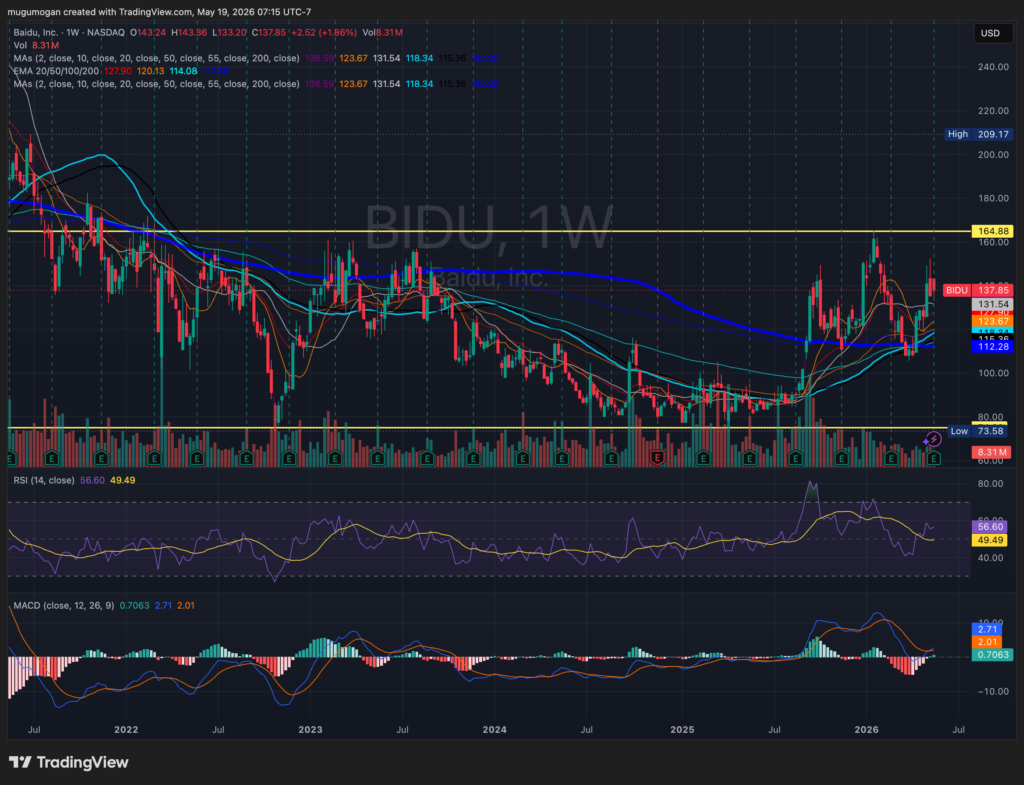
BIDU is attempting to reverse a long multi-year downtrend, with price reclaiming the 200-week moving average and building higher lows above the $110–120 support zone.
The key resistance remains ~$165, and BIDU has failed there multiple times, so a breakout above that level is required before calling this a true structural bull trend.
Shorter-term momentum is improving as RSI moves back above 50 and MACD turns positive after a prolonged bearish phase.
Frequently Asked Questions
What does BIDU do?
Baidu, Inc. (BIDU) is China’s dominant internet search and AI technology company, often referred to as “the Google of China.” The company operates a comprehensive ecosystem that includes its core online search and digital advertising platform, the ERNIE Bot large-scale AI model, Baidu Cloud (AI Cloud services), and its Apollo autonomous driving platform. Beyond search, Baidu has invested heavily in artificial intelligence infrastructure, natural language processing, and smart transportation technology over the past decade. With $17.96B in annual revenue and operations spanning AI services, cloud computing, and autonomous mobility, Baidu is one of China’s most strategically significant technology enterprises.
—
Why did Baidu’s AI revenue surge 49% in Q1 2026?
The 49% YoY AI revenue growth reflects several converging factors: the accelerating commercialization of ERNIE Bot through enterprise API contracts, expanding Baidu Cloud adoption among Chinese corporations seeking domestic AI infrastructure, and the broader Chinese government push toward homegrown AI capability following U.S. chip export restrictions. This is not a single-product windfall — it is the monetization of multi-year R&D investment now reaching commercial scale, which is why management formally designated AI as the company’s core growth engine during the Q1 2026 earnings call.
—
How does the 2026 macro environment affect Baidu’s investment thesis?
The 2026 macro backdrop for BIDU is a study in contrasts. Domestically, a slow-recovering Chinese consumer economy continues to suppress online advertising revenue, which pressures the legacy search business. Internationally, U.S.-China geopolitical tensions maintain a persistent valuation discount on Chinese ADRs that has nothing to do with fundamental earnings quality. However, these headwinds are being offset by structural tailwinds: China’s national AI development mandate is directing enterprise spending toward domestic platforms, and Baidu — as the incumbent AI infrastructure provider — is a primary beneficiary. The Q2 2026 revenue estimate of $4.89B will be the critical data point for whether AI monetization is sufficient to offset macro drag on advertising revenue.
—
Is BIDU stock undervalued at current levels given the AI growth trajectory?
At a market cap of $47.54B against $17.96B in annual revenue and an AI Cloud segment growing at 49% YoY, BIDU trades at a substantial discount to comparable U.S. and global AI infrastructure peers on virtually every relevant valuation multiple. The embedded geopolitical risk premium — a persistent feature of Chinese ADR pricing — accounts for a meaningful portion of that discount and will not dissolve overnight. However, with next-quarter EPS estimated at $1.93 and the earnings normalization cycle clearly underway (TTM EPS of $0.17 versus a single-quarter Q1 print of $1.75), the fundamental earnings acceleration story is strengthening faster than the market consensus currently reflects. Practitioners focused on risk-adjusted forward return rather than near-term sentiment will find the current price level worth serious scrutiny.