Company Overview
Lululemon Athletica is a premium athletic apparel company focused on yoga, training, running, and lifestyle wear for both women and men. Founded in 1998, the company pioneered the premium athleisure category and built a brand that blends performance apparel with community-driven retail. In fiscal year 2024, Lululemon generated approximately $9.6 billion in revenue, growing at a low-teens rate despite macro pressure on discretionary spending. The company is headquartered in Vancouver, Canada, and operates a vertically integrated model spanning design, merchandising, and direct-to-consumer retail. Its top competitors include Nike, Adidas, and Athleta (Gap Inc.).

Most Recent Earnings Performance
Lululemon reported its most recent quarterly earnings in early December 2025 for fiscal Q3 2025. The company delivered earnings per share of approximately $2.53, exceeding analyst expectations by roughly 5%, while revenue came in at about $2.3 billion, also modestly ahead of consensus estimates. Revenue growth was approximately 12% year-over-year, driven by international expansion and continued momentum in men’s apparel. Management reaffirmed full-year revenue guidance while slightly raising full-year EPS guidance, citing improved gross margin control and disciplined operating expense growth. Guidance for the next quarter implied mid-single-digit comparable sales growth, signaling normalization after post-pandemic hypergrowth.
Founding History and Evolution
Lululemon was founded in 1998 by Chip Wilson in Vancouver with a focus on technical yoga apparel, at a time when yoga itself was still niche. The brand differentiated early by emphasizing fabric innovation, fit, and a premium price point that contrasted sharply with mass athletic brands. Early growth was fueled by word-of-mouth, in-store community events, and ambassador-driven marketing rather than traditional advertising. The company went public in 2007 and scaled rapidly across North America through company-owned stores. Over time, governance issues and founder controversies led to leadership changes and a more institutionally run organization.
Products and Brand Portfolio
Lululemon’s core products include leggings, tops, bras, outerwear, and accessories designed for yoga, running, and training. The company has successfully expanded into men’s apparel, which now represents over 20% of revenue and is growing faster than the women’s segment. Footwear, launched in 2022, has become a strategic adjacency with early traction in women’s running and training shoes. Lululemon positions its products at a premium price point, justified by proprietary fabrics such as Align, Nulu, and Everlux. The brand’s focus remains tightly controlled, avoiding category sprawl that has diluted competitors.
Competitive Landscape and Key Rivals
Lululemon competes with global athletic giants like Nike and Adidas, premium lifestyle brands like Alo Yoga, and value-oriented players such as Athleta. Unlike Nike and Adidas, Lululemon does not rely on wholesale distribution, preserving pricing power and customer data ownership. Compared to Alo, Lululemon benefits from scale, deeper technical credibility, and stronger international infrastructure. Athleta competes on inclusivity and pricing but lacks comparable brand heat and profitability. The competitive moat is rooted in brand loyalty rather than pure performance metrics.
Headquarters and Global Footprint
The company is headquartered in Vancouver, Canada, with corporate offices in the U.S. and Asia-Pacific. Lululemon operates more than 700 stores globally, with North America accounting for roughly 70% of revenue. International markets, particularly China, remain the fastest-growing region with revenue growth exceeding 30% year-over-year in recent quarters. The company continues to invest heavily in Asia-Pacific store expansion and localized product assortments. International growth is a central pillar of its long-term strategy.
Market Overview and Industry Dynamics
Lululemon operates within the global athletic apparel and athleisure market, which was valued at approximately $400 billion in 2024. The market is expected to grow to over $600 billion by 2030, driven by health consciousness, casualization of workwear, and rising disposable income in emerging markets. Industry CAGR is estimated at 7–8% through 2030, with premium segments growing faster than mass-market apparel. Direct-to-consumer penetration continues to increase, benefiting brands with strong digital and retail integration. Brand strength and community engagement are increasingly decisive differentiators.
Growth Expectations Through 2030
By 2030, premium athleisure brands are expected to outgrow the broader apparel market due to pricing power and customer loyalty. Lululemon is well-positioned to compound revenue at a high-single-digit to low-double-digit CAGR through international expansion and category adjacencies. Men’s apparel and footwear are expected to be incremental growth engines rather than replacements for the core women’s business. China alone is projected to become a multi-billion-dollar revenue contributor within five years. Margin expansion is likely to be modest but stable given disciplined inventory management.
Competitor Analysis
Nike remains the largest competitor by scale but lacks Lululemon’s focus on premium female-centric apparel. Adidas is undergoing strategic restructuring and has weaker presence in premium athleisure. Alo Yoga is growing rapidly but remains privately held and significantly smaller in revenue and global reach. Athleta struggles with brand relevance and profitability under Gap Inc. Lululemon’s competitive position is defined by consistency rather than volatility.
Unique Differentiation
Lululemon’s key differentiation lies in its brand-led pricing power combined with technical product credibility. Unlike competitors that oscillate between fashion and performance, Lululemon maintains a tight brand narrative centered on movement, mindfulness, and quality. Its vertically integrated DTC model enables rapid feedback loops and margin protection. Community-based marketing creates emotional attachment rather than transactional loyalty. This combination is difficult to replicate at scale.
Management Team Overview
Calvin McDonald serves as Chief Executive Officer and has been instrumental in professionalizing operations and driving international expansion. Meghan Frank, the Chief Financial Officer, has emphasized disciplined capital allocation and margin stability amid macro volatility. Sun Choe, Chief Product Officer, oversees design and merchandising with a focus on innovation and brand coherence. The management team is execution-focused rather than founder-centric. Leadership credibility with institutional investors remains strong.
Financial Performance — Revenue Trends
Over the past five years, Lululemon has grown revenue from approximately $4 billion to nearly $9.6 billion, representing a compound annual growth rate in the mid-teens. Growth accelerated during the pandemic and normalized in 2024–2025 as consumer spending moderated. Direct-to-consumer revenue continues to outpace store growth, driven by e-commerce and omni-channel integration. International revenue growth consistently exceeds North America. Revenue quality remains high with minimal discounting.
Financial Performance — Profitability
Operating income has grown at a slightly slower pace than revenue due to investment in international expansion and footwear. However, gross margins remain among the highest in the apparel industry, hovering around the high-50% range. Earnings growth over five years reflects a low-teens CAGR, demonstrating resilience despite supply chain disruptions. The company maintains disciplined SG&A growth relative to revenue. Profitability remains structurally superior to peers.
Financial Performance — Balance Sheet
Lululemon maintains a fortress balance sheet with minimal long-term debt and several billion dollars in cash and equivalents. Inventory management has improved materially since 2022, reducing markdown risk. The company consistently generates strong free cash flow, enabling share repurchases and strategic investment. Capital expenditures are focused on store expansion and digital infrastructure. Financial flexibility is a key strategic asset.
Bull Case for the Stock
• International expansion, particularly China, sustains double-digit growth longer than expected
• Men’s apparel and footwear scale into multi-billion-dollar categories
• Premium brand pricing power protects margins despite macro pressure
Bear Case for the Stock
• North American demand stagnates due to consumer fatigue and competition
• Brand heat cools, forcing higher promotions and margin compression
• Footwear expansion fails to achieve scale or profitability
Analyst Reactions to Recent Earnings
Following the most recent earnings release, analyst sentiment remained broadly positive with several firms reiterating Buy or Overweight ratings. A handful of analysts raised price targets modestly, citing stronger-than-expected international performance and stable margins. No major downgrades were issued, though some analysts flagged valuation sensitivity given the stock’s premium multiple. Consensus views reflect confidence in execution but tempered growth expectations. The stock reaction was muted, reflecting already high expectations.
Valuation Comparison With Top Competitors
| Company | Revenue (USD) | Revenue Growth | Net Income (USD) | Market Capitalization |
|---|---|---|---|---|
| Lululemon | ~$9.6B | ~12% | ~$1.6B | ~$55B |
| Nike | ~$51B | ~1% | ~$5.5B | ~$150B |
| Adidas | ~$24B | ~5% | ~$1.2B | ~$45B |
| Gap Inc. | ~$15B | ~3% | ~$0.6B | ~$7B |
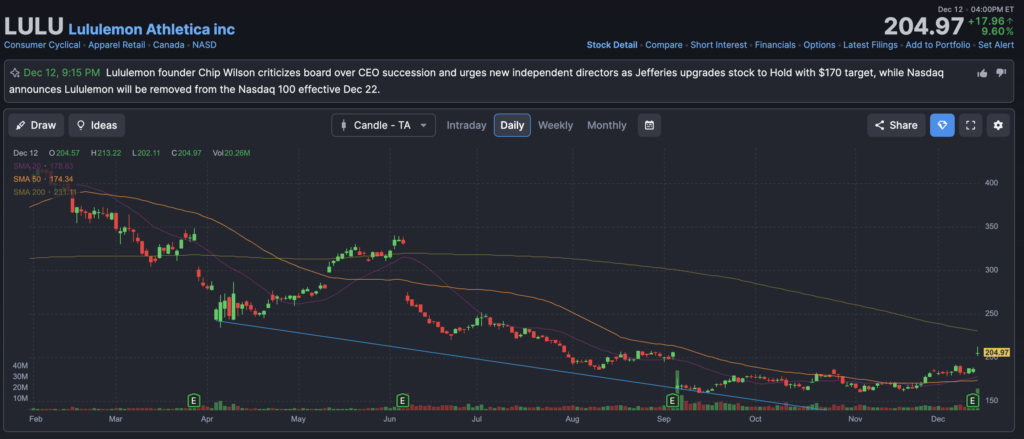
The stock is in a stage 4 markdown (bearish) on the monthly and weekly charts, and is attempting a stage 1 consolidation on the daily chart. The near term is to be range bound between $159 – $209.