nCino is a vertical SaaS company that provides a cloud-based banking operating system used by banks, credit unions, and other financial institutions to digitize onboarding, lending, and account-opening workflows. The platform is built natively on Salesforce, which lets customers use nCino as a process and data layer on top of their existing CRM and front office. The company generates the vast majority of its revenue from recurring subscriptions, with a smaller contribution from professional services and implementation work. For the fiscal year ended January 31, 2025, nCino generated about $541 million in revenue, growing roughly 13% year over year, and now has more than $580 million of revenue on a trailing-twelve-month basis. The company is headquartered in Wilmington, North Carolina, and competes with Q2 Holdings, Temenos, Alkami, and larger banking software vendors like FIS and Fiserv.

In the most recent reported quarter, Q3 FY26 (quarter ended October 31, 2025, reported on December 3), nCino delivered revenue of $152.2 million, up 10% year over year and ahead of Street estimates in the mid–$146–149 million range. Subscription revenue grew 11% to $133.4 million, showing that the core SaaS engine is still expanding faster than the total top line as services become a smaller mix. Non-GAAP EPS came in at $0.31 versus $0.20 a year ago and roughly $0.20–0.21 expected, a beat of about 50% driven by operating leverage and tighter cost control. GAAP EPS flipped from a loss of $0.05 per share in the prior-year quarter to a profit of $0.06, reflecting improving profitability even on a fully burdened basis. Management raised full-year FY26 guidance for revenue and adjusted EPS, signaling confidence that the margin gains are not a one-off.
nCino traces its roots to 2011 as an internal project at Live Oak Bank, which wanted to modernize its commercial lending processes and move away from fragmented legacy systems. The internal tool proved compelling enough that Live Oak spun it out as a separate company, nCino, in 2012, with the goal of selling a cloud-based bank operating system to other institutions. Early leadership included CEO Pierre Naudé and board members affiliated with Live Oak and fintech investor Insight Partners, and the company adopted a product strategy centered on configurable workflows for loan origination, onboarding, KYC, and document management. From the start, the company focused on mid-sized and large banks that needed modern digital capabilities but could not build them in-house at the pace of fintech challengers.
Over the next decade, nCino raised venture funding from firms like Insight Venture Partners, Salesforce Ventures, and T. Rowe Price, using that capital to expand internationally and broaden its product suite. The company went public in July 2020 at a time when vertical SaaS and fintech valuations were peaking, giving it a sizable equity currency for acquisitions and employee incentives. Since the IPO, nCino has used targeted M&A—most notably the acquisition of SimpleNexus in mortgage technology—to add depth in retail and mortgage lending and to extend from commercial lending into a broader, omni-channel banking platform. This funding and acquisition history means that while the company still carries some goodwill and stock-based comp drag from deals, it also has a wider product footprint than a pure-play point solution.
On the product side, nCino’s core offering is the nCino Bank Operating System, which covers commercial, small business, and retail lending, deposit account opening, and treasury management workflows. Modules handle customer onboarding, credit analysis, document generation, covenant tracking, and ongoing portfolio management, while analytics features let banks monitor pipeline, cycle times, and risk metrics. The SimpleNexus acquisition added a modern, mobile-first mortgage point-of-sale platform that integrates with loan origination systems and provides borrowers with app-based experiences that feel closer to fintech neobanks. More recently, nCino has been pushing into AI-driven capabilities with “Digital Partners,” a suite of role-based AI agents trained on financial services data to automate tasks like document review, risk analysis, and workflow routing.
nCino’s key competitors vary by segment but include Q2 Holdings (digital banking front ends and account-opening), Alkami Technology (digital banking, mostly for U.S. credit unions and regional banks), and Temenos (global core banking and digital banking platforms), along with legacy vendors such as FIS, Fiserv, and Infosys Finacle. The company positions itself as a modern, cloud-native alternative that can overlay existing cores rather than forcing customers to rip and replace their back-end systems. Headquartered in Wilmington, North Carolina, with additional offices in major banking hubs across North America, Europe, and Asia-Pacific, nCino now serves hundreds of financial institutions ranging from community banks to top-50 global banks, and has been expanding its presence in markets like Japan and Central Europe.
The market nCino operates in is essentially the intersection of digital banking platforms, cloud core banking, and vertical SaaS for financial institutions. Estimates for the global digital banking platform market typically range from the low tens of billions of dollars in 2024 to between roughly $80 billion and over $150 billion by 2030, implying mid-teens to low-20s compound annual growth rates depending on the report. Several market research firms peg digital banking platforms specifically at around $11–13 billion in 2024, growing at low double-digit CAGRs (roughly 11–15%) through the end of the decade, while some broader “digital banking” definitions suggest growth closer to 15% annually. This is being driven by regulatory pushes for open banking, customer demand for mobile-first experiences, and cost pressure on banks that need to automate manual processes.
Within that broader landscape, the cloud core-banking and core-banking software markets that overlap with nCino’s lending and onboarding workflows are also growing healthily but at slightly lower rates. Recent research on core banking software points to a market of roughly $12–18 billion in the mid-2020s, projected to double or more by 2030 with CAGRs in the 8–12% range. Cloud deployments—where nCino is strongest—are growing a bit faster than on-premise, often around low double-digit CAGRs, as banks accelerate migrations to reduce infrastructure costs and gain flexibility. For a company like nCino, which sits higher in the stack as a process and engagement layer, this means a long runway: as banks modernize their cores and data platforms, they are more willing to adopt cloud-native workflow tools that leverage those underlying investments.
Competitive intensity in this market is high and rising, however. nCino’s direct peers include Q2 Holdings, which offers digital banking and lending solutions for regional banks and credit unions, and Alkami Technology, which focuses on digital banking and account-opening for U.S. institutions; both are similar-sized public vertical SaaS players aimed at modernizing legacy banking front ends. At the higher end, Temenos competes globally with a broad suite of core banking, digital channels, and payments products, and has a much larger revenue base and established footprint with Tier 1 and Tier 2 banks. In addition, hyperscalers and horizontal software vendors are pushing deeper into financial services, and selective banks still build bespoke systems or use a combination of fintech point solutions rather than committing to a single platform.
nCino’s main differentiation relative to these competitors comes from a combination of three factors: deep specialization in credit and lending workflows, a tight integration with Salesforce as a foundational CRM and data layer, and increasingly, AI-native “Digital Partners” that promise to automate complex banking tasks. Unlike general digital banking vendors that start from retail banking front ends, nCino’s roots are in the messy, document-heavy world of commercial and small business lending, which gives it credibility with relationship managers, credit officers, and risk teams. The Salesforce-native architecture lets institutions reuse their existing CRM investments and centralize customer data, which is appealing in banks where Salesforce is already the system of record for customer interactions. Finally, the company is leaning into AI agents that are trained on a large corpus of financial services workflows and data, which could become a meaningful differentiator if banks standardize on nCino as their “AI operating layer” for lending and onboarding.
The current management team is led by CEO Sean Desmond, who took over the top job after previously serving as nCino’s President and Chief Revenue Officer, bringing a strong go-to-market and customer-success orientation to the role. Desmond’s recent commentary has focused on expanding AI capabilities, driving higher operating margins, and continuing to grow within existing customers through cross-sell and international expansion. The company’s finance organization is led by a CFO with public SaaS experience, overseeing the shift from growth-at-all-costs to disciplined, margin-focused execution, including stock repurchase programs. Rounding out the senior bench is a Chief Product or Chief Technology Officer responsible for the nCino platform roadmap and the integration of AI, data, and analytics features, which is increasingly central to the company’s pitch to large banks.
Over the last five fiscal years, nCino’s revenue has grown from about $138 million (FY20) to roughly $541 million in FY25, an approximate 31% compound annual growth rate, though growth has decelerated from high-40s percentages in the early years to mid-teens more recently. Annual revenue stepped up from about $204 million in FY21 to $274 million in FY22, then to $408 million in FY23, $477 million in FY24, and finally $541 million in FY25, reflecting both organic expansion and contributions from acquisitions like SimpleNexus. On a trailing-twelve-month basis following Q3 FY26, revenue stands around $586 million, growing roughly 12% year over year, with quarterly growth in the latest period at 10%. This trajectory shows a classic vertical SaaS pattern: a hypergrowth phase followed by a transition to more moderate, scale-phase growth as the business matures.
From an earnings and margin standpoint, nCino has been steadily marching toward sustainable profitability. Historically, the company ran at negative GAAP net income and operating losses as it invested heavily in R&D, sales, and international expansion, but over the past two years, non-GAAP profitability has improved materially. In Q3 FY26 the company reported GAAP operating income of $11.7 million versus a loss of $0.8 million a year prior, and non-GAAP operating income of $39.9 million, implying a non-GAAP operating margin in the mid-20s and an expansion of more than 400 basis points year over year. GAAP net income for the quarter was $6.5 million, and non-GAAP net income reached $35.8 million; on a trailing basis, nCino still shows roughly $20–22 million of net losses, but that is a significant improvement from nearly $40 million of losses four quarters earlier.
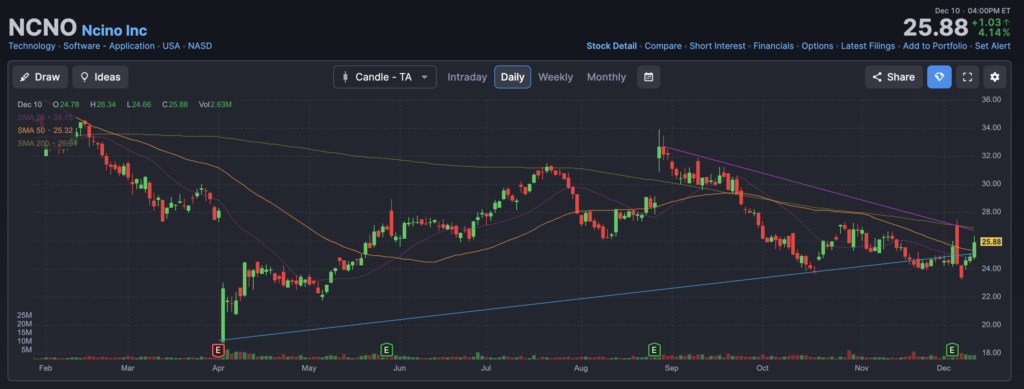
The stock is in a long term consolidation phase, neutral stage 1 on all 3 time frames, with the range of $21 – $33. We wont be investing in the company right now.