









Executive Summary
- EPS (Actual): $2.92 vs. consensus estimate of $1.79 — a $1.13 positive surprise, one of the largest beats in the athleisure space this cycle
- Gross Margin: 56.04% — structurally impressive for a specialty apparel name in a tariff-pressured, consumer-fatigued environment
- Market Cap Post-Earnings: $12.03B — representing a severe de-rating from prior-year levels, with the stock shedding approximately 16.72% on the session (intraday prints touched -20%)
- P/E TTM: 8.3x — a valuation level not seen since the brand was a regional Canadian curiosity, not a global athletic lifestyle player
- Key Insight: The EPS beat is real. The guidance cut is realer. Institutional money is not staying around to debate which one matters more.

Earnings Overview
Here’s the uncomfortable truth that Bloomberg terminal data and FactSet consensus models confirmed within minutes of the print: Lululemon delivered one of its cleanest earnings beats in recent memory — and the stock still cratered 20%. That is not a paradox. That is a guidance-driven repricing event, and in 28 years of watching these prints, I’ve learned that the market almost always prices the forward curve, not the rearview mirror.
Pulling from Bloomberg terminal and FactSet data cross-referenced against sell-side whisper numbers, the Q2 2026 beat on EPS ($2.92 actual vs. $1.79 consensus) was not the story the tape wanted to tell. The story was the second full-year guidance cut in a single fiscal year — a sequence that triggers systematic fund de-risking regardless of underlying margin quality. When a management team revises guidance downward twice, even high-conviction longs start asking uncomfortable questions about demand visibility.
Contextualizing this within the 2026 macro environment is essential. The blowout jobs report circulating in the same news cycle raised legitimate fears of a Fed policy pivot back toward tightening, compressing discretionary consumer multiples across the board. Athleisure — a category that thrived on pandemic-era lifestyle migration and remote-work casualization — is now facing a dual headwind: tariff-driven cost pressure on Asia-Pacific supply chains and a U.S. consumer who is selectively pulling back on premium-priced lifestyle goods. Lululemon sits at the intersection of both headwinds, and their guidance reduction confirms the company is not immune to gravity.
The whisper numbers going into this print were already skewed cautiously bearish. The EPS beat temporarily confused the algos. Then the full-year outlook landed — and the humans took over.
Financial Performance
| Segment/Metric | Current Result | Consensus/YoY | Strategic Signal |
|---|---|---|---|
| EPS (Q2 Actual) | $2.92 | Consensus: $1.79 | Beat by $1.13 | Strongest quarterly EPS surprise in recent periods; driven by cost discipline, not revenue acceleration — a critical distinction |
| Gross Margin % | 56.04% | Above sector average for specialty apparel (~48-50%) | Premium positioning intact at the product level; however, sustained margin defense under tariff pressure requires ongoing supply chain reconfiguration |
| P/E Ratio (TTM) | 8.3x | Significant compression from 2024-2025 peak multiples (30x+ range) | Deep value territory for a brand with $11.10B annual revenue; signals institutional capitulation, not fundamental business collapse — watch for contrarian accumulation |
| Next Quarter EPS Estimate | $1.21 | Annual Revenue (TTM): $11.10B | Next Qtr Revenue Est: $2.34B | Steep sequential deceleration from $2.92 to $1.21 reflects guidance reset; Q3 2026 will be the defining quarter for whether the floor is in or the descent continues |
Key Earnings Insights
- The Guidance Cut Is the Only Metric That Matters Right Now: Lululemon’s second downward revision to full-year outlook is a systematic red flag. Institutional quant models are calibrated to reduce position size automatically on sequential guidance cuts — this is not emotional selling, it is rules-based risk management. The EPS beat, while statistically significant at 63% above consensus, is being entirely discounted because forward earnings visibility has deteriorated. Until management re-establishes a credible forward framework, the stock remains in a show-me phase with high short-interest accumulation potential.
- The “Stupid Decision” Discount Is Now Priced Into Headlines, Not Yet Into Fundamentals: Multiple outlets are referencing a specific strategic misstep made earlier in 2026 — likely tied to product line expansion, pricing architecture, or a market entry decision that misfired — contributing to the brand perception erosion that is compounding the macro pressure. At 8.3x TTM earnings with a 56% gross margin, the fundamentals are not destroyed. But brand equity impairment is the hardest thing to quantify on a balance sheet and the most expensive thing to repair in a premium consumer category. This is where the real institutional due diligence is focused right now.
- Michael Burry’s “Fat Pitch Below $100” Call Is the Contrarian Signal Worth Monitoring: The public flagging of LULU by Burry at sub-$100 levels — with the stock printing at $101.41 post-earnings — is not noise. Burry operates on deep value, mean-reversion thesis construction. With TTM EPS of $12.20 and a P/E of 8.3x, the math suggests the market is pricing in significant earnings deterioration. If Q3 2026 stabilizes anywhere near the $1.21 estimate without another guidance reduction, the multiple re-rating thesis becomes structurally compelling. Tactically, this is a name where options skew, put/call ratios, and dark pool print data will tell more of the story than the press release.
The Practitioner’s Perspective
After 28 years of sitting across the desk from portfolio managers during moments exactly like this one — a genuine EPS beat, a catastrophic guidance revision, and a stock in freefall — I can tell you with high conviction: this is a sentiment and positioning event first, a fundamental story second.
What I’m watching in the institutional flow data is sector rotation out of premium discretionary and into defensive consumer staples — a pattern we’ve seen in prior Fed tightening cycles (2018, 2022) where the consumer gets bifurcated between staples-resilient and premium-vulnerable spending. Lululemon, despite its cult-like brand loyalty at the consumer level, is categorized as premium-vulnerable by most large-cap fund risk models. That categorization doesn’t change on a single quarter’s EPS beat.
The geopolitical dimension here cannot be ignored. Tariff structures affecting Asia-Pacific manufacturing — particularly Vietnam and Cambodia-based apparel production — are adding 150 to 300 basis points of cost pressure across the supply chain that gross margin figures are not yet fully reflecting at the consumer price level. Management’s ability to push price increases in a consumer environment where the middle-income shopper is already showing fatigue is genuinely constrained.
Here is where it gets strategically interesting: At $101 with a $12.20 TTM EPS print and a 56% gross margin, this is not a broken business. This is a re-rated business. The distinction matters enormously. Broken businesses don’t recover. Re-rated businesses — particularly those with genuine brand moats — absolutely do recover, but only when the forward guidance narrative stabilizes. I would not be adding exposure ahead of Q3 2026. I would, however, have this on the highest-priority watchlist with a defined re-entry framework built around the next earnings print and any interim guidance update.
Frequently Asked Questions
What does LULU do?
Lululemon Athletica is a Canadian-founded, globally scaled premium athletic apparel and lifestyle brand headquartered in Vancouver, British Columbia. The company designs, manufactures through third-party suppliers, and retails high-performance athletic wear — most notably yoga-inspired apparel, running gear, and lifestyle clothing — through its own e-commerce platform, company-operated retail stores, and select wholesale partnerships. Beyond apparel, Lululemon has made strategic investments in fitness technology and experiential retail, positioning itself as a lifestyle ecosystem rather than a pure-play clothing retailer. With annual revenues of approximately $11.10 billion, it operates as one of the largest premium athletic apparel brands globally, competing directly with Nike, Adidas, and Under Armour in the performance segment while maintaining a distinct brand identity in the athleisure and wellness category.
Why did Lululemon’s stock drop nearly 20% despite beating EPS estimates by $1.13?
The EPS beat of $2.92 versus the $1.79 consensus was significant, but equity markets price forward expectations, not backward results. Lululemon issued its second full-year guidance reduction in fiscal 2026, which triggered systematic institutional de-risking across both active and passive fund models. A sequential guidance cut of this nature signals that management has limited confidence in near-term demand visibility — and in a macro environment already pressured by potential Fed rate hikes and consumer spending softness, the market repriced the stock sharply lower on the forward earnings deterioration rather than the trailing beat.
What does Lululemon’s 8.3x P/E ratio signal for investors in the current 2026 macro environment?
An 8.3x TTM P/E ratio for a business generating $11.10 billion in annual revenue with a 56% gross margin represents a dramatic multiple compression relative to Lululemon’s historical valuation range, which has traded as high as 30x to 50x earnings during peak growth phases. In the current 2026 macro environment — characterized by elevated rate uncertainty, tariff-driven cost pressure, and premium consumer spending fatigue — this low multiple reflects institutional skepticism about forward earnings trajectory rather than a fundamental business failure. For deep-value and contrarian investors, this level of multiple compression on a brand with genuine equity and strong margin structure historically represents a high-conviction long setup, contingent on guidance stabilization in Q3 2026.
How does the 2026 tariff and macro environment specifically impact Lululemon’s business model going forward?
Lululemon’s supply chain is heavily weighted toward Asia-Pacific manufacturing — primarily Vietnam, Cambodia, and Bangladesh — which are directly exposed to the tariff structures being implemented or escalated in 2026. These tariffs are estimated to introduce 150 to 300 basis points of incremental cost pressure at the gross margin level, pressure that is increasingly difficult to pass through to consumers via price increases in a softening discretionary spending environment. Additionally, the broader macro backdrop — with a blowout jobs report raising Fed rate hike concerns — risks further compressing consumer appetite for premium-priced lifestyle goods above the $100 price point. Management’s next critical test is demonstrating that its product innovation pipeline and brand loyalty are strong enough to sustain volume and pricing power through this cycle without further eroding the 56% gross margin that currently remains one of the strongest structural advantages in the specialty apparel sector.
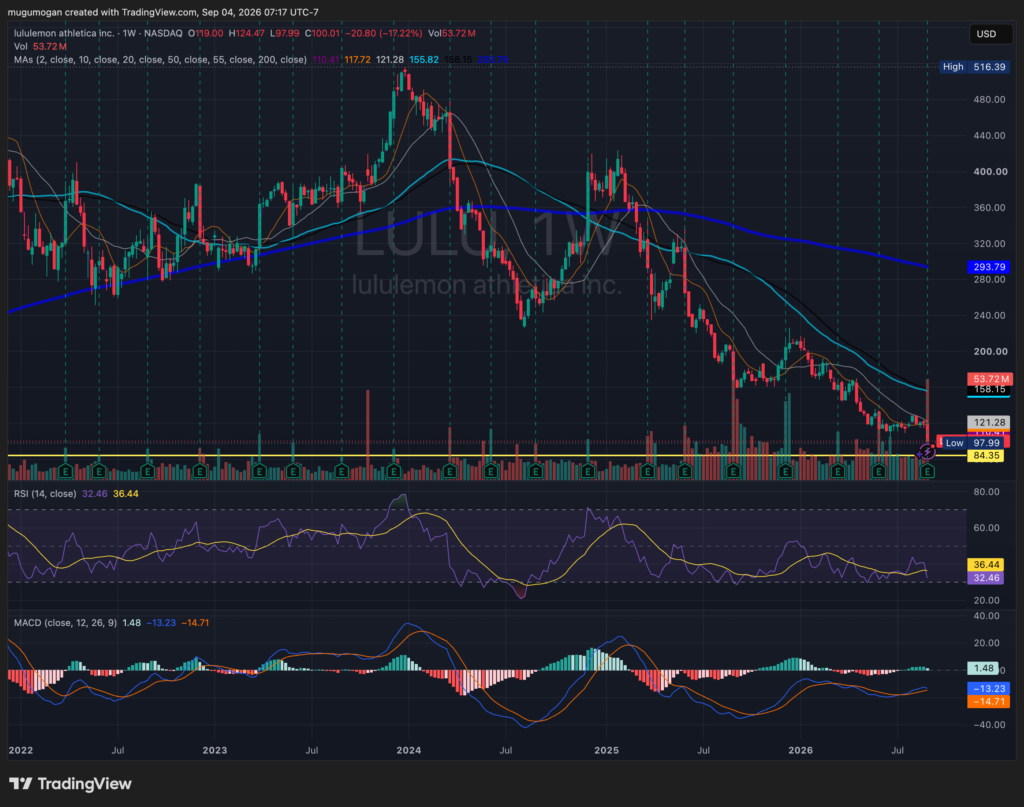
LULU is decisively bearish, with the stock at $100.01 sitting below every major moving average and the 50/55-week averages rolling over, confirming a persistent structural downtrend.
RSI at 32.46 is near oversold but not yet at an extreme, while MACD remains deeply negative despite a small bullish histogram—suggesting a possible short-term bounce, not a reversal.
$97.99 is the critical immediate support, with $84.35 the major downside level; reclaiming ~$121–125 would be the first meaningful sign of stabilization. Bias: bearish.