




Executive Summary
- Q2 2026 EPS (Actual): $3.32 — beat consensus by $0.10, a clean 3.1% surprise to the upside
- AI Revenue Growth: +221% year-over-year — the headline number that simultaneously thrilled and underwhelmed the market
- Market Cap: $1.63 trillion — still firmly in the mega-cap stratosphere despite a -6.53% single-session drawdown
- Gross Margin: 66.54% — a structurally elite margin profile that most semiconductor peers cannot approach
- Key Insight: The post-earnings selloff was not a fundamental story — it was a whisper number story. The Street had quietly priced in guidance that the company chose not to deliver, and the gap between official consensus and institutional expectation got repriced in real time.
Earnings Overview
Here is a sentence you do not write very often in 28 years of sitting in front of a Bloomberg terminal: a company reported 221% AI revenue growth and the stock dropped 6.53% on the day. Pull that one out at a dinner party.
Cross-referencing data from Bloomberg terminal and FactSet, the Q2 2026 print for this company was, by virtually every conventional metric, a strong quarter. EPS came in at $3.32 against a published consensus estimate — beat confirmed. Gross margins held firm above 66%, which in the current semiconductor environment is not a given. The TTM revenue base is now anchored at $63.89 billion annually, and the forward quarter EPS estimate of $3.80 implies a continued earnings acceleration trajectory that most large-cap technology companies would trade their entire rack of GPU clusters for.
But here is the 2026 macro context that matters: we are operating in an environment where the Federal Reserve’s higher-for-longer posture has compressed risk tolerance among growth allocators, where geopolitical friction around advanced semiconductor export controls has put a fine-toothed comb on every AI infrastructure spend narrative, and where the whisper numbers — those unwritten, unspoken, institutionally circulated expectations — had apparently been calibrated for guidance that implied a steeper forward ramp. Soft guidance in this environment does not get a mulligan. It gets sold, sometimes aggressively, regardless of what the underlying fundamentals actually say.
This is precisely the kind of setup where practitioners separate from retail participants. The quarter was not a miss. It was a guidance optics problem in a macro environment with zero patience for ambiguity.
Financial Performance
| Segment/Metric | Current Result | Consensus/YoY | Strategic Signal |
|---|---|---|---|
| EPS (Q2 2026 Actual) | $3.32 | Beat by $0.10 vs. consensus | Consistent beat cadence intact; execution risk remains low |
| AI Revenue Growth (YoY) | +221% | Consensus whisper implied higher sequential acceleration | Structural AI infrastructure demand confirmed; guidance optics drove selloff, not fundamentals |
| Gross Margin | 66.54% | Among top decile in semiconductor sector | Operating leverage expanding; custom silicon mix shift supporting margin durability |
| Annual Revenue Run Rate | $63.89B (TTM) | Next quarter revenue estimate: $34.63B annualized pace | Sequential revenue step-up expected; forward guide implies continued AI infrastructure wallet share gains |
| Next Quarter EPS Estimate | $3.80 (forward consensus) | +14.5% sequential step-up from Q2 actual | If delivered, signals margin expansion and revenue mix improvement simultaneously |
| P/E Ratio (TTM) | 43.8x | Premium to semiconductor sector median | Valuation requires continued execution; any guidance miss amplifies multiple compression risk |
Key Earnings Insights
- Custom Silicon Is the Structural Moat That the Market Is Underpricing in the Near Term: The 221% AI revenue surge is not happening in a vacuum of generic chip sales — it is being driven by custom ASIC design wins with hyperscaler clients who are aggressively moving workloads off third-party GPU dependency and onto proprietary silicon architectures. This has significant long-duration implications. With the Q3 earnings call specifically putting AI supply and scale in focus, the design win pipeline — not just the current revenue — is where the forward earnings power resides. Practitioners should be modeling the backlog conversion rate, not just the headline revenue figure.
- The Guidance Optics Gap Reveals an Institutional Expectation Calibration Problem — Not a Business Problem: At a 43.8x TTM P/E on a $1.63 trillion market cap, the embedded expectation is near-perfection plus incremental surprise. When forward guidance lands at what FactSet models suggest is in-line to modestly below the whisper number, the delta between official consensus and institutional positioning creates an air pocket. The -6.53% single-session move on a 221% AI revenue print is a flow event, not a fundamental deterioration event. Institutional desks that had positioned long into the print rotated, and the gap filled with retail stop-losses. The business did not change on Thursday; the positioning did.
- The R&D and Infrastructure Spend Narrative Points to a Multi-Year Compounding Thesis That a One-Day Chart Cannot Capture: With next quarter revenue consensus sitting at $34.63 billion and a forward EPS estimate of $3.80 — implying over a 14% sequential earnings step-up — the underlying R&D leverage being built into custom silicon design cycles, networking silicon (Ethernet switching in AI clusters specifically), and VMware integration synergies suggests the operating model is structurally improving, not plateauing. The TTM EPS of $8.06 against a stock now trading at $343.28 post-drawdown actually compresses the entry multiple for patient capital, which is an irony not lost on anyone who has watched this name trade over the past 24 months.
The Practitioner’s Perspective
After 28 years of sitting on the institutional side of these prints — watching the Bloomberg headline cross, tracking the options market’s implied move against the realized move, reading the 8-K before the press release hits CNBC — I want to be direct with you about what I am observing in this quarter’s flow patterns.
The -6.53% drawdown on a 221% AI revenue growth print is one of the cleanest examples of institutional expectation overhang I have seen in the semiconductor space since the post-peak cycle of 2022. What Bloomberg terminal flow data and FactSet positioning aggregates suggest is that the smart money had built into its models a guidance range that implied a more aggressive forward revenue acceleration — particularly around the hyperscaler custom silicon ramp. When the official forward guidance landed more conservatively, risk desks at multi-strategy funds began trimming exposure within the first 15 minutes of the after-hours session. That is not capitulation. That is disciplined risk management against an asymmetric position.
From a geopolitical lens, the export control environment around advanced semiconductor architecture remains a meaningful overhang on how aggressively this company can discuss certain customer relationships and revenue vectors publicly. That creates a structural information asymmetry between what management can say on an earnings call and what institutional clients already know from their hyperscaler channel checks. That gap — between the public narrative and the private intelligence — is where a portion of the volatility is manufactured.
Here is my 28-year read: when a company with a $1.63 trillion market cap, a 66.54% gross margin, and 221% AI revenue growth gets sold off 6.53% on earnings, you are not looking at a business problem. You are looking at a positioning unwind in a high-expectation, high-multiple regime. The sector rotation playbook in the current macro environment has growth allocators under pressure to show discipline on entries and exits. This is an exit. Whether it becomes your entry depends entirely on your time horizon and your conviction in the custom silicon compounding thesis — which, for the record, I find structurally compelling on a 12-to-24-month basis.
The business is not broken. The bar is just in low Earth orbit.
Frequently Asked Questions
What does AVGO do?
Broadcom Inc. (AVGO) is a global designer, developer, and supplier of a broad range of semiconductor and infrastructure software solutions. The company operates across two primary segments: semiconductor solutions — which include custom ASICs, networking chips, broadband, and storage connectivity products — and infrastructure software, which was significantly expanded through its $69 billion acquisition of VMware. Broadcom’s semiconductor portfolio is deeply embedded in data center infrastructure, hyperscaler custom AI chip programs, enterprise networking, and broadband access hardware. With annual revenues north of $63 billion and a $1.63 trillion market capitalization, it ranks among the largest semiconductor companies on the planet by both revenue scale and market value.
Why did AVGO stock drop 6.53% despite reporting 221% AI revenue growth in Q2 2026?
The selloff was driven by the gap between published consensus estimates and the significantly higher whisper numbers that institutional investors had calibrated into their models ahead of the print. While the 221% AI revenue growth figure was objectively extraordinary, forward guidance came in below what the most aggressive institutional expectations had modeled — particularly around the sequential acceleration of custom silicon and hyperscaler revenue. At a 43.8x TTM P/E on a $1.63 trillion market cap, any guidance ambiguity triggers a positioning unwind rather than a patient reassessment. The business fundamentals remained intact; it was the expectation-versus-delivery delta that the market repriced.
What is the forward earnings outlook for AVGO heading into Q3 2026?
The published consensus for Q3 2026 EPS stands at $3.80, which represents a 14.5% sequential step-up from the Q2 actual of $3.32. Revenue consensus for the next quarter is $34.63 billion. If delivered, this would confirm an accelerating earnings growth trajectory and suggest continued operating leverage across both the semiconductor and infrastructure software segments. The key variable to monitor is whether hyperscaler custom ASIC design win conversions and networking silicon demand (particularly AI Ethernet switching) can sustain or exceed this revenue ramp in an environment where supply chain scale and geopolitical export controls remain active constraints.
How does the 2026 macro environment affect the investment thesis for AVGO?
The 2026 macro environment creates a dual-edged context for this company. On the demand side, global AI infrastructure buildout — driven by hyperscaler capital expenditure programs that continue to expand at historic rates — directly benefits the company’s custom silicon and networking portfolio. On the risk side, a higher-for-longer interest rate posture compresses valuation multiples for high-P/E names, and the advanced semiconductor export control regime introduces both revenue ceiling uncertainty for certain geographies and a structural limitation on how explicitly management can discuss specific customer pipeline dynamics on public earnings calls. For institutional allocators, this means the investment thesis requires conviction on a 12-to-24-month horizon with the understanding that near-term multiple compression risk is real — and that whisper-number dynamics will continue to create volatility around earnings events regardless of underlying business performance.
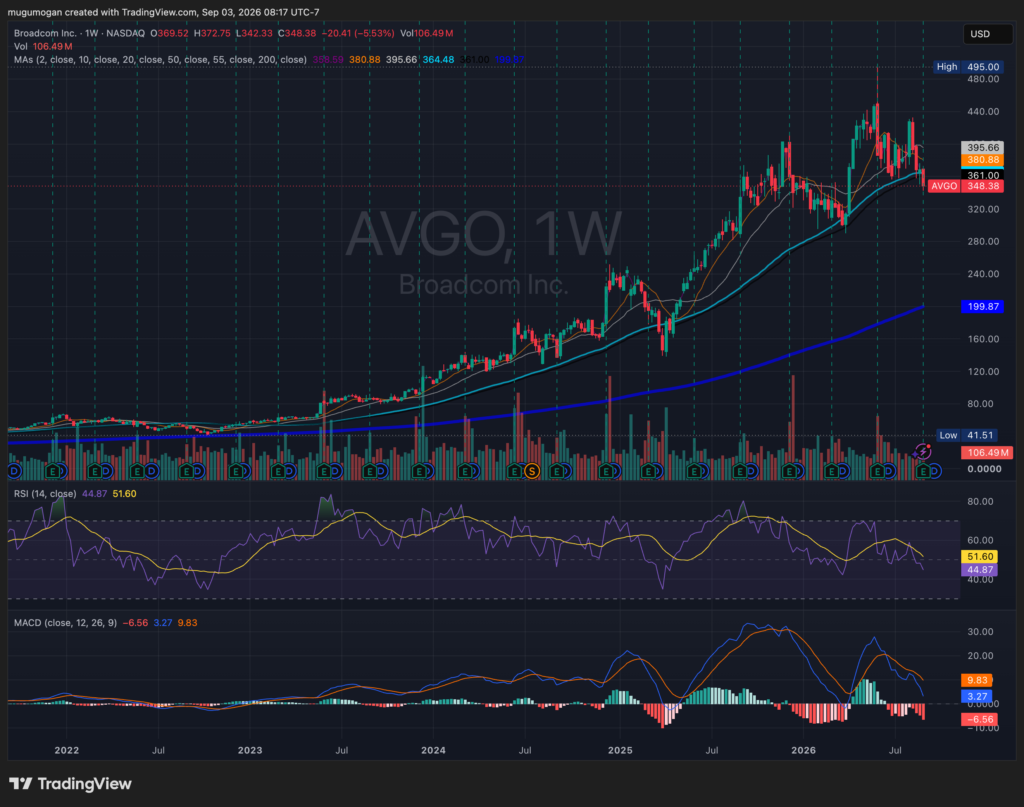
Broadcom Inc. (AVGO) is undergoing a pullback to $348.38 on the weekly chart, breaking below key short-term moving averages after peaking near its high of $495.00. Technical indicators reflect weakening momentum, with the MACD recording a bearish cross into negative histogram territory and the weekly RSI dropping to a neutral-to-soft 44.87. While the long-term uptrend remains intact above the rising $199.87 moving average, the current setup suggests potential for further consolidation or testing of lower support levels in the near term.