Levi Strauss & Co. is one of the most iconic apparel companies globally, best known for inventing blue jeans and building a brand synonymous with denim culture. Founded in 1853, the company has evolved from a workwear manufacturer into a global lifestyle brand with a strong direct-to-consumer (DTC) focus. In fiscal 2024, Levi’s generated approximately $6.2 billion in revenue, with modest growth driven by DTC expansion and international markets. Headquartered in San Francisco, the company competes primarily with brands like Wrangler (Kontoor Brands), American Eagle, and PVH (Calvin Klein/Tommy Hilfiger). Despite its heritage strength, Levi’s is actively repositioning itself as a modern, omnichannel retail brand.
Recent Earnings — Stabilizing Growth Amid Macro Pressure
Levi Strauss reported its most recent earnings in early April 2026 for Q1 FY2026, delivering revenue of approximately $1.6 billion, representing low-single-digit year-over-year growth. EPS came in around $0.28–$0.30, slightly ahead of analyst expectations due to margin improvements and cost controls. However, wholesale weakness, particularly in North America, weighed on overall performance, while DTC continued to grow mid-single digits. The company guided for full-year revenue growth in the low-single-digit range and modest margin expansion, reflecting cautious optimism amid a still uncertain consumer environment. Analysts noted that inventory normalization and improved pricing discipline were key positives.
Founding Story — From Gold Rush to Global Icon
Levi Strauss & Co. was founded by Levi Strauss, a German immigrant, during the California Gold Rush in 1853. Initially selling dry goods, the company partnered with tailor Jacob Davis in 1873 to patent riveted denim pants, effectively creating blue jeans. This innovation became the foundation of one of the most enduring apparel brands in history. Over decades, Levi’s became embedded in American culture, from workwear to youth rebellion in the 1950s and 1960s.
Evolution — From Wholesale to Direct-to-Consumer
For much of its history, Levi’s relied heavily on wholesale distribution through department stores and retailers. However, over the past decade, the company has aggressively shifted toward a DTC model, including owned stores and e-commerce. Today, DTC represents over 40% of total revenue, a critical strategic pivot to improve margins and customer control. This transition has not been seamless, as wholesale declines have offset some gains.
Product Portfolio — Beyond Just Jeans
While denim remains the core of Levi’s identity, the company has expanded into tops, outerwear, and athleisure categories. The Levi’s brand itself drives the majority of revenue, but Dockers, once a major contributor, has declined significantly and is now being repositioned. The company has also launched premium lines and collaborations to appeal to younger consumers and maintain cultural relevance. Still, over 70% of revenue is tied to denim-related products, making diversification an ongoing challenge.
Competitive Landscape — Fighting for Relevance in a Fragmented Market
Levi’s competes in a highly fragmented apparel market that includes heritage brands, fast fashion players, and emerging DTC-native companies. Key competitors include Kontoor Brands (Wrangler, Lee), American Eagle Outfitters, and PVH Corp. Unlike fast fashion brands like Zara or H&M, Levi’s operates on a slower product cycle, which can limit responsiveness to trends. However, its brand equity and pricing power provide a meaningful competitive moat.
Market Opportunity — Denim is Mature, Lifestyle is the Bet
The global denim market is expected to grow at a CAGR of approximately 4–5% through 2030, reaching an estimated $90–100 billion. Growth is driven by emerging markets, particularly in Asia and Latin America, where Levi’s is expanding aggressively. However, denim itself is a mature category in developed markets, meaning Levi’s growth depends on gaining share and expanding into adjacent categories. The broader apparel market is expected to grow at a similar pace, but with increasing volatility driven by consumer trends and macro conditions.
Strategic Shift — DTC and International Expansion
Levi’s long-term growth strategy hinges on two pillars: increasing DTC penetration and expanding internationally. The company is targeting DTC to reach over 50% of total revenue, which would significantly improve gross margins. International markets already account for more than half of revenue, with strong growth in Asia-Pacific and Europe. This geographic diversification reduces reliance on the U.S. market, which has been relatively weak.
Competitors — Strengths and Weaknesses
Compared to competitors, Levi’s has superior brand recognition and pricing power, allowing it to maintain premium positioning. However, companies like American Eagle have stronger traction with younger consumers, while PVH benefits from diversified brand portfolios. Kontoor Brands operates with higher margins due to a more focused operational model. Levi’s sits somewhere in the middle: strong brand, but operational complexity and slower growth.
Differentiation — Brand Equity is the Moat
Levi’s primary differentiation is its unmatched brand heritage and cultural relevance. Few apparel brands can claim over 150 years of continuous recognition and global appeal. This allows Levi’s to command premium pricing and maintain customer loyalty across generations. Additionally, its scale and global distribution network provide advantages that smaller DTC brands cannot easily replicate.
Management Team — Experienced but Under Pressure
The company is led by CEO Chip Bergh, who has been instrumental in driving the DTC transformation and brand revitalization. Under his leadership, Levi’s returned to public markets in 2019 and improved profitability. The CFO and senior leadership team bring strong retail and operational experience, but execution risk remains high as the company navigates structural changes in distribution and consumer behavior.
Financial Performance — Steady but Not Explosive Growth
Over the past five years, Levi’s revenue has grown from approximately $5.6 billion to around $6.2 billion, representing a CAGR of roughly 2–3%. This reflects the challenges of operating in a mature category. Earnings growth has been slightly better due to margin improvements and cost discipline, with EPS CAGR in the mid-single digits. However, growth remains modest compared to high-growth apparel or DTC brands.
Margins and Balance Sheet — Improving but Not Best-in-Class
Gross margins have improved as DTC mix increased, but operating margins remain in the low-to-mid teens, below some peers. The company maintains a relatively healthy balance sheet with manageable debt levels, though not as strong as asset-light competitors. Inventory management has been a key focus, especially post-pandemic, where excess inventory impacted profitability.
Bull Case — Why the Stock Could Work
The bull case for Levi’s centers on successful DTC expansion driving higher margins and better customer engagement. International growth, particularly in Asia, offers a long runway for revenue expansion. Additionally, brand strength provides resilience in pricing and demand even during economic downturns.
Bear Case — Why Investors Should Be Cautious
The bear case is straightforward: Levi’s operates in a slow-growth, highly competitive market with limited category expansion. Wholesale declines could continue to offset DTC gains, creating a “treadmill” effect on growth. Furthermore, changing consumer preferences away from denim or toward faster-moving fashion trends could erode market share.
Analyst Reactions — Mixed but Slightly Positive
Following the latest earnings, analysts maintained a cautiously optimistic stance. Several firms reiterated “Hold” ratings while modestly raising price targets due to margin improvements and better-than-expected EPS. A few bullish analysts highlighted DTC momentum and international growth as key upside drivers. However, concerns remain around top-line growth and wholesale channel weakness, leading to a lack of strong conviction upgrades.
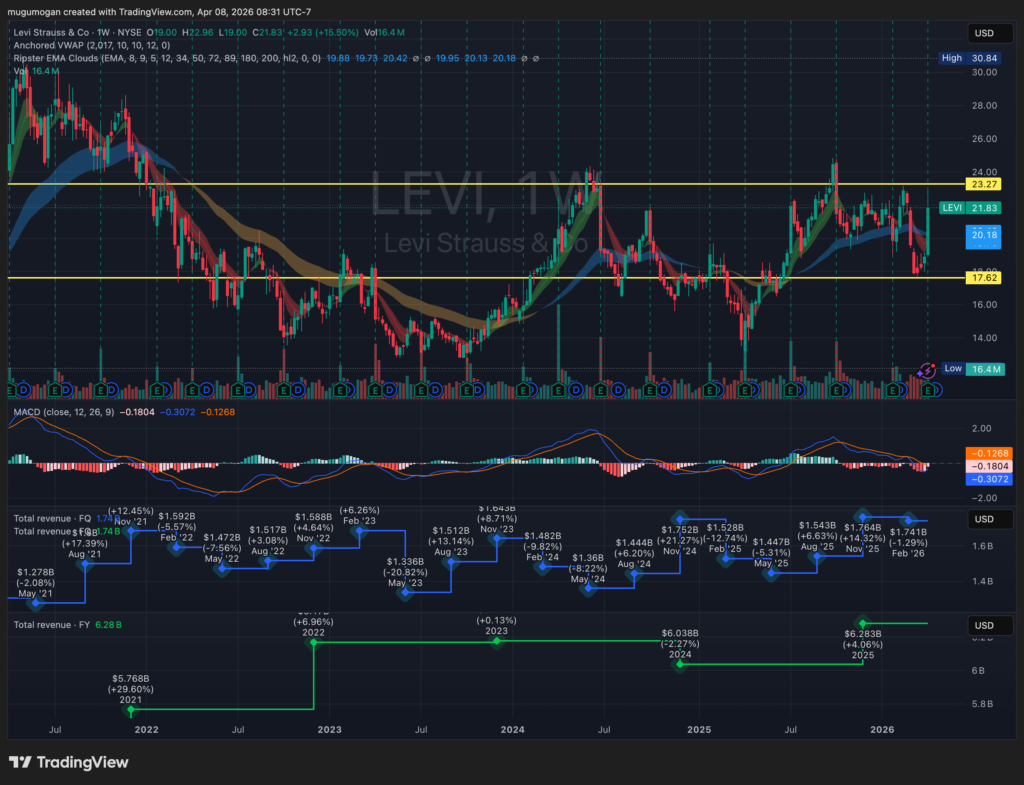
Levi (LEVI) is currently trading around $21.85, sitting between key support at ~$17.60 and resistance near ~$23.25, effectively stuck in a range-bound consolidation. The recent bounce off the lower support zone shows buyers are stepping in, but price is still below the upper resistance, so no confirmed breakout yet. The moving averages are flattening and slightly compressing, indicating indecision rather than strong trend continuation. MACD is slightly negative, suggesting momentum is still weak despite the bounce. Net: this is a base-building phase, and a clean break above ~$23.25 likely triggers upside, while losing ~$17.60 would flip the structure bearish.