DLocal is a Uruguay-based fintech company that enables global merchants to accept payments and make payouts in emerging markets through a single API. Founded in 2016, the company focuses on simplifying cross-border commerce in regions like Latin America, Africa, and Asia where payment fragmentation is high. Its platform handles local payment methods, compliance, and FX, making it easier for companies like Amazon, Spotify, and Microsoft to operate in these markets. DLocal’s revenue model is primarily transaction-based, earning fees on payment volume processed. The company has positioned itself as a critical infrastructure layer for global expansion into hard-to-navigate economies.

Recent Earnings Snapshot (Latest Available)
DLocal’s most recent earnings showed continued growth but with some deceleration relative to prior hypergrowth years. Revenue grew in the ~30–40% range year-over-year, driven by higher total payment volume (TPV), though take rates have been under pressure. EPS came in roughly in line with expectations, with margins slightly compressing due to investments in expansion and compliance. The company maintained solid guidance, signaling continued TPV growth but acknowledging macro volatility in emerging markets. Analysts noted improving diversification beyond Latin America as a positive trend.
Business Model & Product Overview
DLocal operates a “one-to-many” payments platform that allows merchants to integrate once and access dozens of emerging markets. It supports local payment methods such as bank transfers, cash vouchers, mobile wallets, and credit cards, which are essential in regions with low card penetration. The platform also offers payouts, enabling companies to send funds to suppliers, gig workers, or customers in local currencies.
A key differentiator is DLocal’s deep local infrastructure and regulatory compliance layer. Instead of relying heavily on third-party aggregators, the company builds direct connections with local banks and payment systems. This improves authorization rates and reduces costs, which is critical in markets with inconsistent financial infrastructure.
DLocal’s customers are typically large global enterprises expanding into emerging markets. This includes e-commerce platforms, streaming services, ride-sharing companies, and SaaS providers. The company’s land-and-expand model allows it to grow alongside its customers as they increase transaction volume in new geographies.
Market Opportunity (Cross-Border & Emerging Market Payments)
The global cross-border payments market is massive, estimated to exceed $150 trillion annually when including B2B flows, with emerging markets representing one of the fastest-growing segments. Digital payments in regions like Latin America, Africa, and Southeast Asia are expected to grow at double-digit CAGRs through 2030, driven by smartphone penetration and financial inclusion trends.
Emerging markets present unique challenges—fragmented payment systems, regulatory complexity, and currency volatility—which create barriers to entry. This is exactly where DLocal operates, effectively turning complexity into a moat. As more global companies expand into these regions, demand for localized payment infrastructure is expected to rise significantly.
Competitive Landscape
DLocal competes with a mix of global and regional players, including Adyen, Stripe, PayPal, and regional specialists like EBANX and PayU. While global players offer broader platforms, they often lack deep local integrations in frontier markets.
Regional competitors may have strong local expertise but lack DLocal’s global merchant relationships and unified API approach. This creates a fragmented competitive environment where DLocal’s positioning as a “bridge” between global merchants and local economies becomes valuable.
Differentiation
DLocal’s strongest differentiation lies in its focus on emerging markets combined with a single integration model. Unlike Stripe or PayPal, which are stronger in developed markets, DLocal specializes in high-friction regions where localization is essential. Its direct connections to local payment rails improve success rates and reduce dependency on intermediaries.
Another advantage is its regulatory and compliance infrastructure. Operating in emerging markets requires navigating complex and changing regulations, and DLocal has built expertise that is difficult to replicate quickly. This creates switching costs and reinforces its role as a trusted partner.
Management Team
The company was founded by Sebastián Kanovich, who serves as CEO and has a background in payments and fintech in Latin America. The leadership team includes experienced executives in finance, operations, and technology, many of whom have worked in emerging market environments. Their expertise in navigating regulatory and operational challenges is a key asset for the company.
Financial Performance (Last ~5 Years)
DLocal has demonstrated strong revenue growth since its IPO, driven by increasing TPV and expansion into new geographies. Revenue has grown at a high CAGR, often exceeding 40–50% during peak years, though growth has moderated more recently as the company scales.
Profitability has been a standout feature relative to many fintech peers. DLocal has maintained positive EBITDA margins, supported by a capital-light model and strong take rates in emerging markets. However, margins have recently faced pressure due to reinvestment and competitive dynamics.
The balance sheet remains healthy, with strong cash generation and relatively low debt levels. This provides flexibility for continued expansion and potential acquisitions. The company’s financial discipline has been a key differentiator in a sector where many players burn cash.
Bull Case
DLocal is well-positioned to benefit from the secular growth of digital payments in emerging markets, which are underpenetrated and growing rapidly. Its infrastructure-first model and deep local integrations create defensible moats in complex regions. As global enterprises expand into these markets, DLocal could see sustained TPV growth and operating leverage over time.
Bear Case
The company faces risks from macroeconomic volatility in emerging markets, including currency fluctuations and regulatory changes. Competitive pressure from global players expanding their capabilities could compress take rates. Additionally, growth deceleration may challenge its premium valuation if margins do not expand as expected.
Analyst Reactions
Analyst sentiment has been mixed following recent earnings. Some firms have maintained bullish outlooks based on long-term growth in emerging markets, while others have expressed caution around margin pressure and slowing growth rates. Price targets have seen modest adjustments, reflecting a balance between strong fundamentals and near-term uncertainties.
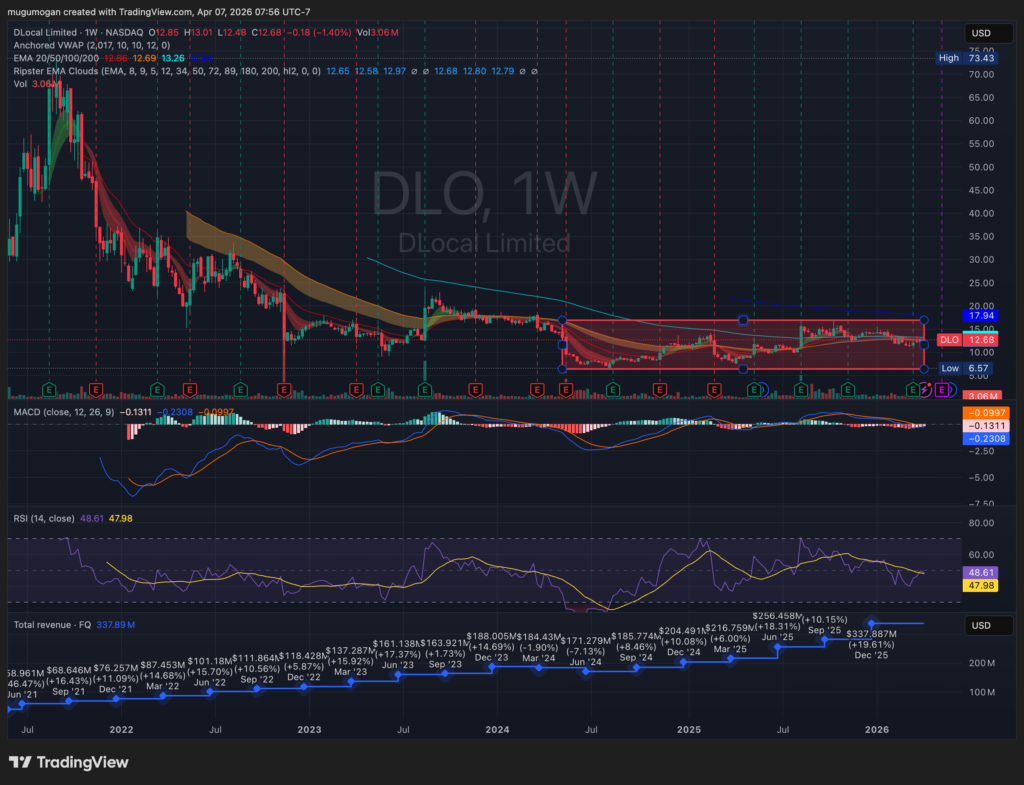
DLocal ($DLO) is stuck in a long-term downtrend but has been building a base between roughly $10–$14 for over a year, which is constructive if it can hold. Price is currently hovering near the anchored VWAP and key moving averages, signaling equilibrium rather than strength. MACD is flat and slightly negative, showing lack of momentum, while RSI around ~48 confirms a neutral, directionless setup. The key level to watch is ~$14–$15 for a breakout—clear that and you likely get a trend change; lose ~$10 and the base fails. Right now, this is classic “wait for confirmation,” not a high-conviction setup.